About This Site
Over 50 years of research into the Stratton, Schneider, King, and allied families—from colonial Massachusetts to Indiana and beyond. Built by Bill & Karen Stratton.

 Strattons of Massachusetts Bay
Running Through the Sands of Time
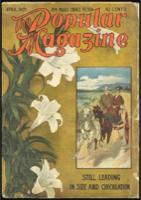
Frank Nelson Stratton (1860–1905) was my grandfather—a self-taught attorney, state prosecutor, and short-story writer who published under his own name and the pen name Frank Neilson. He never finished grade school. He worked sawmills and farms as a boy, studied law by lamplight, and was admitted to the Indiana bar in 1894 at the age of thirty-two. Within four years, Kokomo’s newspapers were calling him one of the best-read men in the county. Within ten, his fiction was appearing in the leading Eastern magazines alongside writers whose names are still remembered.
The newspapers of his day told his story better than I can:
“In 1892 he began the study of law, and was admitted to the bar in August 1894. Frank is one of the promising young lawyers and at this writing a candidate for the office of prosecuting attorney on the Republican ticket.”
“Mr. Stratton has the right sort of stuff in him for this office. He has fought his way from the sawmill, the clearing and the farm to the front rank at our bar. He has so educated himself by the ‘midnight oil’ that there is perhaps no one in the county better versed in the wide field of literature, and especially in the domain of history, sacred and profane. In questions of law his opinion is respected by the oldest members of our bar.”
—The Kokomo Morning News, 1898
“Frank N. Stratton is a prolific writer, and his story, The Governor’s Visitor, was awarded the fourth prize in a short-story contest. The judges were three well-known authors; several hundred manuscripts were submitted.”
—The Kokomo Dispatch, 1903
“Attorney Frank N. Stratton of Kokomo is writing some of the best short stories in the leading Eastern magazines. There is a remarkable difference between Frank N. Stratton and most popular writers of short stories. The Stratton contributions are popular in Kokomo, where he has been known so long. In the years that he has traveled, Frank Stratton is one of those careful, sympathetic observers who sees the best and the truest side, as well as the more humorous. He gets all that there is in a situation, and he knows how to write about it in a way that attracts the people. He is as good a story teller as he is a story writer and the listener frequently misses other things while he listens to what Stratton says.”
—The Kokomo Morning News
Nearly a century after his death, scholar Robert Ohmann cited two of Frank’s stories—The Call of the Quail and The Sheriff’s Dream—as fiction that “fed and flattered the cultural change and upheaval arising out of the magazine revolution at the turn of the century” (Selling Culture: Magazines, Markets, and Class at the Turn of the Century, 1996).
Frank died on February 15, 1905, at forty-four. More than 800 men from his fraternal lodges walked in his funeral procession—a measure of the man that no newspaper clipping can quite capture. The stories that follow are his own words, recovered from the magazines that published them more than a hundred years ago.
 — Wm. F. Stratton, April 2026
"Stories are the creative conversion of life itself into a more powerful, clearer, more meaningful experience." —Robert McKee

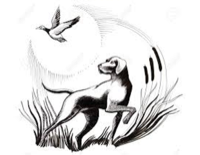
Alfred Rider was in the market for a good bird dog, and all Kokomo knew it. In fact, Alf was anxious that it be generally known that anyone seeking a purchaser for either a pointer or a setter with a good and sufficient pedigree need go no further than the City National Bank, wherein Alf ruled as president and chief stockholder.
Alf had discovered soon after coming to the town that its wealthiest businessmen were active members of the Kokomo Gun Club, a jovial and fraternal band that descended en masse each fall upon the broad plains of Illinois in search of the savory prairie chicken and the elusive quail. As the members of this club, having a proper preference for unperforated skins and un-crippled dogs, made it a sine qua non that applicants should have some practical knowledge of the eccentricities of a gun, Alf had been persistently posing as one of the mightiest nimrods that ever flushed a bird, for Alf had an eye for business—and deposits.
Now, in truth and in fact, the only game Alf had ever hunted was the great American game in which aces and flushes are the chief trophies, and the only birds he had ever flushed were those so intimately connected to the great American dollar.
Therefore, when he was finally admitted to membership, he realised forcefully that he must immediately and secretly go into training in order to make his bluff good when he should attend the fall hunt.
So it was quite natural that when he received the telephone message from Matthews, the local express agent, he should take with him Jib Gay, the club’s president, to see the dog, for what Jib didn’t know about dogs was not worth itemizing.
Alf knew this, but he didn’t know that Jib had him sized up right from the start, and that both Jib and Matthews loved a practical joke as well as a day’s sport in the field.
It is only fair to state that Alf entertained some doubt when he saw the dog. He was a doubtful looking dog. He sat in the crate in the express office with drooping head and an expression of ennui and utter disgust. His ears had evidently usurped the material that should have been used in his tail, his legs were attached at different angles, he was hairy in some places and hairless in others and he lacked that air of chic and aplomb that distinguishes the bird-dog of ancient and honorable lineage.
“Philippine pointer, by smoke,” Jib ejaculated.
"Sh-h-h said Matthews, warningly; “don’t talk so loud. Let Alf surprise the boys this fall. Shipped here by mistake. Meant for Kankakee. Fellow there won’t accept him now because of delay. Shipper says if I can get eighty dollars and charges to let him go rather than return. Had him sold for a hundred. See, here’s the bill.”
Jib encouraged the brute to stand up by poking him in the protruding ribs, looked into his mouth, examined his feet and then stood back and surveyed him critically.
“Alf, you’re in luck. If the Government never gets anything else out of those islands, the discovery of that breed of dog will square the bill. Watched a couple of ’em at work out East last fall and never saw anything like it. Just look at that eye — and those legs. Of course, he’s poor and fagged out now from the trip, but in a week you won’t know him. You know the shipper’s name, Alf. No kennels like his in the country.”
“Yes; he’s undoubtedly a fine specimen,” said Alf, judicially, “but it strikes me that eighty dollars is a pretty stiff figure for an untrained pup.”
“What, for a genuine Philippine pointer? Say, Alf, if you don’t want him, he’s mine. I’ll train him on the q.t. this summer and then have the laugh on you this fall.”
“I’d have jumped at him myself,” said Matthews, with a sigh, “but I’m devilish short right now.”
“I’ll take him,” said Rider, eagerly, “and you fellows keep quiet till this fall.”
He gave Matthews his check for eighty dollars, plus eight dollars and fifty cents charges, with instructions to deliver the prize at his house after dark that night.
How or just when he made the discovery that he had bought an itinerant mongrel, sired by an unknown and damned by everybody that kept flower beds or made garden was never learned. Alf was game and suffered smilingly and silently. He even attended the club’s banquet, given, so the cards of invitation announced, at an expense of eighty-eight dollars and fifty cents, donated by “our distinguished member and dog connoisseur, Mr. Alfred Rider.”
But he didn’t go with the club that fall. He was not well, he said, and had most urgent business at home.
Of course, Jib went and took his wife, as usual, leaving his home, 220 North Main street, unoccupied.
On Tuesday evening the following advertisement appeared in the local papers:
WANTED—Dogs, for dog and pony show. Any size or color. Good prices. Deliver, Thursday afternoon, at 220 North Main street, side entrance.
Wednesday morning Jib received a telegram:
Meet me at bank Friday morning without fail. Important.––Alfred Rider.
Jib was one of the heaviest depositors, and with dire foreboding of financial disaster he lost no time in embarking upon the next train, due in Kokomo at 11.45 P.M., Thursday.
Early Thursday afternoon an almost endless procession began the invasion of Jib’s premises, men and boys with “goods in hand.” At the side entrance they read this placard in large letters:
Out of town, back tonight. Tie dogs in yard. Will pay at my office to-morrow morning. “—J. Gay.
At midnight Jib hurriedly rushed through his front gate and fell over a large dog. He then arose and trod on small dog, who protested noisily, inaugurating a chorus that could have been heard from Dan to Beersheba. Then Jib discovered that his front lawn was full of dogs; likewise the back yard. Every tree and shrub, every post and pillar of fence and verandah, every object to which a rope could be fastened was adorned by a dog. There were big dogs and little dogs, smooth dogs and woolly dogs, white, black, yellow and spotted dogs, and those that didn’t howl barked. Jib couldn’t count them, but he estimated the number at one hundred and fifty and let it go at that. Some were good-tempered and some were not. Two large and ferocious brutes anchored to the side porch Jib was obliged to shoot in order to enter the house.
Jib was mad. When several of his neighbors asked him, from their bedroom windows, if he purposed to keep that row up all night he made remarks that caused them to shut their windows and mouths simultaneously. When he had severed about one hundred and fifty ropes, chased the menagerie off the premises, hoisted the two carcasses over the back fence and viewed the damage to shrubbery, flower beds and young trees, he said bad things about Alf Rider.
To the clamorous crowd that surrounded his office next morning he emphatically and violently denied all liability, and when the canine owners started angrily for 220 North Main street to retake their property he fled.
Next day he was made defendant in two law suits instituted by the owners of the murdered dogs, whose testimony on the witness stand upon the question of value indicated, as was remarked by Alf Rider, that the dear deceased were certainly genuine Philippine pointers.
When he had finished fighting the suits, paying lawyers and repairing damaged premises, he dropped in at the bank and shook hands with Rider.
“It’s on me, Alf,” he said. “You got off easy. Let’s quit.”
"There is no greater agony than bearing an untold story inside you." —Maya Angelou
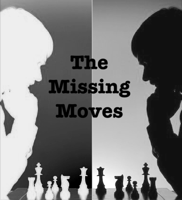
I shall always believe that if Robert Maxwell had lost his inherited fortune the world would have gained another Edison. His fine residence was full of strange and bewildering electrical devices. His well-equipped laboratory, into which only Dr. Bell and I were allowed to penetrate, was the repository of many secrets that might have enriched the scientific world. But Maxwell chose to keep his secrets for his own amusement.
I formed the acquaintance of this strange, taciturn genius through the mediumship of Dr. Bell, whose only sister, at this time deceased, had been Maxwell’s wife. As an insanity-expert the doctor had been employed by my clients in an important case involving the distribution of a large estate. A strong intimacy resulted from this association which led to my being received by Maxwell as a friend and companion, a privilege accorded to only the doctor and myself. Electricity, chemistry, and chess, these were Maxwell’s three hobbies, and the greatest of these was chess. I have seen him absorbed for hours in the solution or composition of some intricate problem in that game of games. He was a faithful and highly valued correspondent of several chess-publications, and a member of several chess-clubs. I was no novice at the game, but soon found myself no match in the checkered field for the silent, studious Maxwell.
My professional duties had called me, one rainy evening, into the vicinity of Maxwell’s residence. Returning at a late hour, I passed his house. Observing a light in his study, and knowing that he usually kept late hours, I ascended the steps, rang the bell, and was shortly admitted by a sleepy servant. As I stepped Into the dimly lighted hall I heard a struggle, a choking cry, the fall of a heavy body, and a sound of crashing glass. I rushed into the study whence the sounds came, and beheld there a sight I shall never forget. Prone on his face, near the center of the room, bleeding profusely from a wound in the head, lay the master of the house. The shattered window near him showed how the assailant, in his haste, had escaped. Hastily I lifted the almost lifeless victim, administered such aid as I could and hurried one of the aroused frightened servants after Dr. Bell, who lived near, and who quickly arrived. Under his skillful treatment the flow of blood was soon lessened and the peculiar nature of the wound became apparent. The instrument used was evidently a short, heavy sort of Cuban machete which, along with other weapons of war and chase, had adorned the walls of the study, but which now lay blood-stained on the floor. The weapon, wielded by a powerful arm, had actually severed from the skull a large section of the frontal bone without inflicting any apparent injury to the brain, which lay bare and throbbing under our gaze. The severed section lay attached to the face by the skin at the lower part of the forehead and could be thrown to and fro, the skin acting as a hinge. The unusually projecting forehead of the victim made such a wound possible. I heard the doctor murmur, “wonderful, wonderful,” and in answer to my anxious inquiry, he replied: “It is almost a miracle that the brain is not wounded. He has a powerful constitution and may live. There have been several instances of recovery where the brain itself had been badly wounded. I shall call Dr. Herrington. I prefer not assume all the responsibility in such a case.”
To me it was deeply interesting to watch the rapid, deft work of those two veteran surgeons. All parts of the wound were carefully cleansed, and the detached portion of the skull was replaced and skillfully secured, the wounded man tenderly carried to his bed and left to the care of Doctor Harrington, while Dr. Bell and myself endeavored to find some clew to the identity of the intruder. Under the shattered window, and leading from the house to the street, were the tracks of broad, heavy shoes indistinctly imprinted on the rain-soaked lawn. After reaching the street these tracks were lost in the multitude of others. No clew whatever could we find. As to motive, there could be but one — that of robbery. Maxwell always kept a large sum of money in a safe in his laboratory. Distrust of banks was one of his eccentricities. So far as we knew, he had no enemies. The case was turned over to the police. The best detectives were employed. Time sped on, and the mystery remained unsolved. The patient fought a good fight and was well on the road to recovery when I was called to western states on professional business.
When I returned, Dr. Bell, by appointment, met me at the Grand Central depot. “He is convalescent,” the doctor reported, “and practically out of danger physically; but I fear for his mind. He can only remember that he had retired for the night but could not sleep. Some brilliant passage at chess kept running through his mind. He arose, partly dressed himself, wrote the game on a sheet with his new ink and was preparing to impress it on his hectograph. From that moment until he recovered consciousness, after the operation, his mind is a blank. I do not allow him to talk of the affair. I fear he will never fully regain his former strength of mind and body. The shock was too great. No, there is yet no clew; but I shall never give up the search. You will, I know, pardon me if I ask you not to see Robert until I give permission. He often asks for you, but if you met he would insist on playing, and at present any mental strain might prove injurious.”
And so a month had passed when we three again sat in the familiar room. Maxwell was greatly pleased to meet me and seemed in high spirits, but often during that evening a wild, frightened expression flitted across his features, his head would droop, his conversation cease, and his hand would be drawn nervously across the high, white forehead, now so cruelly disfigured. At such times I saw the doctor watching him as anxiously as a mother watches her sick child.
At length I arose to depart, but Maxwell demurred. “I have my heart set on at least one game tonight,” he pleaded.
I glanced inquiringly at the doctor, who smiled and nodded acquiescence. The board with its beautiful ivory-pieces was placed by the doctor. Maxwell took the white and played pawn to king’s fourth. I made the same play. He then played pawn to queen’s fourth and I captured the pawn.
He hesitated a moment, played bishop to queen’s third, and I followed with queen’s knight to bishop’s third. He seemed slightly perplexed at this, studied the board intently for several minutes, passed his hand nervously across his forehead, and then slowly moved his king’s pawn to the square occupied by my king's pawn and removed the latter from the board. As I raised my eyes in astonishment, I saw the doctor regarding him with the intentness of an Apache on the trail, at the same time murmuring to me, “Go on.”
More than ever perplexed, but wishing to see the result, as did evidently the doctor, I captured the trespassing pawn with my knight. Maxwell immediately played bishop to knight’s sixth, where it could be captured by either pawn, and, although the pawn remained between his bishop and my king, he cried “Mate!” and, with a smile, threw himself back in his chair, remarking, “Very neat; very neat, indeed. You do not display your usual skill tonight, Neilson. Shall we try another?”
Completely bewildered, I looked at the doctor for my cue. He nodded slightly, without removing his eyes from his patient. I rearranged the pieces, while Maxwell sat with drooping head, apparently abstracted, until I made the first move. Then he straightened up and said: “You play very curiously, my friend. It seems to me that some of your moves were clearly inadmissible. How’s this? You have given me black. Will you turn the board, please?”
Again following the doctor’s instructions, I reversed the board, saying, “I am somewhat absent-minded tonight, I fear. I have a perplexing case in court. But look to your laurels this time.”
Eagerly Maxwell again opened the game with pawn to king’s fourth. I varied my former moves, somewhat, but his moves were exactly as before, and for his fifth move he again placed his bishop on knight’s sixth, over-leaping all obstacles, cried “Mate!” and smiled complacently. “Evidently, Neilson, you are no match for our friend tonight,” the doctor said, laughingly, “and to spare you further humiliation I now declare a truce.”
“One more, doctor,” cried Maxwell, “give him one more chance to retrieve his prestige.”
“No,” the doctor replied, ‘‘I must insist that you play no more tonight, Robert. Now, don’t be stubborn. You must defer to my judgment in matters concerning your health.”
“It is spoken,” said Maxwell, laughing and wheeling his chair away from the table, “but as Neilson stays with us tonight, I shall insist upon a game before he leaves in the morning.”
After a half-hour’s pleasant conversation I retired to the chamber that had been prepared for me. I could not sleep, but lay pondering over my host’s strange actions. His perfectly natural manner when not playing, his erratic and exactly similar moves in both games, the doctor’s watchfulness and anxious curiosity — all these things puzzled me and awakened fears that poor Maxwell’s mind was deranged.
I was yet awake, and I remember that the great clock in the study above me had just chimed the witching hour of midnight, when someone rapped at my door. Hastily arising I admitted Dr. Bell. He was considerably excited, the first time I had ever seen him so. His hand, grasping a thick, heavy sheet of paper, trembled quite perceptibly. “Neilson,” he said, speaking rapidly, but in a low tone, “do not think me a lunatic when you hear what I have come to say. I may be wrong; probably I am. But if my theory is correct, I have made a discovery that will puzzle the medical fraternity — aye, the scientific world. Will you pass me a glass of water, please? I am slightly feverish. Thanks. Now, to begin at the beginning. About one week before the assault, Robert told me of a peculiar ink he had invented, or, rather, compounded, for use in connection with the hectograph. But I will first explain the nature and use of the hectograph, as it is a recent invention with which few are as yet familiar. It is a copying or duplicating process consisting of a shallow pan filled with an elastic, jelly-like, semi-transparent substance, having the quality of receiving and transmitting any writing impressed on its surface when written with what is known as hectograph-ink. The writing to be duplicated is first written on a good quality of paper with hectograph-ink. That original sheet is then laid, face down, on the hectograph, firmly pressed down, and allowed to remain there for a few minutes. When removed, the hectograph has absorbed the ink, or much of it, and the writing appears, in reverse, of course, upon the surface of the jelly, Now, if blank sheets are pressed on this surface, each sheet when removed is an exact copy of the original. Several hundred copies can thus be made from one original under favorable conditions. Robert used this process for copying games and problems in chess to be sent to the various publications and to his numerous chess-correspondents. Instead of paper, however, he used a fine quality of linen for the last few copies because of its greater durability. These he keeps for further use and reference. He found that the ordinary ink blurs on this linen, and to avoid this he compounded the ink he spoke of. It answered the purpose fully, and is so cohesive and powerful that, if an impression made with it is allowed to remain on the jelly for thirty minutes it is deposited at the bottom of the pan in precisely the same formation as when first impressed on the surface. Now, examine this sheet of paper. It is an original sheet from which copies were to be made.”
I took the paper, and although it was somewhat blurred with what seemed to me blood-stains, I saw at once that it was the record of a game of chess, written in Maxwell’s large, familiar hand, and ran thus:
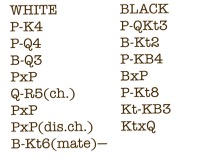
I at once saw that “white’s” first four and last moves were the identical plays made by Maxwell that evening.
The doctor continued, “You observe — the same moves, excepting the fifth, sixth and seventh.” I nodded. “You also observe,” he went on, “that the column of Black’s moves is clear and bright, the ink untouched; no impression has yet been taken from it. On the other hand, White’s column is stained with blood and the characters are dim and faint, indicating that an impression has been taken of them. But the fifth, sixth, and seventh moves are somewhat brighter and stronger than the other five, indicating two separate impressions of White’s column.” Again I nodded, silent but deeply interested. “Now,” the doctor continued, leaning forward and lowering his voice almost to a whisper, “comes the astonishing part of my theory. When we dressed poor Robert’s wound I observed a peculiar grouping of very faint, purplish marks upon the exposed portion of the brain. I gave them but little attention and proceeded with the operation. But his peculiar play last night set me to studying seriously on a theory already faintly suggested. Neilson, those marks came from this sheet and were White’s first, second, third, fourth, and eighth moves, just as Robert played them last night. You smile, but, my friend, the finger of Science has as yet but pointed to the border-land of anatomical and psychological knowledge. With all our boasted discoveries we are yet but groping in the dim light of the dawn. I believe that Robert fell in such a position that the exposed brain was pressed on White’s side of that sheet. Some other substance, at the time covered the fifth, sixth, and seventh moves or had previously absorbed them. Otherwise Robert would have played the entire eight moves last night. The idea startles you. You are asking yourself if this theory can possibly be correct. I say, yes. Moreover, I predict that Robert will never play other than those five moves so long as they remain impressed on his brain. If I am correct, the situation is truly astounding — dumbfounding. There is a method of testing my theory, but I would never resort to it simply as a test.”
He arose and paced excitedly to and fro for several minutes. Finally I spoke. “May I ask, doctor, the nature of your test?”
For some time he made no answer. Then, again seating himself and endeavoring to subdue his excitement, he said, “I will answer your question by asking another. Suppose we were to again expose that part of the brain and impress on it in the proper position and with the same ink, those missing moves. Suppose, then, that when fully recovered from this second operation, the patient should play all of White’s moves in their proper order. Would my theory be proved?”
“It would at least be supported by rather strong circumstantial evidence,” I said, hesitatingly, “but surely, doctor, you have no thought of resorting to so dangerous an experiment?”
“Not as an experiment. Certainly not. But as a last resort it may become necessary. Possibly you do not know what a fascination the game of chess possesses for certain natures. From a casual amusement it grows into a fixed habit; from a fixed habit it often becomes a vice. I have seen more than one man neglect his family, and his social duties to brood and puzzle day after day over the infinite combinations of the game, until his mental faculties failed and the victim sank into the obscurity of the asylum. For years I have seen this fatal passion growing on Robert, and absorbing more and more of his time and thought. In his present condition he dimly realizes that something is wrong with his play. In his waking and sleeping hours I have heard him muttering over those moves. He worries constantly, and the worry grows and preys on him. It must cease. Now that I have this sheet, I shall try to teach him to grasp the game in its entirety. If I fail there I have but one resort left. Rut I have interfered with your rest and I beg your pardon. You have a long journey before you tomorrow. If anything unusual occurs I shall inform you. Good-night.”
Two weeks later, while in the west, I received from the doctor a short letter letter informing me that he and Dr. Herrington had found the proposed operation necessary and had performed it; that the patient had rallied nicely and was recovering rapidly; that Dr. Herrington had consented to the operation with the greatest reluctance and scouted his theory, and that the final test would be deferred until my return, which was impatiently awaited. My business detained me much longer than I had anticipated, but when I again rang the familiar bell it was Dr. Bell himself who admitted me. He greeted me cordially and gave me the welcome information that Maxwell was in better health and spirits than when I left, but was impatient to again cross swords with me.
“Doctor,” I said, as we turned toward the study, “it is somewhat presumptuous in me to question your theory in this case. It is within the bounds of your profession and entirely outside mine. But when we consider that the dreams of the healthiest persons are often on the subject uppermost in his mind at the moment of falling asleep, may we not suspect some analogy between such a fact and the facts in this case? Perhaps Maxwell’s thoughts, at the moment of receiving the blow, were concentrated upon an analysis and variation of those five moves to the exclusion of the three missing ones. The action of the brain was arrested at that point. On its partial recovery it took up its work where it had left off, but for some occult reason was unable to proceed or throw off those last conditions, a situation that time and increased strength might have remedied.”
“Why, then, did he make no attempt to play those possible variations?” the doctor exclaimed, impatiently. “And why did he refuse to play Black’s moves? They must necessarily enter into any variation. And you forget that there were sounds and evidences of a struggle before the blow was struck, so that those were not his last thoughts before unconsciousness. But why waste time and words when the answer awaits us? Come.”
I found Dr. Herrington with the patient. Maxwell did, indeed, look better than when I last saw him. Yet I could discern the same strange gaze, and, as before, the hand often passed nervously over the marred forehead.
It was but a short time until we again smiled at each other across the mimic field of war. The two physicians were seated at my right, and as Maxwell adjusted his pieces, Dr. Bell laid on my knee the sheet he had brought to my room. Again Maxwell opened the game with pawn to king’s fourth. Following the text, I answered with pawn to queen’s' knight’s third. He instantly followed with pawn to queen’s fourth, and the game progressed as written down to the fifth move. Here was the critical point, and here Maxwell hesitated, his hand poised over the pieces. The two doctors almost arose from their chairs. I myself tingled with nervousness. A moment of intense suspense; then the poised hand descended on the queen, pushed her to rook’s fifth, and Maxwell murmured “check.” Dr. Bell arose, walked to the window, came back and stood behind his patient. Amazed, I proceeded with pawn to king’s knight’s third and my opponent quietly took pawn with pawn. Here, Herrington could conceal his agitation no longer and he joined Dr. Bell. I placed my knight on king’s bishop’s third and my pawn was immediately captured, discovering check. As I captured queen with knight, Maxwell announced mate, played bishop to knight’s sixth, and settled back in his chair triumphantly.
“A beautiful little game,” he exclaimed, “You probably expected me to play — why, what’s the matter? Have you three seen a ghost?”
“Quite the contrary,” said Dr. Bell, quickly. “We see our patient, not yet out of the shadow of the valley, playing with all his old brilliancy, and I suspect that our faces betray our surprise and satisfaction. But do not overtax your strength, Robert. You had better play no more tonight.”
“One more, doctor; one more. I feel quite strong. One more, and I bow to your behest.”
“One more be it then, but only one,” the doctor replied, and as Maxwell again eagerly seized the white pieces, he whispered, “Vary your moves.”
Again Maxwell opened with the same attack, and although I followed the doctor’s suggestion and played a totally different defense, he persistently followed the text, apparently unconscious of all obstacles, and at the eighth move played bishop to knight’s sixth, called “mate,” made a few complimentary remarks to me, wheeled his chair to its accustomed place at the grate, and turned the conversation to other subjects.
We three conspirators were nervously anxious to be alone together, but scarcely a half-hour had passed when I received an urgent message requiring my immediate presence at my office. The next morning found me fifty miles up the river. I dined at Newburg and took the night express back to the city. To complete the business I was then engaged on it was necessary that I see the proprietor of a certain second-rate hotel not far from the Grand Central, and although the night was far advanced I determined to go to him at once. And now follows, perhaps, the strangest part of this strange experience. Dusty and travel-stained I stepped to the washroom, and as I passed the large mirror I mechanically glanced into it. What I saw there paralyzed me for an instant as might an electric shock. Then I turned and inspected the cuff of a “shabby genteel” who was carefully adjusting his tie. Within two minutes I was in telephone communication with police headquarters and in twenty minutes my man was in custody and on his way to jail. What did I see in the mirror? Write a few words in ink, heavily, on a clean sheet. Take a fresh blotting-pad and absorb the writing. Hold that pad before a mirror and see how legibly the writing is reflected. On the mirrored image of the linen-cuff on the left wrist of the culprit these characters stood forth, as clear to me as “proof of holy writ”:
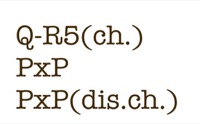
I had found the missing moves and the missing man. In the office of the Inspector I examined the cuff. It was frayed with wear and washing, but the powerful ink had refused to “out,” and there were the familiar characters, in reverse, of course, and absolutely unintelligible to the uninitiated. When he realized how strong the proof was the fellow confessed. He had been a clerk in a wholesale grain-house, had “played” the markets, became more and more involved, used his firm’s money, and saw ruin and imprisonment before him. One evening he had gone with a friend to a chess-club, saw Maxwell, and learned of his eccentric habit of keeping large sums of money in his house. In his desperate situation he formed the resolve suggested by this information. When he entered the house the lights were extinguished, but before he could find the safe Maxwell arose, turned on the lights, and began work at his table. My entrance frightened the amateur-burglar, and as he rushed toward the window, his only means of escape, Maxwell seized him. In his terror he snatched the weapon from the wall and struck the blow. He remembered that during the struggle Maxwell had hurled him against the table and that his left arm had rested on it. He had afterward noticed the stains on the cuff but had given them no special attention.
I may add that he served his time, was a model convict, and after his release vanished from my knowledge. Dr. Bell, of course, was overjoyed at the arrest. Maxwell heard of it with wondering eyes and puzzled gaze, and said but little.
Poor fellow, he has never recovered, and he still plays the same game and ever with the same zest. He never knew of the doctor’s theory or real reason for the second operation. The doctor, realizing the failure of his experiment, in atonement gave up his practice and is devoting his life to Maxwell. But he still insists on the correctness of his theory. I have long since ceased puzzling my brain over the question. Possibly the strange play of Maxwell’s was only one of those startling coincidences that sometimes appear in this mysterious life. What surgeons and psychologists may think of my story I know not, neither do I care. I know that, with the exception of names, I have related the facts as they occurred. More learned brains than mine may solve the riddle.
"A writer who waits for ideal conditions under which to work will die without putting a word on paper." —E.B. White
He sat under the largest tree in sight. He was hatless and dusty. A horse that had seen better days, and many of them, stood near him, panting painfully with drooping head. Southward the prairie rolled away to the horizon. Northward the mountains climbed to the clouds.
The cry of a distant coyote smote the silence. The shadow of a circling buzzard swept about the tree.
The man glanced upward at the substance of the shadow, shrugged his shoulders, and said, “You are early, my friends. The feast is not yet prepared.”
Then he fixed his gaze steadily upon the distant mountains.
Down the pass that cleft them asunder, six dark objects appeared in rapid, undulatory motion. The man under the tree dropped his head upon his breast and closed his eyes.
When he looked up again, six horsemen were approaching at a long gallop.
They were dusty and rough-looking. One carried a rope at his saddle-bow.
They slackened their pace and advanced cautiously. The man under the tree hailed them from where he sat.
“Looking for someone, gentlemen?”
“We was,” replied the man with the rope. “We ain't now.”
The man under the tree stood up. He was tall, straight, and handsome.
“Make it short,” he said. “With a good horse instead of that plug, I might have been over the line. But last night was a dark one, and I was in a hurry.”
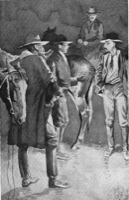
“You surely was, stranger,” said the man with the rope as he dropped the noose over the head of the hatless one. “’Nother case of haste makes waste. Best hoss in th’ camp was in th’ next stall.”
The six drew a short distance away and consulted in low tones. Then the man who had carried the rope called out, “Stranger, you admit takin’ the hoss, don't you?”
The hatless one smiled and nodded.
“There ain't no use of a trial,” urged the man who had carried the rope to the other five. “I'm a law abidin’ citizen, but when a man pleads guilty, there ain't no use a wastin’ time a tryin' him.”
“Stranger, the jedgment of this court is that you air guilty of hoss stealin', the particular hoss bein' Dick Arp’s old black Bill there. The sentence of the court is that you be hung by the neck from this here tree until dead, an’ may God have mercy on your soul. Have you anything to say before we purceed?”
“I think not, gentlemen,” said the hatless one, “except to call your attention to my courtesy in halting under the only available tree in the neighborhood.”
“It was obligin' of you, Stranger, it was so. You’ve saved us considerable time, and we’re in right smart of a rush to git back to th’ diggin’s. He’s a game one all right, boys. Hitch on there now an’ let’s git th’ job over with.”
The five seized the loose end of the rope and awaited the signal.
“Sure you ain’t got no folks you'd like to send word to, Stranger? By the way, what is your name, anyhow? ”
“Anianas.”
“Fust er last name? ”
“Both. And—yes—there are those who are—waiting for me. Perhaps it would be better if they—knew.”
“Gimme th’ address, stranger, an’ they’ll git th’ word, ’n’ I’ll make it as easy for ’em as I kin. I like a game man, 'n' I’m sorry you’re at that end of th’ rope. Gimme th’ address.”
“It is in the letter in my coat pocket. Will you look at it now? The other pocket. Thanks. Sorry to trouble you, but you will observe that you have tied my hands. Just examine it, please.”
“Couldn't read it in a week of Sundays. Here, Bob, you’re a book sharp; come’n read out th’ address of the th’ gent’s folks so’s we kin all ketch it.”
The smallest man of the six advanced and glanced over the sheet hastily. Then he read it carefully. Next, he turned to the hatless one and exclaimed, “My God man, are you mad? Have you no plea to make?”
The hatless one smiled sadly. “What’s the use? You would not believe. You intend to murder me—and them. I will not beg, not even for—the children.”
But the man with the letter was reading it aloud to the five.
"Dear Papa: You must come home, quick. Mamma is much worse. The doctor says he might save her if you were here. And the little money you gave us is all gone, and baby and I are hungry. But I can’t tell the doctor that. So you must come. I know you will, so I told mamma you were coming and she is listening for you. Your loving little girl, Mary.”
The four men had dropped the rope. The man who had brought the rope had turned and was looking over the prairie.
Perhaps he was thinking of his brood, far away in the east waiting for his return when he should strike it rich.
Perhaps it was the dust that choked him when he spoke.
“Where air they, stranger?”
“Mexico. Jest over the line. Had to leave them there until I could send for them. That was months ago. I have had—hard luck.”
The man who had brought the rope looked inquiringly at the other five. Then there were seven free men under the tree, and the rope was coiled on the arm of the man who had brought it.
“Take the horse stranger. He’s yours. We made a mistake. He ain’t much good, but he’ll take you to the waiting’ children.”
But the hatless one shook his head.
“Gentlemen, I’ll be frank with you. God knows I am too near the grave to lie. I am not a criminal. Two years ago I had a good business, a happy family, and a comfortable home. My partner ruined me. In one awful day I lost everything. Then I was offered a good position as manager of a Mexican plantation. I accepted the offer thankfully, and with my little family had almost reached our destination, where I hoped to recoup my fortune when I learned that the company had failed and had made an assignment.”
“We were homeless, among strangers. My wife, who had never known an ungratified desire, was sinking under our adversities. I could find no employment. I gave them every dollar I had and left them in two little rooms, intending to work my way northward into God's country, where I might find steady employment.”
“I was a hundred miles north of here when that letter reached me. I was sick, had found no work, and had no money. In desperation, I took a horse and rode him until he dropped. You who have wives and children can understand.”
“I did not want to steal. But they are after me for taking that horse. I threw them off the trail last night, just before I took this horse from you. But they have struck it again by this time. They are well-mounted. I cannot escape unless I catch the midnight train south at the station.”
“And even then, I have no money. You may as well proceed. If they catch me, they will take me back. I prefer this tree. It is—nearer home.”
When six earnest men agree, a conclusion is soon reached. The man who had brought the rope announced the result of the hasty consultation,
“Stranger—I can't pronounce yer name nohow—you're agoin’ home. We ain’t no millionaires, but we've dug up enough coin here to see you through ’n a little to spare. Jump that roan, quick. Here's your hat. Bob's th‘ treasurer of this syndicate, ’n he’s goin’ with you to bring back the roan.”
“You kin make it if you hustle. That’s all right—we know what you want to say. We're rough, but we’re fair. So long. Get a move on you now er you’ll miss th’ train.”
Twenty-four hours later, Bob returned to the little mining town, from the south, leading the roan and bearing a sealed message to the man who had carried the rope.
“Most Generous but easy friends:
It looked like a bold game, but there was everything to gain and nothing to lose. Hanging is hanging, whether for horse stealing or murder. I was sorry for the children when I found that letter in his pocket, but I needed his clothes and horse, and he was stubborn. It is very bad form to travel in convict's stripes. Kindly inform the sheriff when he reaches your town that, at present, my address is Central America.
Most thankfully yours,
R. E.”
At five-thirty that evening, the sheriff of Maricopa County and two deputies in search of Richard Earl, alias “Slick Dick,” confidence man, escaped convict and murderer, galloped into town from the north and had a fascinating interview with six wrathful and crestfallen citizens.
At six o’clock, they departed slowly over the same road they had come. None showed a disposition to talk.
At the summit of the pass, the sheriff halted his weary horse, turned in his saddle, and gazed down upon the town long and thoughtfully.
Then he said, earnestly, contemptuously, deliberately, “Well, I'll be durned!—Anianas!”
"Every writer has the power to do this: to reach beyond the walls of his own city or country, and to tell the human story." —John Cheever
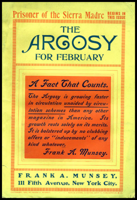
When Mr. Beasly arrived within sight of his house, he groaned. When within sight, he also came within hearing, and what he heard reminded him of what he had forgotten—that Mrs. Beasly was entertaining the Ladies’ Whist Club.
The sounds of laughter, animated voices, clinking tableware indicated that Mrs. Beasly’s entertainment was genuinely entertaining. Beasly groaned again.
Anything that pulled at his purse or produced pleasure made Beasly groan.
Pleasure meant an expenditure of money or of time, which was the same thing. Beasly believed in the encouragement of economy and the prohibition of pleasure.
Beasly was not a gregarious animal. Mrs. Beasly was. Beasly had found it cheaper to compromise than to contest, and Mrs. Beasly had been allowed to join the club upon the condition that she entertain but once per annum.
“I suppose they’ll cackle around my table until every scrap is devoured,” Beasly muttered. “Then I can buy more or go without my supper. If I hadn’t forgotten this, I’d have stayed downtown. Wonder if I can hide in the library till the row’s over. I’ll try it.”
He tried it via the side window and succeeded.
“Must be about through,” he growled as he turned the key. “Hear ’em telling Maria what a good time they’ve had. Good time indeed! Don’t cost them anything. Go ahead! Gorge yourselves! Beasly pays!”
Another groan.
“Yes, thank heaven, they’re beginning to straggle into the next room after their wraps. Some of ’em in there now. Wonder if they consider who’s putting up for this infernal nonsense. Wonder if they’ll give me any credit. I’ll listen.”
He seated himself where he could employ eye and ear alternately at the keyhole. He tried an eye first, unsuccessfully. Then he applied an ear.
“It's positively shameful,” a low voice was saying. “She ought to be expelled from the club. I saw her cheat twice with my own eyes. She stole that prize.”
“Why don’t you protest to Mrs. Beasly?” queried voice number two.
“And what good would that do?” rejoined the first voice. “Mrs. Beasly’s been brow-beaten and cowed by her brute of a husband” (Beasly nearly fell off his chair) “till she hasn’t the backbone of a mouse.”
“That’s the truth,” asserted voice number two.“I pity her. It’s awful the way she has to skimp along. It’s my opinion that lunch didn’t cost over ten dollars. I could see how mortified she was.”
“John says,” resumed voice number one, “that old Beasly’s the meanest —“
“Oh, come on, dear, quick. There comes that Mary Jacobs, and I will not speak to her, the hateful cheat. I’d have won that prize if —”
“They’re gone,” snarled Beasly, applying his eye. “Great Moses! Ten dollars for a lunch for such creatures to gobble up. And here comes another gang. What’ll they have to say about me?”
Voice number three: “So glad you won the prize, dear. Isn’t it pretty?”
Voice number four: “Do you think so? I think it horrid. I priced that very bowl at Hubbard’s bargain sale last week, and it was two ninety-eight. What do you think of that? Wouldn’t that jar you?”
It did jar Beasly so that he came near shrieking out what he thought of that. Three dollars for a bowl to give away!
Voice number five: “Well, it isn’t as expensive as our club’s accustomed to. But Mrs. Beasly has to economize, you know, um! But haven’t you heard? Really? You mustn’t repeat it for the world, but Will says that it’s generally understood that old Beasly is in his last-ditch financially. Yes — the crash may come any minute.”
“Will told me to keep my eyes open this afternoon, and if I saw anything to confirm the rumor, he would intimate the truth in his morning paper. That would be quite a scoop on the other papers, you know. And I’ve seen enough, goodness knows.”
Voices three and four, in chorus, softly but intensely: “Why, what?”
Voice number five: “Lots of things. Isn’t the house miserably cold? I’ll guess there isn’t a ton of coal in the bin. And there’s no hired help. And Mrs. Beasly's wearing a last year’s dress made over. And the carpets, and the curtains, and that lunch! How much proof do you require?”
Voice number three: “And I saw a large darn in the table cover. Mrs. Beasly tried to hide it with a platter, but I saw it. And I know she borrowed most of that silverware. Probably they’ve had to sell or pawn their own. Tom was saying only last night that Beasly looked shabbier every day. Oh, it must be true — and Tom’s put all my money in Beasly’s hands, too.”
Voice number four: “Maybe it’s only stinginess. Fred has often said to me that Beasly is too mean to live. Look at this house and the furniture. Old fashioned, of course, but —”
Voice number five: “The house and furniture were left to Mrs. Beasly by her father. Didn’t you know that? Catch old Beasly buying anything good. She’d have had more, too, but Beasly was executor, you know, and they say —”
Voice number three: “Oh, I’m so glad you told us. I’ll have Tom draw my money the first thing in the morning.”
Voice number five. “Do, dear. And do have him warn his friends. Beasly has simply been speculating until he has lost all of his own money, and goodness only knows how much more. It’s just awful. I hope Will will come right out plain in the morning paper, and —”
Beasly didn’t try to hear any more; he had heard enough to make the fringe of gray hair around his bald head bristle with rage and his red face turn crimson.
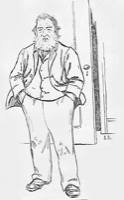
He waited, wrathfully, until the great, lonely house was silent. Then he climbed softly out of the window and let himself in at the front door.
Mrs. Beasly sat alone at the remnants of the lunch. She looked tired and sad.
She had often looked that way, but Beasly had been too busy making money to notice it before.
“Maria,” he said as he sat down opposite her, “what did that lunch cost?”
“Not — not over twelve dollars, Alfred. I tried”
“And the prize?”
“I got that for two dollars, Alfred. It was marked”
“Can you give another party and have those same people — the very same, mind you?”
“Why — yes — I suppose I could,” Mrs. Beasly gasped.
“Well, do it — and do it quick. And make it double discount anything of the kind that has happened in this town. And don’t you pay less than twenty-five dollars for the prize.
“Oh, don’t ask me any questions. I’ll show ’em,” savagely. “And you get a girl. Two of ’em — the best. Don’t mind the cost. Whose silver is this? Why will you wear that old dress? See here; you’ll have an account of one thousand dollars at the First National Bank in the morning. And it’ll grow. Buy everything you want. Show those people that Alfred Beasly is no pauper. I’m going downtown to see Will Ware. You needn’t wait for me. Go to bed.”
The next day at breakfast, Beasly called his wife’s attention to an article on the first page of the morning Banner:
“To the First Presbyterian Church of our thriving city:
Next Sunday will prove to be a day-long to be remembered. The mortgage of five thousand dollars, which has so long been a burden to the congregation and the faithful pastor, will be burned in public.
This is made possible by the beneficence of our esteemed fellow citizen, Mr. Alfred Beasly, one of the most enterprising and successful financiers in the State.
In an interview last night, Mr. Beasly reluctantly admitted that he had just handed his check to the Rev. J. R. Lane for the amount and purpose above stated. Like Mr. Carnegie, Mr. Beasly purposes to devote much of his great wealth to charitable and educational institutions, and this first step in that direction will meet with the heartiest approval.
This church is first favored for the reason that Mr. Beasly’s estimable wife has long been a member of that congregation. Mr. Beasly’s valuable and increasing business warrants”
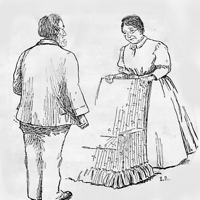
"I can’t understand it at all,” stammered Mrs. Beasly.
“Don’t try,” said Beasly.
And she didn’t. She’s too happy to care. But she believes in modern miracles — for Beasly never told her about the voices.
"The job of a writer is to make the reader care." —Anne Lamott
—FROM THE PUBLISHERS
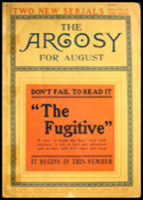
Indiana enjoys the distinction of having produced a great number of able fiction writers. Attorney Frank N. Stratton of Kokomo has for years been writing some of the best short stories printed in the leading Eastern magazines.
Mr. Stratton's delightful series, “Pottering Pete,” begun in Wayside Tales some years ago, is being continued in the current numbers of the magazine.
It is always a compliment for a man to be appreciated at home. That Mr. Stratton is not without honor in his own town the following from Kokomo newspapers witness:
There is a remarkable difference between Frank N. Stratton and most of the popular writers of short stories. The Stratton contributions are popular in Kokomo, where he has been known so long. It is not mere local enthusiasm which supports the desire of the people here and in other Indiana cities in this section to read the Stratton stories, but it is an eagerness to see more of the delightful and original work that has been coming from the versatile pen of the Kokomo lawyer. In the years that he has traveled, Frank Stratton has been an observer, one of those careful, sympathetic observers who sees the best and the truest side of any situation, as well as the more humorous. He gets all that there is in a situation, and he knows how to write about it in a way that at- tracts the people. Singularly enough, he is as good a story teller as he is a story writer and the listener frequently misses other things while he listens to what Stratton says.
In the March Everybody's Magazine there is a short story, “Jimmy's Mother." It is a pathetic tale of court and justice, of an aged woman, whose loyalty wins the victory of which the lawyer had despaired. It is a gem of the pathetic sort and makes the reader kinder and better for the reading. In the March Munsey, the story of “The Woman in the Case." It is one of those western stories, teeming with interest and action, showing the author’s intimate knowledge of the country where so much is strenuosity. The broad humanity of hunted Reddy McGuire and the fidelity of Sheriff Dan Rowe to his sense of duty, while yet not unmindful of the heroism of the man he wanted to arrest, are well described. In the March Wayside Tales the story is told of Pottering Pete’s desire for a wife and the investigations he made of a matrimonial grafter. This is the first of a series of Pottering Pete stories that Mr. Stratton will furnish to Wayside Tales, and their clever humor will be well received. — Kokomo Morning News, 1904.
The third series of “Pottering Pete” tales, by Frank N. Stratton of this city, appears in Wayside Tales for February. These products of the pen of the Kokomo writer have been contracted for by the Sampson-Hodges Company of Chicago, owners of Wayside Tales and one of the three great short-story syndicates, the other two being the Daily Story Publishing Company and the McClure Syndicate of New York. The Stratton tales are to be syndicated after publication in Wayside Tales.—Kokomo Dispatch, 1904.
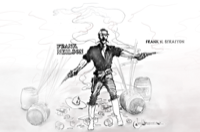
"Writing is the painting of the voice." —Voltaire

“Jest one drink, Shorty.”
“Nein. You owes me more as tree tollars, alretty—you vas one dead peat. I vas not in der pizness for mine gomplexion.”
Pottering Pete, tall, gaunt, ragged, and unkempt, leaned against the bar of the Mountain Gem and contemplated Shorty, vigorously polishing the woodwork preparatory to catering to the morning trade.
“But, Shorty, my luck can’t last allers. Bound to come my way purty soon. I feel it in my bones.”
“You’ll feel somedings outside your bones if you get not oud right avay, alretty. You drive avay my gustomers.”
“That’s all right, Shorty. Gimme a drink, and I’ll — hold on there, Shorty, hold on.”
Shorty held onto the collar of Pete's shirt and the rear of his nether garment until Pete found himself in the middle of the dusty road.
“Und don’t you nefer come pack," ejaculated the panting German, from the door, "or I preaka efry bone In your pody. You vas one fraud."
Accompanied by his tremendous and growing thirst, Pottering Pete slowly shambled down the one street of the rambling little mining town. Since his last unsuccessful prospecting trip, he had lived upon the generosity of its inhabitants. Lazy, shiftless, drunken, and discouraged, he had outstayed his welcome. Simultaneously he reached the end of the street and a determination to keep going. To achieve resolution was a novel sensation for Pete, and he rather liked it. Possibly he could impose for a week or two upon the citizens of the next town. There might even be a possibility of a grubstake and another prospecting tour with a pot of gold at the end of it.
When he had toiled up the pass to its summit, Pete turned and looked down upon the town nestling in the distance, amid the lofty peaks bathed in the golden glory of the rising sun. In Pete’s unromantic mind, admiration for the picture was drowned by resentment against the citizens who had refused to harbor him longer.
From somewhere among the willow pools of his memory arose a long-forgotten tale of a prophet of old, scorned and reviled, who had stood upon a mountain-top at early dawn and hurled a curse upon the slumbering denizens of the valley, a curse so vehement and effective as to result in the immediate and utter annihilation of the unconscious objects of the prophet’s wrath.
"Durned ef I don’t try it,” muttered Pete. “Durned ef I don’t cuss the whole danged town once, jest fer luck. Don’t cost nothin’ ’n’ ye can’t tell what’ll happen.”
Inspired by this commendable resolution, he clambered slowly up the steep side of the pass to the top of the spur. After a moment's rest, he drew his long, gaunt body to its full height, tilted back his unsheared head for a supreme effort, and thrust out his arms to add force to his malediction. Then his foot slipped upon a rounded rock, and a tangled mass of long, waving arms and legs and hair rolled down the opposite side of the sharp spur and landed upon a ledge of rock with a crash. Slowly and painfully glancing up along the course of his sudden descent, Pete scrambled to his feet, gasped, gave a great cry, and fell to clawing in the thin, loose soil like a wild beast.
For two hours, he dug and scraped and pounded with boulder and knife, and when he finally climbed back to the top of the spur and down into the pass, his face was set toward the town, and his pockets were bulging with rocks.
He passed through the town with such stride and manner that the citizens glanced after him in surprise, and Shorty, looking out of the open saloon door and addressing the early coterie at the bar, exclaimed derisively. "I know’d it vould coom. No mooch drink can nicht one-man stand. He vas plum grazy at last, alretty. Yah."
It did not occur to any of them at the time that Pete's nose was pointed straight toward the nearest government office.
But it did occur to them shortly after when the truth came out, and a couple of capitalists, with a force of men, arrived to begin the development of the richest mine in the region.
"And right in sight of town, too," lamented sundry citizens, “and us a prospectin' ’n a-proddin' around every place but that."
Shorty was handing out the drinks to a line of mourners when he became aware of the unexpected presence of Pottering Pete, a little better clothed than formerly, but still the same slouchy, listless, lazy-looking Pete.
“Shorty,” he drawled, “gimme a drink,” and he got it.
“Shorty,” he continued, lazily, “I’m a-goin' inter th’ saloon bizness. I kinder like yer place. What’s th’ price?”
“It vas not for sale, Mr. Patten,” said Shorty, obsequiously. “I haf a goot trade, alretty, und don’t sell me oud.”
“All right, Shorty. I starts opposition and see who breaks up fust. Gimme ’nother one, Shorty.”
Shorty was not pleased with the prospect of the threatened opposition.
“Der place vas wort a tousand tollars to me, Mr. Patten,” he remarked, as he replenished Pete’s glass.
Pete slowly swallowed the liquor, smacked his lips approvingly, and laboriously counted out ten beautiful one-hundred-dollar bills. “Th' whole outfit ain’t wuth th’ half of it, Shorty, but I’m stuck on it bekase of old and sweet memories. Gimme a receipt, Shorty.”
Then, as Shorty labored over the receipt, Pete scratched his left shin with the toe of his right boot and soliloquized.
“Short time sence Potterin’ Pete wuz th’ only critter in this here town as couldn’t git a drink at this bar. An’ now Mr. Patten’s th’ only critter in this here town as kin — fer he’s a-goin’ into th’ saloon bizness — fer a limited time only. Git out o’ here, Shorty.”
And Shorty got out — as did the bystanders. Some chose the front door, others utilized the back exit, and a few preferred the windows. For Pottering Pete had languidly produced a couple of wicked-looking guns and had started into the saloon business.
His first shot shattered the big mirror over the bar; the next decapitated a bust of Gambrinus, the third disarranged the internal anatomy of the superannuated nickel-in-the-slot machine. When last observed by the flying Shorty and his erstwhile customers, Pete had turned a fusillade upon the little pile of kegs and jugs at the end of the room, creating a horizontal geyser with each shot.
At a respectful distance, the amazed inhabitants gathered and watched liquors of various brands and colors gurgle out under the closed door and ooze through the cracks in the floor, forming miniature rivers and lakes in the dusty roadway. An occasional shot warned them that they might look but must not taste.
The prevailing opinion was that a man who would waste good liquor like that was undoubtedly crazy. It was felt that the affair was indeed a public calamity since it would require at least four days to get more whiskey into the town.
Late in the afternoon, a few of the hardiest, encouraged by resonant snoring, and the total absence of any other sound, ventured into the wrecked saloon.
As they lifted Pottering Pete from a pool of mingled whiskey, beer, and gin, they heard him mutter lazily. “Have one on me, Shorty. I’m in th’ bizness myself — fer a limited time only.”
"Literature is the most agreeable way of ignoring life." —Fernando Pessoa
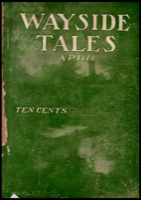
Pottering Pete stretched his long arms along the cemetery fence's top board and solemnly surveyed the grim array of atones and monuments.
“Dogged ef it hain’t changed even more’n th’ town,” he soliloquized. “Reckon 'bout all th’ folks I know’d twenty-five years ago is camped out here.”
From the depths of a pocket, he produced a long and twisted plug, from which, with much facial contortion and grinding of teeth, he wrested a large segment, restored the shattered fragments to the pocket, and resumed his soliloquy.
“Wonder what corner they put her in. Ef I hadn’t ’a be’n allers busted I could ’a —”
A faint, pattering sound in the distance attracted his attention. At the foot of a green and gentle slope, little clouds of clay were rising from the earth's surface and falling back at regular intervals, like an infant geyser.
“Reckon he’ll know,” Pete muttered.
He clambered over the fence and slouched down the slope toward the upheaval.
From the bottom of an oblong excavation, a little, wizened man gazed shrewdly up at the hairy face that peered into the pit — then grinned, toothlessly, and thrust the handle of his shovel up into the palm of Pottering Pete.
“Shake, Misther Pether Patthen!” he exclaimed. “Fer thot’s yer name or me own’s not Dennis O’Teague. Ye’ll ixcuse me fer not climbin’ up — me back’s thot bad wid th’ rheumatics.”
“Right ye air, Denny,” responded Pete, shaking the shovel handle vigorously. “Still at th’ old job eh? And how’s bizness?”
The little man leaned heavily on the shovel and shook his gray head dolefully.
“Shlow, Pether, shlow. It's an unwillln’ thrade I have. Nobody pathronizes me place till they’re driven to it. Oi’m th’ last mon they’ll dale with. But yersilf, Pether — ‘twas in th’ papers thot Misther Pether’s Patthen had found a gould moine out west, an’ we’re wonderin’ is it our Pether thot runned away twinty foive year agone.”
“I reckon it wuz, Denny. Yes, I reckon it wuz.”
“Good fer ye! Manny’s the toime whin folks said ye’d come to a bad end; ’twas Dennis O’Teague told thim to wait ’n’ see. A gould moine! Glory be! I always know’d ye’d get th’ credit ye desarved sometoime, Pether.”
“Waal,” Mr. Patten drawled, “I wuz a needin’ some credit when I hit th’ mine. I wuz a-goin' downhill purty swift. Still, I don’t know as enny partickilar praise orter be comin’ to me fer findin’ th’ mine. I jest kinder fell into it.”
“Shure, it’s yer blessed mither would have joyed to see this day. Manny’s th’ toime th’ Widdy Patthen’s said to mesilf, ‘Ah, Dinny, if me only child would but let me know where he is.”
A small avalanche of damp, unpleasant clay, starting from the vicinity of Pottering Pete’s boot, caromed from Dennis’ head, interrupting the unhappy reminiscence.
“Ginerally didn’t know where I wuz myself,” Pete remonstrated. “But I orter have wrote — yes, I orter have wrote. Reckon I might have borrowed a stamp. But I never thought she’d — Denny, where’d ye put her? I’m a-goin' to give her a moniment that’ll —”
“A monument is it,” Dennis ejaculated, clawing the clay from his scant hair. “Shure, ye’re too late agin, as ye always was, Pether. She’s got one; th’ saints be praised.”
“What? Who — who did it?” exclaimed Pottering Pete.
“’Twas the Burtons, Pether — ould mon Burton ’n’ wife — bekase yer mither, peace to her soul, nursed thim through th’ small-pox whin nobody else would go nigh. D’ye mind the Burtons, Pether, thim as owned th’ foine farm over th’ hill beyant? Manny’s th’ apple ye’ve stole from that orchard, Pether. ’Tis a monument will make yer mouth wather.”
“Whar’bouts is it, Denny?”
“Tis behint ye, Pether, in th’ corner beyant, by th’ little willow th’ one wid th’ blind angel holdin’ th’ dhruggists’ scales.”
Pottering Pete was gone a long time. When he returned, Dennis had ascended to the surface and was industriously scraping clay from his shoes.
“Denny,” said Pottering Pete — there was a suspicious tremor in his voice — “I’m a-goin' to see old Burton.”
"Tis a long journey we’ll be makin’ thin, Perther,” observed Dennis, looking up quizzically. "Tis for him I’m diggin’ this day. Th' funeral’s this afternoon, and he’s betther off than th’ wlddy.”
"Hey? What's th’ matter with th’ wldder?” demanded Pottering Pete.
"Tis a sade tale, Pether — a tale of sickness- an’ th’ children dyin’-an’ payin' security debts on’ droughts, an’ panic — till all goes but th’ home eighty, an’t hey has to borry on that — an’ th’ mortgage is foreclosed, an’ Clubbs gits th’ place tomorry, lavin’ th’ widdy widout kith ner kin, ner roof fer her head, ner dollar fer her pocket.”
“Who’s Clubbs,” asked Mr. Patten hoarsely.
“Ye don’t know him, Pether. He come since ye lift. It’s a foine gentlemon he is, wid a heart of brass, an’ th’ eye of a salted codfish, an’ by all th’ saints, thot do be him comin’ now!”
Pottering Pete, following Dennis’ gaze, beheld a small, skinny man tying a large, bony horse to the cemetery fence.
“Maybe he do be havin’ a mortgage on th’ Burton lot, here, an’ is comin' to sthop th’ funeral till it’s paid,” Dennis suggested, ironically.
The small, skinny man hurried through the gate and ambled down the slope. As he neared Pottering Pete, he removed his hat, bowed obsequiously, and smiled profusely.
“Mr. Patten, I believe. My name is Clubbs, Simeon K. Clubbs, real estate and loans. Happy to make your acquaintance, Mr. Patten.”
Mr. Patten certainly did not see the extended hand, for his right hand wandered back to a hip pocket while the left was transformed into a knotted fist.
“Welcome back to your native heath, my dear sir,” continued the unabashed Mr. Clubbs. “Welcome back; truly, fortune favors the brave. Let me be among the first to congratulate you and to proffer my humble services should you desire to make a few investments.”
“Our little city is on the eve of an era of prosperity, sir. The financial clouds that have so long obscured the national horizon are being swiftly dispersed, and a bright future awaits us.”
“Jedging from what I’ve heered sence I struck town this mornin’ there’s a glowin’ future awaitin’ fer you,” growled Pottering Pete.
“Thank you, my dear sir, thank you. I do not deny, Mr. Patten, that I have prospered and that my business is promising. Perhaps you would like to try the real estate business — with me. Splendid investment, sir, splendid! We would pull together famously. You furnish the capital, and I furnish the brains — that is — ahhm-m-m this open grave reminds me, Mr. Patten, that one of my dearest friends has been called to his reward. Sad, sir, very sad.”
Mr. Patten drew a deep breath and irrigated the atmosphere to windward of Mr. Clubbs with fluid extract of the plug so copiously that Mr. Clubbs shifted his position hastily.
"I was a-thinkin’, remarked Mr. Patten, meditatively.” I was a-thinkin’ ’bout a small farm — say eighty acres. An' ef it suited, I might go into th' real estate bisness — for a limited —“
"Eighty acres? Yes, sir, exactly! This way, Mr. Patten, to my buggy. Only a short drive, sir. This eighty will suit you — I’ll make it suit you, and we'll then discuss our partnership."
How’s th’ title?” inquired Pottering Pete as he climbed into the dilapidated vehicle.
“Straight as a string,” asserted Mr. Clubbs cheerfully, encouraging the bony horse into a shambling trot. “Own the place myself — that is, I hold the certificate. Get my deed from the sheriff this evening — foreclosure, you see. Year for redemption expires this evening. Widow can’t raise the money."
"Wldder Burton, I reckon," remarked Pottering Pete carelessly.
“Yea. Just so. She’s —”
"’Pears kinder rough fer us to be prowlin’ 'round th' place when th’ funeral’s gotten’ ready, don’t it?”
Mr. Clubbs laughed and laid his skinny hand caressingly on Mr. Patten’s knobby knee. “My dear sir, business is business. The wheels of commerce can’t stop because people will die. It’s been an unfortunate affair for the widow, but fortune of war, Mr. Patten, fortune of war. Up today, down tomorrow. Ha, ha! As practical men, Mr. Patten, as men of affairs, you and I know that business and sympathy won’t mix. It’s an ill wind that blows nobody any good. If I hadn’t got this eighty as I did, I couldn’t offer you such a bargain.”
“What's yer figgers?”
“Now, Mr. Patten, let’s not be hasty. We’ll go over the place first, and then — here we are, Mr. Patten — the big white house with the red barn. Everything spick and span, clean as a whistle. Old Burton was a model farmer, but he couldn’t keep off of other people’s paper.”
“Look at that timber, over there, Mr. Patten. Ten acres — mostly poplar. Timber alone is worth what the place cost me,” and Mr. Clubbs chuckled.
“Let’s hitch to th’ fence here and walk acrost to th’ timber,” suggested Pottering Pete.
“Certainly, certainly, quite right,” assented Mr. Clubbs, leaping out and proceeding to anchor the bony horse to the fence.
Pottering Pete, as he leisurely descended, surreptitiously transferred something from underneath the buggy seat to his capacious pocket.
“I will state, Mr. Patten,” resumed Mr. Clubbs, as they entered the woods, “that the price I will name you will mean cash, though, of course, your check —”
“Ye’ll git th’ cash — when we trade. I come heeled — fer another kind of investment.”
“Real estate?” queried Mr. Clubbs anxiously.
‘‘Moniment,” answered Mr. Patten laconically.
“Oh, monument. Deceased relative? Yes, just so. But you didn't invest? No. Quite right. Excellent. Too much money squandered in such things. A man’s fame and good name should be his monument, Mr. Patten.”
“Sum folks is goin' to git a durn puny moniment,” soliloquized Pottering Pete in an undertone.
Possibly Mr. Clubbs did not catch the remark, for he was gazing rapturously upward at the top of a tall poplar.
“Look at this tree, Mr. Patten. Isn’t it a beauty? Two men couldn’t span the trunk with their arms.”
Pottering Pete’s eyes twinkled.
“O, I reckon they could,” he insisted.
“Try it,” suggested Mr. Clubbs, knowingly, extending his arms about the rough trunk.
Pottering Pete stepped around the tree, out of Mr. Clubbs’ sight, drew from his pocket a strong rope halter, and before Mr. Clubbs could comprehend his purpose, the skinny wrists were deftly bound about the tree.
“Why — what!” exclaimed the amazed Clubbs. “Ah, yes, a little joke. Very clever, very clever, indeed, Mr. Patten. Ha! Ha! But, as time is pressing, suppose we go on.”
“I’m afeard ye will go on — and somebody might hear ye,” remarked Pete. “So I’ll finish th’ job.”
He took the big red bandanna from his neck and gagged the sputtering, struggling Clubbs.
“Now, ye kin buck all ye want—th’ more ye buck th’ tighter ye git. I never cinched a burro eny better. Forchun of war, Clubbsey, forchun of war. Up to-day, down to-morrow. So long, old boy. I’m a-goin' into th’ real estate bizness — fer a limited time, only.”
In a few minutes, the enraged Clubbs heard the sound of his rattling buggy on its way toward the town.
That evening, the heart-sick Widow Burton opened an envelope handed her by Dennis O’Teague as she left the cemetery. It contained a receipt from the sheriff in full of all claim against the eighty acres, and a few scrawled and labored lines running thus:
“Widder Burton — this is tu pay fer the moniment with intrust; ef ye hear enny yellin’ back in yer woods let him yell; its Clubbs; mebbe the skinny leetle kuss will slip the gag don’t wurry i told his offis boy clubs wants tu see him at the n w kornur yer woods at 6 p m — and he duz — bad. denis will giv ye this — im goin back west on the 4 pm Clubbs mite giv me trubel fer goin intu the reel state bizness — fer a short time only
respeckfly — PETER PATTEN.”
"There is no greater thing you can do with your life and your work than take it very seriously." —Stephen King

BARNEY," drawled Pottering Pete, as the two sat at the little table in Shorty’s place, “I’m a-goin’ to do a little speculatin’.” Old Barney McGlynn extracted the stumpy, black pipe from his grizzled whiskers, and stared incredulously at his employer.
“Speculatin’! Ain’t ye satisfied with findin’ th’ richest gold mine in th’" country, without blowin’ it in by speculatin’? It’s a jolly ye’re givin’ me, Pete.”
“Nary a jolly, Barney,” Pete asserted, gazing admiringly at the profile of a female head he was tracing in the small puddle on the table. “I’m a-goin’ to take a little flyer. I’ve picked my market.”
“Stocks?” asked Barney, anxiously. Pete shook his head.
“Grain?”
“Onct more, Barney.”
“Real ’state, then.”
Pottering Pete glanced cautiously about him, then leaned over the table and whispered:
“Matrymonial!”
The stumpy, black pipe fell to the floor; Barney’s gnarled hands dropped to his knees, and he glared across the table at his companion.
“A wife, is it? a boss? Air ye plum crazy, Pete? I’d never a-thought it of ye!”
“What’s th’ matter with matrymony, Barney? Where’d you an’ me be ef it hadn’t a-be’n fer matrymony ?”
“So ye’d waste yer coin on a wife, when ye kin buy a scoldin’ parrot fer five plunks, an’ a fust-class, hidjeous night-mare fer th’ price of three drinks! Matrymony! Hike over to th’ mine, sonny, an’ jump down th’ shaft; it’s quicker an’ less painful.”
Pottering Pete gave a finishing stroke to the profile, straightened up and grinned.
“’Cause you drew a blank in that lottery, Barney, ain’t no sign I will.”
“There ain’t no prizes in that lottery, Petey. They’re all blanks; it’s a skin game clean through.”
Pete tilted his chair back, shoved his hands into his pockets, and smiled complacently.
“That may be your idee, Barney, but I’ve got a ticket that calls fer a prize, an’ I’m a-goin’ to cash it in.”
Barney groaned, picked up the stumpy pipe, and settled down in his chair with an air of patient resignation.
“Jim Sigsby’s gal, I reckon,” he grunted.
“That skinny critter? Not on yer life!”
“Betz Wilson?”
“No red-heads in this game, Barney.”
“Well, who’s th’ female? Who’ve ye selected fer gineral over-seer? Perduce yer ticket.”
From the pocket of his flannel shirt Pottering Pete fished a well-worn newspaper clipping and passed it over the table.
“On th’ q. t., Barney. Read that.”
With much wagging of his gray head, and focusing of his solitary eye, Barney spelled out the communication, interjecting his own observations.
“’Middle-aged lady (Humph!), educated, refined, affectionate (Rats!), wishes to correspond with wealthy gentleman, competent to manage her financial affairs. ( Pete, this is orful) Object, matrimony. (Sure!) Address, Box 257, Parson City."
With an expression of intense disgust, Barney tossed the clipping to its owner, and expectorated copiously.
"What d'ye think of it?" asked Pete.
"I don't keer to say. I don't keer to bust up our old friendship."
Pottering Pete laughed softly, and extracted from a second pocket a photograph, and a perfumed letter written in a fine, feminine chirography.
"Squint at them, an' ye’ll change yer mind," he said, confidently. Barney squinted, long and earnestly.
"'Wuss an' wuss," he groaned. "She's too willin'. Ah, ten to one that pitcher ner th' hand-write ain't her'n. It's a salted mine, Petey; don't invest. Ye hain't sent her th' hundred dollars, have ye, Peter?"
"'Lowed I'd send it tumorry."
Barney suddenly reached over the table, seized Pete by the collar of his shirt, and emphasized his remarks by jabs and flourishes of the stumpy pipe.
"Looky here, Peter Patton This hain't my funeral, but I'm th' chief mourner. I've prospected with ye, an' starved with ye, an' fit Indians an' alkali with ye, an' I'll be cussed ef I go back on ye now. Listen to mean' quit pullin'.”
"Pete, there ain't a man this side th' Great Divide that kin lay it over ye in findin' pay dirt er guessin' on an assay, but when it comes to women ye'r crazier’n a locoed bronk. Ef ye send that hundred dollars ye'll never see th' woman, but th' whole fool bizness'll leak out, an' ye'll never hear th' last of it. I'm not a-going to set still an' see ye played fer a sucker an' a idjut."
“I’m a-goin' to foller this lead to th' end," Pete growled. "Ye kin gamble on that.”
"Then jump th' keers an' go to her. Ef ye don't find a gold brick at th' end of th' trail, bring her back with ye, an' kick old Barney McGlynn down th' shaft."
Pottering Pete folded his long arms and gazed reflectively out of the open door.
"There's only one man," he muttered, "that has license to stick his nose into my bizness without gittin' it broke off, an' that's old Barney Mc Glynn. He allers could see furder with his one eye than most fellers kin with two, an' I reckon I'll take his advice oncet more.”
"I'm a-goin' to jump th' eight-forty tumorry mornin' an' tackle th' matrymonial market fer a limited time only. Ef it pans out I'll invest heavy. Ef it don't a refined an' effecshunate blonde, objeck matrymony, is a-goin' to lose th' chance of her life."
Mr. Patton's friends would have bad some difficulty in recognizing him as he slouched lazily along a street in the suburbs of Parson City the following afternoon. A cheap suit of checked "hand-me-downs" flapped and fluttered on his bony frame, a narrow-brimmed derby perched jauntily amid his flowing locks, and he endured with commendatory fortitude the torture of a towering collar bound by a gorgeous tie. He halted before a shabby frame building and surveyed it dubiously.
"Reckon this must be th' cage of my turtle-dove," he soliloquized. "Her letter sez direct reply to number 257.”
The social circles in which Mr. Patton was a shining light considered it an unnecessary and superfluous ceremony to knock at a door before entering, and as to this point of etiquette Mr. Patton had not risen above his environments; he gently opened the door and stepped into a grimy and uncarpeted hall. The door at the farther end being invitingly ajar, Mr. Patton approached it noiselessly and peered into the adjoining room.
In a corner of the scantily furnished apartment a red-nosed individual, with a crop of stubbly beard, ripe for the sickle, dozed in a wobbly rocking-chair. Two women in slovenly garb conversed in guarded tones across a rickety table littered with letters, newspapers and writing material.
"Jolly Hanscomb along till we hear further from this Patton," the elder female was saying, while the other listened with poised pen. "Patton seems easy and promising. If he has half what he claims I've no objection to becoming his blushing bride until I'm ready to break away, with a fat slice of his property."
"In which case you'll not forget my customary percentage," added the younger lady, as she dipped her pen in the ink. Then she sprang up with a suppressed scream, for Pottering Pete stood in the room, hat in hand, bowing awkwardly.
"What th’ hell!" sputtered the man in the chair, opening his bleary eyes and struggling to his feet. The elder woman silenced him with a gesture, and turned to the intruder.
"May I ask the nature of your business here?" she said, scanning the visitor suspiciously.
"Yes, ma'am, ye kin," Pete responded, languidly. "I'm th' privut sec'tery of Mr. Peter Patton, an' I'm a-lookin' fer a young lady, objeck matrymony, by th' name of Tyce, Miss May N. Tyce. Mebbe I've rounded up th’ wrong herd."
The woman smiled with a cordiality and copiousness that accentuated the crow's-feet about her sharp eyes. "Please be seated," she exclaimed. "This is indeed a most joyful surprise, Mr. ?“
"McGlynn," Pete prompted, accepting the proffered chair, and carefully depositing the derby on the bare floor, within easy reach. "So ye're Miss Tyce, eh? Ye don't favor th' photygraff no great sight."
"That photo was taken only one year ago, Mr. McGlynn,” explained the beaming Miss Tyce, as the younger woman and the red-nosed individual hastily disappeared.
"Since then the cares of business and sudden financial responsibilities have left their marks, but with some strong, manly companion to assume those burdens, my youthful beauty will soon return.”
"Sure it would," assented Pete, gallantly. "Ennybody kin see it hain't gone far."
Miss Tyce simpered and lowered her eyes.
"Mr. Patton got yer little bill due all right," Pete continued, meditatively twirling his thumbs and surveying the smoke-stained ceiling. "He 'lowed it warn't safe to risk th' money in th' mail, so he sent me, him bein' consid'able under th’ weather jest at present. Wants me to fetch ye right back.”
Miss Tyce moved her chair a little nearer the private secretary, clasped her hands together, and gazed up at him rapturously.
"Such commendable prudence!" she exclaimed. "Ah, I see that I may safely trust him with my affairs. And such ardor! The dear man! I yearn to be with him," the eyes drooped again, “but it will require a few days' preparation, Mr. McGlynn, only a few days after you give me the money. As I informed him, if it were a few weeks later when the regular returns from my investments are due I should not ask him for this favor.”
"Can't wait no few days," said Pete, decisively. "Told me not to give ye th' stuff onless ye come to-day. He's a-needin' ye, bad.”
Miss Tyce laughed pleasantly and glanced furtively toward the door through which her two companions had disappeared.
"Since Peter — I must call him Peter — since Peter is so insistent, I will obey. I can be ready in a few hours after a little shopping — the purchase of a modest bridal trousseau. So the dear boy is ill? Nothing serious, I trust, Mr, McGlynn."
Pete shifted uneasily in his chair, avoiding Miss Tyce's inquiring gaze. The lady wrung her hands and leaned forward in an agony of alarm.
"Tell me," she implored. "I have the right to know all. What ails my dear boy?”
Pete looked wearily around the room, cleared his throat, leaned toward Miss Tyce and whispered.
"He's — he's got 'em agin!"
"Got what? I don't under”
“‘Leeryum-tremmin's! Snakes!"
Miss Tyce recoiled, horrified.
“Delirium tre —“
“Shshsh!” Pete hissed, warningly. “We’re a-tryin’ to keep it quiet. But I can’t see a’ innocent, fine-look’ woman with prospects, like you, imposed on. Yes ma’am, snakes! Th’ real article! Violent! ’Tween you an’ me, Miss Tyce, Tain’t no wonder that his fust wife died so sudden, in th’ night. He might nigh killed his three youngest children this time, before we could overpower ‘im.”
"Children!" gasped Miss Tyce. "And his wife died suddenly in the night! Really, Mr. McGlynn. this is quite sad!"
"Turrible, turrible!" Pete groaned, drawing the ends of the resplendent necktie across his eyes. "But I've done th' square thing by givin' ye th' tip."
Miss Tyce's sharp eyes assumed a stony glare. Her thin lips closed tightly, and she meditated, as though solving a perplexing problem. Then she arose and flung out her arms tragically. "will I desert him in his affliction," she cried. "Never! My duly is clear! The money, the money, Mr. McGlynn! In two short hours I will be ready to fly to his side."
Pottering Pete leisurely replaced the derby on his head, rose to his feet, and drew forth a plethoric wallet. "A hundred dollars is a big pile fer Mr. Patton to let go of now," he observed, hesitatingly, "though he don't know it. We dassent tell him' bout th' accident to th' mine; th' doc said it might make him wuss."
"Accident to the mine?" repeated Miss Tyce, eagerly eying the fat wallet.
"Yep. Struck an underground river yisterday. Mine flooded. Water runnin' out th' top of th' shaft. Pete ain't wuth a tinker's cuss."
Miss Tyce turned pale, and leaned against the rickety table. Then, with a cat-like movement, she snatched the wallet from Pete's hand.
"You scoundrel!" she shrieked "How dare you threaten me. Help, Bill, help!”
The red-nosed man appeared with suspicious suddenness and rushed toward Mr. Patton, who promptly retreated, unpursued. Reaching the street, he continued his departure at an unwonted gait, the gaudy neck-tie fluttering behind him.
"Beats all," he muttered, "how a jay kin git took in. Reckon' I'd better hustle fer home, before sumbody swipes these here store clothes. Th' city ain't no place fer a sucker."
The waiting Barney seized him as he swung from the train, pulled him into the furthermost corner of Shorty's place, pushed him into a chair, and whispered solicitously: "Well, what's th' verdfck?"
"Barney," said Pete, solemnly, "she's a peach."
"Ye didn't give her th' money, did ye. Pete?"
"She got th' wallet an' contents, an' th' show was wuth it."
"An' ye're a-goin' to marry her! Pete Patton, ye're surely th' biggest dern“
"Who sed ennything 'bout marryin'?" Mr. Patton growled, as he produced a lightly wrapped roll of bills.
“Ef ever ye open yer head 'bout this I’ll knock it off. What ye goin' to have, Barney, name yer pizen. We’re ‘bout to celebrate th' occashun of me monkyin’ with the matrimonial market, fer a limited time only, while an effeshunnate blonde, object matrimony, is a-figgerin’ how much bridle trewso she kin buy, with a wallet full of corn-shucks.”
"The beautiful thing about writing is that you don't have to get it right the first time, unlike a brain surgeon." —Robert Cormier

Agent in th’ office to see you, Mr. Patton.”
Pottering Pete, dozing in the shadow of the great building that enclosed the “Lucky Tumble” stamp-mills, slowly opened his eyes and gazed up at his red-shirted clerk.
“What’s he want?” he drawled, drowsily.
The red-shirted clerk shook his head.
“Won’t tell; has to see you.”
“Enny knots on ’im like a book concealed ’bout his person?”
“Nary a knot; smooth as an old saddle.”
“Mebbe he’s another of them subscription-paper devils, Jimmy,” suggested Pete, anxiously.
The swift upward movement of Jimmy’s eyebrows expressed utter ignorance.
“Got me guessin’; it’s a new specimen; looks like it might be bizness.”
Pottering Pete yawned protestingly, struggled to his feet, and followed the red-shirted clerk.
A small young man, smooth of face and long of nose, whose sharp, half-closed eyes glittered behind gold-mounted glasses, rose alertly from a chair in the outer office and held out a gloved hand.
“Mr. Patton?” he inquired, briskly. “Ah, yes! May I see you privately, Mr. Patton? Important business highly important, I assure you.”
Pottering Pete’s gaze began at the patent-leather shoes, roamed inquisitively upward along the carefully creased trousers, gorgeous vest and short, stylish coat, paused for an indignant instant on the immaculate shirt-front and lofty collar, and halted contemptuously on the skin-white line that defined the exact center of the closely plastered hair.
“Who air ye, ennyway?” he grunted.
“My name, Mr. Patton, is Schott — Otto B. Schott”
“An’ that’s no lie,” Pete muttered, fumbling absently at his belt. “’Taint too late yet.”
“Too late — did I understand you to say, Mr. Patton? Not at all, sir. This way, please. My business is confidential, strictly confidential.”
Mr. Schott airily pushed open the door leading into Mr. Patton’s private office, dropped into the easiest chair, and looked about him complacently. With an expression of extreme amazement, Pete followed him, closed the door, and seated himself at his desk.
“Ef you’ve got as much bizness as nerve you’re it,” he growled. “Say yer piece, an’ say it quick.”
Mr. Schott displaced a pile of private papers on the desk to make room for his hat, and leaned forward confidently.
“Now, Mr. Patton, I’m a promoter,” he announced in a cautious tone.
“What’s a promoter?”
Mr. Schott smiled — a superior, pitying smile.
“A promoter, my dear sir, is one who creates and fosters financial undertakings; builds up substantial business from airy nothing; groups and consolidates small and struggling ventures into gigantic and profitable monopolies.”
“I see,” observed Mr. Patton. “Melts down a few honest little men an’ casts ’em into one big thief. Well, ye’d better begin by promotin’ yourself out of this camp before th’ boys ketches sight of them clothes. That’s all there is to promote around here.”
Mr. Schott grinned nervously and laid his hand on Mr. Patton’s knee.
“You’re wrong, sir; quite wrong. Allow me to demonstrate. You own a controlling interest in the ‘Lucky Tumble’ mine.”
“An’ I ’low to keep on ownin’ it. Ye can’t”
“Wait a moment! And you doubtless own a few worthless claims adjacent to the mine.”
“Reckon I do.”
“For instance — that one?”
Mr. Schott pointed through the open window to a heap of sun-baked earth, surmounted by a meditative jack-rabbit, that projected from the rocky face of a distant slope.
“Yes,” assented Mr. Patton. “Give old Bill Disbro a hundred fur that one, ’cause he was hard up. I’d ruther have th’ rabbit.”
“Wrong again, Mr. Patton. That abandoned claim — any abandoned claim in this vicinity — is worth to you at least ten thousand dollars!”
Here, Mr. Schott struck the desk violently, and leaned back to note the effect of his startling assertion. Mr. Patton didn’t seem too enthused — his hand again wandered mechanically to his belt.
“Come out of th’ bushes an’ talk English,” he said, gruffly. “What d’ye want?”
Mr. Schott glanced about him warily, again bent forward, and whispered impressively: “Your name — ten thousand dollars, twelve thousand dollars — for your name.”
Pottering Pete started to rise, and Mr. Schott threw up a deprecating hand.
“Now, don’t be hasty, Mr. Patton. I’ll make it plain. Listen. There are two other gentlemen in this — Mr. Squivers and Mr. Peek. Mr. Squivers puts up what little money we will need for advertising purposes — the only outlay. I manage the scheme. You furnish nothing, absolutely nothing, but the worthless claim — we’ll call it the Jack-rabbit claim. We’ll dig a couple more holes and call them ‘Star of Hope,’ and ‘Dead Cinch,’ all located on the ‘Lucky Tumble’ lode.’ See?”
Mr. Patton’s face had taken on an expression of deep interest.
“I begin to ketch on,” he murmured. “What next?”
“Then we incorporate — The Aurora Mining and Development Company, authorized capital — One Million Dollars, the Honorable Peter Patton, President; Mr. Hernando Squivers, Secretary and Treasurer; Mr. Otto B. Schott, General Manager— do you follow, Mr. Patton?”
“Like a burro behind th’ bell-mare,” declared Pete. “You want my name as a successful an’ wealthy mine owner to inspire confidence, so’s we kin unload”
“Exactly! So that we can sell the stock,” interrupted Mr. Schott, gleefully noting Pete’s increasing interest. “We offer the public half the stock — and the public falls over itself to buy.”
“Th’ public don’t do nothin’ of th’ kind; not fer stock like that,” declared Mr. Patton, energetically.
“Aren’t they doing it all the time?”
“Mebbe they air fer stock that’s got good prospects behind it claims that’ll bear investigation. Bizness men don’t shoot their cash into a hole like that one without investigation.”
Mr. Schott laughed softly, tilted his chair back, and elevated the patent-leathers to the desk.
"Guess you never heard of United States Steel, Mr. Patton. Besides, we don’t offer stock to business men. We sell only to those who’ve just enough money to invest and not enough to investigate; widows, clerks, laborers that’s our class — safe, soft and sure."
"How’s widders, an’ clerks an’ laborers goin’ to buy high-priced minin’ stock?”
"High priced? Not at all. Ten cents on the dollar, Mr. Patton. Fifty shares, $5. Fifty shares in the Aurora Mining and Development Company elegant steel engraved certificates for only five dollars! ‘Honorable Peter Patton, President’Oh just wait till you see our prospectus, Mr. Patton! That’s my strong line prospectuses — prospectuses that are poems of persuasion and plausibility. Fifty shares the minimum, at above price. Positively not more than two hundred shares to any one person. Price will be advanced, January 1, to fifteen cents. Additional advances as the ore increases in value. Don’t worry about the public not buying, Mr. Patton. Printers’ ink, mixed with brains, will sell anything these prosperous times.”
“There’ll have to be a show-down sometime,” observed Mr. Patton, dubiously. “After th’ stock’s sold people’ll be wantin’ to hear about dividends.”
“And they’ll hear about bonds,” replied Mr. Schott, with a grim chuckle.
“Bonds?”
“Certainly. Early in the game the Board of Directors that’s us find it necessary to issue bonds, to mortgage the plant. Bonds fall due — no money — foreclosures — bond-holder takes the property— we’re out, slick as a whistle.”
“Court might want to know what went with them proceeds. State’s attorneys an’ jedges git derned meddlesome sometimes.”
"That’s where your pay-roll and political influence comes in. Mr. Patton controls the appointment and election of those fellows. And we give them each a block of the stock make them appear particeps criminis in case of inquiry. Besides, there’s padded pay-rolls, expensive machinery that breaks down, salaries, cave-ins, all kinds of bad luck. We keep the books! Understand?”
Mr. Patton nodded, and thoughtfully contemplated the meditative jack-rabbit in the distance.
“And that other feller — Peek?” he inquired. “Where does he come in?”
“Peek? Early in the game he’s the expert; at the wind-up he’s the bondholder.”
“Expert what?”
“Mining expert. Sent by prospective investors to investigate and report. His report goes out with the second batch of circulars and it’s a hummer.”
Pottering Pete bit a generous hunk from a plug of “Miner’s Twist” and offered the remainder to Mr. Schott, who shrank back with a shuddering gesture of declination.
“Enny of you fellers practical miners?” Pete asked. “Know good ore when you see it?”
“No, indeed, sir. We’re promoters, not miners.”
Mr. Patton again relapsed into hesitative cogitation.
“Nothing criminal about the scheme, Mr. Patton,” ventured Mr. Schott, watching Pete anxiously. “We make no positive statements. There can be no doubt of our being on the Lucky Tumble lode. Developments will undoubtedly prove, within the next sixty days, the unsurpassed richness and so on. We deal only in conjectures and promises. No direct misrepresentation of facts. Everything legitimate. Come, what do you say, Mr. Patton?”
“You think th’ widders an’ th’ other suckers ’ll come into th’ net?”
“Shoals and mobs of them!”
“An’ I don’t put up no cash?”
“Not a cent. You can’t lose. Nothing to lose.”
Mr. Patton leaned back and masticated the “Miner’s Twist” vigorously and blithely.
“Looks like a sure winner,” he announced at length.
Mr. Schott sprang to his feet.
“will we say Tuesday, then, Mr. Patton, to close up the deal?” he asked, eagerly.
“Ye kin say Tewsday, er Thursd’y, er Saturd’y. Don’t keer what ye say.”
“Tuesday, then. I’ll be here with the articles of incorporation and the deed to the claim, ready for your signature. If you should wish to communicate with me in the meantime, my address is Coronado City. Good-day, Mr. Patton. Tuesday, mind — Tuesday morning.”
Through the window Pottering Pete watched the retreating figure of Mr. Otto B. Schott as it tripped down the trail on its way to the station. He closed one eye, calculated the distance to a nodding sun-flower, and projected a stream of “Miner’s Twist” into its exact center. Then he stepped to the door, thrust his head into the outer office, and yelled, in a voice that jarred the pen from Jimmy’s fingers:
“Git Barney McGlynn, an’ come in here — an’ be quick about it.”
That night old Barney McGlynn bought a round-trip ticket to Coronado City. Monday night Pottering Pete and the red-shirted clerk, from their place of concealment, saw three men with a dark lantern steal warily up the slope to th' Jack-rabbit Claim. One of the three bore a startling resemblance, in the uncertain light, to Mr. Otto B. Schott; another was portly, dignified and white-whiskered; the voice of the third could have fitted no one but old Barney McGlynn.
The three seemed intensely interested in numerous chunks of ore which, with much labor, they extracted from the Jack-rabbit claim. Finally, after much low-voiced and animated discussion, the three, carrying specimens of said chunks, disappeared toward the heaps of ore near the Lucky Tumble mine.
Tuesday morning Mr. Schott presented to Mr. Patton a portly gentleman with benevolent white whiskers, who beamed genially upon Pete as he vigorously shook his hand.
“Mr. Patton, Mr. Squivers,” said Mr. Schott, pleasantly. “We’re punctual, you see.”
“Glad to see ye,” declared Mr. Patton. “Perduce them papers an’ we’ll sign up. Time’s money — widder’s money in this bizness.”
Mr. Schott coughed uneasily, and edged nearer the door, while Mr. Squivers caressed the benevolent whiskers and beamed again.
“Fact is, Mr. Patton,” he said, gravely, “we’ve decided to abandon the affair. Too risky.”
Mr. Patton’s face fell. He glared at his visitors.
“Put up job,” he growled. “You fellers want to beat me out of makin’ somethin’ out of that wuthless claim.”
“Tut, tut! Mr. Patton,” exclaimed Mr. Squivers.
“Rather than have you harbor any such unjust suspicion we’ll take the claim off your hands — at a reasonable figure, bearing in mind that it’s absolutely worthless.”
“But I lose my sheer of them stock proceeds.”
“Very sorry, very sorry, indeed, sir; but business is business, you know, Mr. Patton. We’ve something better in sight. If you care to put a price on the claim merely enough to compensate you for loss of time we’ll do what’s honorable. Say a hundred dollars.”
“Too much, entirely too muchI” expostulated Mr. Schott.
“True, true,” Mr. Squivers rejoined, with much dignity. “But my word is out now. I said a hundred, and a hundred it is.”
Pottering Pete was laboriously figuring upon an envelope, commenting audibly to himself.
“Five hunderd thousan’ sheers at ten cents is fifty thousan’ dollars. One-fourth is twelve thousan’ five hunderd. Knock off five fer my sheer of th’ expense. Split th’ balance fer spot cash. Gentlemen,” he drawled, looking up, “th’ claim’s your’n fer six thousan’ dollars, spot cash.”
“Preposterous!” ejaculated Mr.‘ Schott.
“Superlatively preposterous!” Mr. Squivers exclaimed. “We wish you good-day, sir.”
At the door the two paused, and Mr. Squivers turned around.
“Mr. Patton,” he said in a solicitous tone, “with a man of your prominence and influence we can’t afford to be unfair. If you’d say five hundred we might”
“My word is out,” Pete broke in. “I said six thousan’, an’ six thousan’ it is.”
“But”
“Take it er leave it. Ain’t anxious to sell, nohow, ’fore I examine it. It’s purty close to th’ Lucky Tumble, an’ ol’ Bill Disbro was too boozy them days to tell pay-ore from saw-dust. Guess I’ll go right now an’ have a squint at it, jest fer luck.”
Mr. Squivers’ florid face turned pallid as Pottering Pete arose. Mr. Schott nudged him in the rotund stomach, and he hastily produced a roll of bills.
“I shan’t squabble with you for a few paltry hundreds,” he declared, pompously. “There’s your money, Mr. Patton. And here’s the deed, ready for your signature, if you please.”
“But I don’t think th’ claim’s wuth a cuss.”
“Undoubtedly worthless,” responded Mr. Squivers, with an aggrieved air. '‘But the claim’s not the point, Mr. Pattonit’s my sense of business honor.”
“Then jest write it in th’ deed,” Pete suggested.
“Understood an’ agreed said claim not wuth a cuss, an’ I’ll sign.”
The pen in Mr. Schott’s nervous fingers worked with the energy of a gas-meter.
“There it is, Mr. Patton, just as you desire. Now, if you’ll sign, we’ll end this unfortunate affair.”
With much deliberate effort Pottering Pete affixed a scrawling signature, and the red-shirted clerk took his acknowledgment. Mr. Squivers pounced upon the document, laughed hysterically, and departed, followed closely by Mr. Schott. Pottering Pete tossed the roll of bills to the grinning clerk.
“Credit six thousand dollars to th’ Lucky Tumble Employee’s Co-operative Insurance Fund,” he directed. Then he drew one hand across his bearded mouth.
“Talkin’ to sich fellers makes me dry,” he said, “an’ Barney’ll be down at Shorty’s a-waitin’ to hear. Come on, Jimmy.”
“How’d it pan?” inquired Barney, anxiously, as the three ranged along the bar.
“Barney,” said Pottering Pete, solemnly, “Charley Swab’s a baby an’ J. Peirpont’s an ol’ woman, side of us.”
“Did they have my name in th’ deed?” asked Barney.
“Nope. Reckon they forgot ye was to have a third interest. Ye must have played yer keerds jest right, Barney.”
Barney tapped his black pipe on the bar, and chuckled.
“They was a leetle juberous at fust ’bout my havin’ an’ ol’ grudge agin ye, but when I pried that ore outen th’ Jack-rabbit, right under their noses, an’ then showed ’em th’ Lucky Tumble ore, they went plumb crazy. 'Lowed th’ two wuz jest th’ same.”
“Durn good guessers, they was, too,” remarked Pete, languidly. “Jimmy an’ me planted a whole cart-load of Lucky Tumble into th’ Jack-rabbit ’fore we was satisfied with th’ job. What’ll it be, boys? Th’ best ain’t none too good fer celebratin’ our goin’ into th’ promotin’ bizness, fer a limited time only.”
"Start writing, no matter what. The water does not flow until the faucet is turned on." —Louis L'Amour
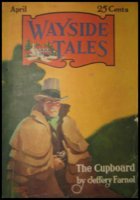
Pottering Pete and Barney McGlynn stood on the platform in front of Shorty’s Place and watched the train from the North, as, with a final puff and snort, it stopped at the little station.
“Mornin’, Mr. Patton,” called out the grimy engineer, as he swung from the cab, oil-can in hand.
“Mornin’, Billy,” Pete drawled; “how’s tricks up th’ road?”
“Quiet, quiet,” Billy grunted, punctuating his remarks with squirts of the oil; “though they was havin’ a little excitement up at Peterson’s as we come through. Hoss thief.”
“Hang ’im?” Pete asked, carelessly, as he watched the passengers filing into the dingy lunch-room.
“Nope; they’ll fix that when they git him back to Moccasin Camp. That’s where he stole th’ hoss.”
“Plenty o’ trees on Peterson’s ranch,” observed Mr. Patton, dryly. “Procrastynashun is th’ thief of time.”
“Nervy cuss, he was,” Billy continued, straightening up and surveying his engine critically. “Winged one of th’ Moccasin boys jest as they grabbed him, gittin’ onto th’ train. Joe Burrows they said his name was. New comer in th’ camp.”
Pottering Pete’s drooping shoulders squared with a jerk.
“What’s that?” he asked. “Say that name ag’in, Billy.”
“Joe Burrows,” repeated the engineer. “They caught him dead to rights, too.”
Mr. Patton seized old Barney by the arm.
“Barney,” he whispered, excitedly, “hike up to th' mine, hot foot, an’ round up four of th’ boys — boys that kin shoot — an’ see that they’re heeled fer bizness.”
“What fool scheme ye up to now?” Barney growled.
“Don’t ask no questions,” said Mr. Patton, gruffly. “Have ’em here in an hour. I’m goin’ to wire to headquarters fer a speshul, an’ to ol’ Peterson to have six good hosses waitin’ at his ranch. I’m fer law an’ order, right now, Barney. Git a move on ye.”
At one o’clock the special pulled in to receive six armed and stalwart passengers, five of whom wore mystified expressions on their rough faces. At two o’clock six horsemen galloped away from old Peterson’s ranch.
“They’ve got a good start on us,” muttered Mr. Patton to Barney, who galloped at his side, “but their hosses is tired an' they’ll take it easy.”
“Looky here, Pete,” Barney growled; “I reckon ye know what’s up, but I’d like to be took in as pardner in th’ informashun.”
“Told ye, Barney, that we’re goin’ into th’ law an’ order bizness goin’ to see that the law’s enforced ’cordin’ to th’ statutes.”
“Ain’t goin’ to try to take that hoss thief frum them Moccasin boys, air ve, Pete?” asked the old man, anxiously.
“Ain’t goin’ to jest try. Goin’ to do it!”
Barney emitted an exclamation of disgust, and pulled on the reins, only to be jerked almost from his saddle as his horse leaped forward in frightened obedience to Mr. Patton’s persuasive spur.
"Own up — ye’re afeared, Barney, an’ ye kin go home,” said Pete, contemptuously.
"But, Pete,” the old man protested, "th’ feller stole th’ hoss. We hain’t got no bizness to butt in. An’ them Moccasin boys’ll fight.”
"So’ll we!’ answered Pete, savagely-
Barney stared amazedly into the stern face and fiery eyes of the man whose listless, lazy ways had won for him the sobriquet of Pottering Pete.
"It’s th’ duty of ev’ry off’cer to enforce th’ law, Barney,” Pete continued, in the old drawling tone. “An’ I’m a offcer — speshul const’ble — with a warrant fer Joseph Burrows, grand larc’ny. Fixed it with Squire Dibbs, afore we left.”
Barney groaned, and relapsed into silence, listening to the sixteen galloping hoofs behind him as they beat in regular rhythm upon the tortuous trail. From the darkening recesses of the mountains at their right the night-owls hooted weirdly. The mournful howls of prowling coyotes floated across the valley at their left. Dim in the gathering twilight, the trail ahead of them rose and fell, sinuously, among projecting spurs. As they labored up a steep ascent, Pottering Pete suddenly threw out a long arm, in warning to those behind. A faint note of laughter came from the farther side of the spur.
“They’re jest ahead,” Pete announced, as the others gathered around him. “Stay where ye kin see me, an’ don’t come till I strike th’ second match. Then come quick but don’t begin th’ shootin’.”
Half-way down the slope, Pete saw the dim forms of four horsemen turn and face him.
“Halt!” commanded a voice ahead.
Pete laughed noisily.
“’Fraid of Peter Patton?” he called out. “Put up yer guns, boys. I’m lookin’ fer company not fer trubble.”
“Oh, it’s you, is it, Mr. Patton?” said the man on the gray horse, as Pete trotted up. “Thought mebbe it was some of Joe’s friends if he's got any.”
Pete turned toward the man whose arms were bound behind him.
“Prisoner?” he asked.
The man on the gray horse nodded.
“Hoss thief,” he said, laconically. “He won’t be with us long.”
One of the other men laughed, and the eyes of the prisoner flashed toward him. Mr. Patton struck a match and held it near the captive’s face.
“Th’ image of ol’ Joe,” he muttered, as the charred stick fell from his fingers.
“Pardner,” he said, softly, to the man on the gray horse, “I reckon ye know that Peter Patton usually gits what he wants — an’ he wants this man.”
The man on the gray horse laughed a short, sneering laugh.
“Sorry to refuse you, Mr. Patton,” he said, “but we really can’t disappoint th’ toys at Moccasin Camp.”
He gave a silent signal, and his two companions rode nearer the prisoner. One of them carried his right arm in a rude sling.
“Two an’ a half to six,” chuckled Mr. Patton.
“You’re the last man, Patton,” continued the man on the gray horse, “that I’d think would interfere in this affair. Didn’t you help swing”
“I wasn’t an officer then,” Pete broke in. “I am, this trip. Speshul const’ble, sworn to enforce th’ law. Here’s my warrant. I’ll strike another match while ye read it.”
The three peered at the paper by the light of the flickering match.
“No use buckin’ th’ law; an’ th’ statutes, boys,” urged Mr. Patton.
“Ner my possy,” he added, suavely, as the five miners dashed down the hill.
The man on the gray horse ripped out an oath.
“What you goin’ to do with him, if we give him up, peaceable?” he asked, fingering the revolver at his belt.
“Th’ Squire’ll bind 'im over to Circuit Court, ’cordin' to th’ statutes,” answered Mr. Patton.
“What’s th’ use of all that tomfoolery?” the captive interrupted, sullenly. “I can’t give bond, an’ that dinky jail won’t stand five minutes before th’ Moccasin Camp gang.”
“Kain’t help it,” said Mr. Patton. “I’ve got to go ’cordin’ to law. When I land you in th’ coop I’m out o’ th’ game.”
The three Moccasin Camp men glanced at each other significantly.
“I guess you can take him, Mr. Patton,” said the man on the gray horse. “Mebbe we’ll see him later. You can leave the hoss at Peterson’s.”
“All right, pardner,” replied Pete, cheerily. “Now, Joseph, come a-jumpin’. You’ve give us trubble enuff already; don’t try enny tricks.”
It was midnight when seven men stepped from the special in front of Shorty’s Place.
“Hold her here,” Mr. Patton directed the engineer. “Ye’ll have a passenger in twenty minnits.”
Squire Dibbs, roused from his slumber, blinked sleepily over his docket as the posse gathered in the back room of the little shack.
“He pleads guilty, Squire,” Mr. Patton announced. “What’s th’ bond?”
“Considerin’ th’ shootin’ ez well ez th’ larc’ny, I’ve made it five hunderd, Mr. Patton,” replied the Squire, looking at Pete, uneasily.
“Cheap enuff; no time to change it, ennyhow. There’s my name; reckon it’s good, Squire?”
“This here court so considers it,” replied the Squire, pompously.
“Now, Joseph,’ said Pete, hastily, “th’ quicker ye jump that speshul th’ better fer yer health. At headquarters ye’ll take th’ next train south, an’ ye’ll not git off till ye hit El Paso. Yer transportashun’s arranged fer, an’ here’s a little roll, to give ye a start. Git!”
The late prisoner hesitated.
“I don’t understand all this,” he said, huskily. “Why should you, a stranger”
“Ye don’t need to understand it,” cried Mr. Patton, impatiently. “What ye need is to git a move on. That speshul won’t wait all night an’ Moccasin Camp’s a-comin’ this way on th’ jump.”
The man seized Mr. Patton’s hand, shook it heartily, then turned and sped toward the waiting car.
Pottering Pete put his elbows on the Squire’s table, rested his bearded chin on his hairy hands, and gazed dreamily into the darkness beyond the open door.
“Boys,” he said, softly, a queer intonation in his rough voice, “I’m a-lookin’ back fifteen year. I see Mr. Peter Patton snugglin’ among th’ rocks, under a blazin’ sun, with no water, mighty little ammunition, an’ a broken arm, listenin’ to th’ howls of a dozen dirty Apaches a-waitin’ to starve ’im out, er to plug ’im if he shows so much as th’ tip of his nose.
“Two miles up th’ ravine I sees ol’ Joe Burrows an’ little Speck Hillis, who’d come with me on that prospectin’ trip. They hears th’ racket. Duz they scoot fer safety? Not much! Ol’ Joe drunk half th’ time, an ornery always hoists Speck onto one of th’ mules, an’ starts him to th’ camp, twenty mile away, fer help. Then he packs sum water an’ ammunition on t’other mule, waits till night, an’ rushes through them ‘paches like a skeered steer through a cornfiel’. Connects with Mr. Patton, an’ helps ’im to stand them red pups off till th’ boys shows up next day. Otherwise, Mr. Patton would now be twangin’ a golden harp. ’Bout a year after that ol’ Joe gits his in a little argyment down at Striker’s Point.
“Pete.” sez he, as he hit th’ trail fer th’ New Jerusalem, “I’ve got a kid somwhere back in th’ states named fer me, an’ takes after me, though I hope he won’t turn out as ornery. Ef ye ever git a chance to give th’ kid a lift ye’ll do it, won’t ye, Pete?”
“I sed I wouldan’ I have. I reckon th’ account’s square, now. That’s why I wuz fer law an’ order — fer a limited time only. Let’s go home, Barney.”
"Good writing is rewriting." —Truman Capote

Pottering Pete tilted his chair back against the sunny side of the little office building, stretched out his long, lank legs, and cast one more drowsy glance over the landscape before sinking into the arms of Morpheus.
Sleepily his gaze wandered over the noisy buildings of the Lucky Tumble mine, the numerous heaps of ore and refuse, the groups of busy laborers, and slowly swept down the slope toward the little town below. Then the front legs of the chair thumped heavily upon the rocky soil, Mr. Patton’s eyes and mouth flew open, and his bearded face took on an expression of puzzled curiosity. He shifted the quid of Miner’s Twist from his left cheek to his right, turned his head toward the office window, and called, in guarded tones:
“Jimmy! Hey, Jimmy! What’s a comin’ up th’ trail?”
The red-shirted clerk appeared in the doorway, thrust a pen behind his ear, and scrutinized the approaching object.
“Search me!” he finally responded.
“What’s them things on th’ shins, Jimmy?”
The red-shirted clerk looked again. “Bloomers!” he ejaculated.
“Mebbe it’s th’ Sultan of Turkey, comin’ to s’licit a donashun fer the Armenyuns,” Mr. Patton suggested.
Jimmy shook his head.
“He wouldn’t be wearin’ a skirt over ’em. It’s a woman.”
Mr. Patton started from his chair. “Shorly not, Jimmy,” he said, apprehensively. “Look at that cap, an’ coat, an’ necktie, an’ short hair.”
“It’s a woman,” insisted Jimmy, confidently. “There’s some runnin’ at large. Seen one in Washington named Walker. Gosh! See them eyes glitter through th’ specs.”
“What d’ye reckon she could want of me, Jimmy?” Mr. Patton asked, tremulously.
“Dunno. Matrimony mebbe — hold up there! What you goin’ to do?”
The red-shirted clerk had leaped forward and seized Mr. Patton’s wrist, for that gentleman had jerked the revolver from his belt, and his long forefinger was groping nervously for the trigger.
“Jest a couple o’ shots, Jimmy over ‘er head to skeer”
“Scare! That brand don’t scare any more’n a rhinoceros. You’re in for it, Mr. Patton!”
“An’ there ain’t no law”
“Good afternoon, Mr. Patton,” the strident voice of the approaching personage interrupted. “No, thank you, young man; I prefer to stand. Can talk better. No doubt you have heard of me, Mr. Patton. I am Miss Ripper — Miss Angelina Ripper better known as A. Ripper, Apostle of Reform. Sent by our noble Society into these Western wilds upon a great and glorious mission, Mr. Patton; a mission that appeals to every generous impulse in the breast of man.”
Miss Ripper paused, filled her ample lungs with fresh mountain air, and glared at Mr. Patton, who retreated one step and murmured weakly, “Yes, ma’am.”
“I find a great work awaiting me in your little town,” pursued the Apostle. “A noble work, in which you will join me — in which you will join me, Mr. Patton.”
Again Mr. Patton retreated one step, and murmured: “Yes, ma’am.”
“Ah, I knew you would; I could not err in my estimate of your manly nature. We will begin at once, Mr. Patton. Hand in hand, shoulder to shoulder, we will”
“What’s th’ graft this time?” Mr. Patton broke in, desperately.
“Sir?”
“What’s yer game — scheme — mission or whatever ye call it?”
“My mission? Listen to me. Look me squarely in the eye, Mr. Patton, and heed my words. Down there, in that little town, two hundred slaves of the tyrant Man lie bound in chains, denied the emancipating power of the ballot! More! In that same town the Demon of Rum rears his hateful head and stalks abroad, withering with baleful breath”
“Looky here, ma’am,” exclaimed Pottering Pete, “I’m sorry to spile that speech, but ye’ll have to deal me a new hand; ye’ll have to talk English. What d’ye perpose to do to said town?”
The Apostle of Reform thrust out a long arm, terminating in a quivering forefinger, and struck a tragic pose.
“I propose, sir and I defy any human being to impede the Progress of Reform — I propose to assemble those slaves and reveal to them those rights given by God and denied by Man. I propose, also, to drive the Demon of Rum from his lair. And generations yet unborn will rise up and call me blessed!”
“Sum genyrashuns as is born’ll rise up, mighty suddent, an’ call ye sumthin’ else ef ye go to kickin’ up a rumpus,” Mr. Patton growled.
“Don’t try to intimidate me, sir! I know too well how loyally my sex will flock to my support when they have heard my battle-cry. You do not know the power of aroused womanhood. Mightier, far mightier, sir, than the hand that wields the sword is the hand that rocks the cradle.”
“Ye’d a darn sight better invest in th’ cradle-rockin’ bizness yerself, then,” observed Mr. Patton.
“And become the slave of tyrant Man ? Never”
“Oh, I kin see ye have good reasons,” interrupted Mr. Patton, looking the Apostle over. “An’ now, ma’am, let me give ye a little tip. Ye’ve dropped off at th’ wrong station. Th’ boys here is well paid, an’ the women is contented an’ happy, fer we don’t keep no man who don’t treat his fambly right. An’ this ain’t no stampin’ ground fer th’ Demon Rum. There ain’t be’n no drunks here for over two year. Th’ boys takes their little dram, but they has to keep sober an’ peaceful, er git. There ain’t no grand an’ glorious misshun fer ye here, ma’am. So ye’d better move on an’ not start nothin’sumthin’ might happen to hurt yer feelin’s.”
Miss Ripper laughed, scornfully and sarcastically.
“The stale, trite arguments of the blind and besotted! Hear me, benighted man! This very evening I begin my work, and woe to him who seeks to stay the Progress of Reform! Woe unto”
“Don’t whoa me, ma’am,” growled Pottering Pete, dodging the quivering forefinger. “I ain’t no cayuse, Miss Nipper”
“Ripper, sir!”
“Yes, ma’am, Ripper. What I wuz goin’ to say, Miss Flipper”
“Sir! Ripper!”
“Shore! I wuz jest a goin’ to remark, Miss Dipper, thet it’s dangerous to work yerself into sich a latherin’ sweat. Th’ temperachure might, drap suddently, an’ give ye a cold that would strike in.”
“You refuse to assist me, Mr. Patton?”
“I shorely do. Ye’re playin’ a lone hand this round. Count me out.”
“Very well, sir! You will see what a woman, armed in the cause of right, can accomplish single-handed. You will bitterly regret the glorious opportunity you have cast away. Mark my words!”
The Apostle of Reform stalked majestically down the slope. Mr. Patton heaved a sigh of relief, and dried his perspiring face with his shirt sleeve.
“Sence I stumbled onto th’ Lucky Tumble mine,” he asserted, watching the retreating figure of Miss Ripper, “I’ve be'n pestered by all kinds o’ people with all kinds o’ schemes, but th’ ’postle shorely duz hold th’ gavel. She’s a wantin’ to be bought off, Jimmy. Ef she riles up them female slaves down yander there’s a goin’ to be trubbel.”
The red-shirted clerk grinned and nodded, concurrently, and returned to his desk, leaving Mr. Patton in deep meditation.
“Jimmy,” Mr. Patton called, after awhile, “I kind o’ thought I heerd a yell. Jest take a peep out o’ th’ south winder.”
“Looks like sumthin’ had erupted down at Shorty’s Place, Mr. Patton,” Jimmy reported.
Pottering Pete arose slowly and slouched around the office building to the window that commanded a view of the little town. Looking downward he discerned a group of agitated children gathered at a safe distance from Shorty’s front door. An instant later Shorty himself emerged tumultuously, holding his head with both hands, while the Apostle of Reform, brandishing an ax, appeared in the doorway.
“The reform movement has begun,” observed Mr. Patton. “Th’ ’Postle is Nationizin’ Shorty’s Place, fer a starter.”
The red-shirted clerk snorted indignantly. “If it was only a man!” he snarled.
Pottering Pete scratched his bearded chin.
“But it’s a woman, Jimmy,” he said, softly. “I reckolect ol’ Doc Phipps useta say thet like cured like. Ain’t Mike Hannigan’s shack th’ third frum th’ big boulder, down there, Jimmy?”
“Fourth.”
“I don’t like to impede th’ progress uv reform,” Mr. Patton continued, “but I kind o’ reckon it’s up to Mike’s wife to take a fall out o’ th’ Senorita Bloomerino. I’m a goin’ now to persuade her to organize a box party of them female slaves to attend th’ ’postle’s show, Jimmy. I’ll be back in an hour.”
When he returned, Mr. Patton seemed full of suppressed elation.
“Th’ ’postle’s meetin’s goin’ to begin in a few minnits, Jimmy,” he announced. “Th’ slaves is a gatherin’ now, right down there in th’ flat, to hear th’ ’mancipashun procklymashun. We’ll set here in th’ winder an’ watch th’ proceeding.”
“And Mrs. Hannigan’s box party“
“Will attend, Jimmy. It’s a gatherin’ now, back uv Mike’s shack. 'Twould shock ye to hear Mrs. Hannigan’s opinyun uv th’ ’postle, Jimmy. Not a drap uv beer did th’ Hannigan’s have fer supper, ’count o’ Shorty’s Place bein’ wrecked. ’Twas lucky fer th’ ’postle I got to Hannigan’s jest as I did. Mrs. Hannigan wuz jest a startin’ to hurl th’ curse uv Rome an’ a few bricks at th’ ’postle’s head.”
“They mustn’t hurt the Apostle,” said Jimmy, in alarm. “I ain’t got no special love for her, but she’s a —“
“No danger, Jimmy,” said Mr. Patton. “Jest a little escort uv slaves down to th’ deep hole in th’ crick, an’ then to the seven-thirty train — which n’ ‘postle’ll probably be anxious to git away on.”
The red-shirted clerk grinned approvingly.
“There’s th’ ‘postle now. Jimmy,” exclaimed Mr. Patton. “A climbing up th’ big boulder to begin her revylashun to th’ slaves.”
Dusk had settled over mountains and gulch, but the brilliancy of a full moon enabled the two watchers almost to distinguish the faces of the little assemblage of roughly clad women that surrounded Miss Ripper as her first shrill tones floated up the slope.
Soon another voice chimed in — the harsh and powerful voice of a towering giantess, who shook her bare and brawny arms above her auburn head as she shouted:
“It’s a brazen hussy ye air, a cavoortin’ around in thim pants, an’ a causin’ thrubble in th’ town. Out wid ye, a callin’ dacint wimmin slaves — as though lookin’ afther her ould mon that wurrks fer her, an’ th’ little childer that cries fer her, wasn’t all th’ roights anny dacint woman wants. Kim down off there!
The bare and brawny arms had reached up and plucked the astounded Apostle from her perch. Quietly and quickly, in regular order, the little procession disappeared around a bend in the gulch.
“Can’t we slip down and see th’ baptism?" asked the red-shirted clerk, eagerly.
Mr. Patton shook his head.
“It’s fer female slaves only, Jimmy. How many dips d’ye reckon th’ postle’ll stand afore she agrees to be good?”
“Down an' out in three rounds,” Jimmy ventured. "Her jaw swings too loose for a stayer.''
"Yer a good guesser, Jimmy,” remarked Pottering Pete, after several momenta of expectant silence. "They’re a cornin’ backin plenty o’ time fer that seven-thirty. Observe th’ Senorita Bloomerino, Jimmy; she’s had a change uv raiment, ez well ez of convickshuns. She’s a wear-in’ one uv Mrs. Hannigan's wrappers — an’ wearin’ it with th’ grace uv a Dutchus at a soshul funkshun. There’s nuthin’ like th’ water-cure, Jimmy‘specshully ef th’ water’s cold."
"Pay ye to start a sanitarium down there, Mr. Patton,” suggested the red-shirted clerk.
"What kind uv a flag’s that Mrs. Hannigan’s a carryin’ on that pole?’’ asked Pete, craning his long neck. "’Tain’t th’ flag uv ol’ Erin, is it, Jimmy?”
The red-shirted clerk shaded his eyes with his hand, and peered sharply downward at the procession as it moved up the only street of the town, toward the railroad station.
"S’help me Dr. Mary Walker!" he ejaculated. "It’s bloomers!”
Pottering Pete slid from the window to the ground, took a fresh bite of Miner’s Twist, and stroked his bearded chin caressingly.
“Th’ reform movement is busted,” he said, mildly, “an’ th’ victors has th’ spoils. Bloomers! two uv a kind, an’ no keerds to fill with, sence th’ ’postle hez quit th’ game. Jimmy, I move we go down to Shorty’s Place an’ see ef we can’t find enuff fragments of th’ Demon uv Rum to celybrate th’ ockashun uv our impedin’ th’ Progress uv Reform.”
"A writer is someone for whom writing is more difficult than it is for other people." —Thomas Mann

The shadows of the mountains, heralds of approaching night, crept slowly eastward across the undulating plain toward the little, lonely house.
From the recesses of the darkening pass the night owls hooted derisive answers to the coyote’s calls. Outside the solitary dwelling, a little boy paused in his play to listen, wide-eyed, to the clamorous concert, while his childish fancies peopled peak and gorge with hideous monsters, voracious enforcers of maternal edicts.
Near the brick-red barn a brindled cow contentedly chewed the cud while a sun-bonneted woman milked her with rapid fingers. A squeaking windmill, whose slow-moving sails blazoned the enterprise of an Eastern firm, reluctantly forced sparkling treasure from subterranean depths in gurgling and intermittent spurts.
Silently, warily, with ready gun, and every sense alert, a man emerged from out the deepest shadows and approached the boy. He was dusty, tattered, and unkempt. A sullen, desperate courage glittered in the restless eyes. Drawn across one bronzed and bony cheek, a fresh and livid scar marred and distorted the once handsome face.
“Folks at home, sonny?” he inquired.
“Mam is. Pap ain’t. He’s out huntin’ Jack Bayliss.”
“Hunting Jack Bayliss, eh? And what’s your pap’s name, sonny?”
“Jim Ross. He’s th’ sheriff, pap is,” the boy answered proudly.
The man with the scar laughed softly. Then he threw his gun over his left arm, strode round the little house, and met the woman near the door. She started back, and her bucket of foaming milk fell to the ground. The little lad, who had run through the house, clung to her skirts. Her eyes flashed toward the revolver hanging in its holster just within the open door.
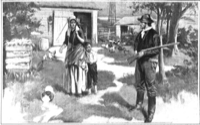
The man with the scar, following her glance, stepped through the door and buckled the weapon about his waist; then he removed his hat and bowed.
“Sorry to intrude, Mrs. Sheriff, but I’m hungry, and —”
“Not a bite do you git in this house. You’d better clear out, and go quick. Jim’s due here enny minnit, an’ ef he corners you again you’ll git more’n a scar!”
“Madam, your prevarication is really painful. You know that my dear friend, the sheriff, is far distant, seeking one Bayliss, who doesn’t happen to be in the same vicinity. Come, Mrs. Ross, I don’t wish to be rude, but my time is valuable. If you’ll not oblige me I must help myself and a man makes such a litter about the kitchen, you know.”
The woman dropped into a chair and gazed up at the man defiantly.
“Not a step do I take fer th’ likes of you,” she exclaimed.
“Thank you. I am pleased to experience the proverbial hospitality of the people of the plains. Fortunately, this cupboard seems to be plentifully stocked.”
The man ate hastily, but heartily, while the woman and child watched him silently. Finally he arose.
“Now, Mrs. Sheriff,” he said jocularly. “I will have to borrow a horse — your husband carelessly shot mine, you know.”
“Hain’t a horse on the place,” said the woman exultantly. “Jim took ’em both. Ef he sees you he’ll be glad to give you a lift, though.”
“No doubt a high and a long one. Good-day, Mrs. Sheriff. Your cordiality will not be forgotten. Your cheering words spur me to fresh effort along my chosen line of endeavor. I sincerely hope this little incident may not give you nervous prostration. Give my regards to Jim when he returns. Sorry he wasn’t in!”
On the threshold he bowed again, and strode away. The woman slammed and bolted the door behind him.
Peering cautiously into the gloomy night, the man with the scar halted, half crouched. The keen and restless eyes had caught the reflection of a strange red glow upon the eastern sky. Gazing wonderingly for a moment, he slung the gun across his sinewy back and nimbly ascended the squeaking windmill. From its top he watched the red glare deepen and expand. At the edge of the horizon flames danced and flickered, darting yellow tongues athwart the cloudy sky. Dark, swiftly-moving forms, silhouetted against the fiery glow, appeared and vanished intermittently. Echoing up to him came strange, faint cries, terribly significant to ears that knew their meaning.
The man with the scar descended swiftly, rapped at the bolted door, and called to the woman.
“I thought you was gone fer good,” she answered angrily. “You can’t come in.”
“Mrs. Ross, a war party of Apaches crossed the line last week, to the south of us. Some or all of them are only a few miles to the east, murdering and burning. The cavalry must have turned them this way. They are headed for the pass yonder, and this ranch is directly in their path.”
“It won’t work, Jack Bayliss. There ain’t been no Indians this far north fer years. Ef you wasn’t lyin’ you’d be hustlin’ away to save your own scalp.”
The man with the scar hesitated and glanced toward the mountains, where shelter and safety awaited him. Then he stepped back, hurled himself against the door, and crashed into the room. The woman faced him with an uplifted axe.
The man rushed, parried a desperate blow, and wrenched the weapon from the woman’s hands. He seized the boy and sprang out over the wrecked door. The mother followed fiercely. Out on the open plain the man halted, and, as the woman came up, released the screaming child.
“Look and listen!” he cried.
The fiery tongues, seen now from where they stood, leaped higher up the sky. The fiendish yells swept faintly down the freshening wind, mingling with a woman’s shriek of mortal agony. The woman saw, heard and understood.
“My God!” she moaned, hugging the boy to her breast. “And Jim’s out there somewhere. It’s all my fault! Jim wanted to move to town when he was elected, an’ I wouldn’t.”
“Don’t worry about Jim,” said the man with the scar. “He’ll take care of himself. Come quick! We must reach the mountains before they see us. We can’t stand them off here — they’d roast us out; and we daren’t take to the prairie — the moon will soon be up. Give me the boy.” Half-way to the mountains they heard a dull crescendo of galloping hoofs.
“They’re coming fast,” muttered the man with the scar, seizing the panting woman’s hand. “Don’t hold so tight, sonny; you’re chokin’ me.”
The hoof-beats ceased. A fresh light flickered overhead, faint at first, then stronger, brighter, brilliant, illuminating the mountainsides, causing fantastic shadows to dance and dart across the rocky crags.
“They’ve fired the ranch,” panted the man, as they halted to gather breath for the climb. “They’ll see us now.”
A chorus of exultant yells rang out; the sound of galloping hoofs started afresh and swiftly swelled.
“They’ve seen us!” exclaimed the man with the scar. “Hurry, now! Up there, to the left — around that boulder, and then back under the ledge. Good, we’re sheltered from the light! Here, take the boy and lie down flat!”
He handed her the revolver. “Don’t shoot unless they get in — and then only three times. Save two for the boy and yourself. Do you understand?”
The woman gripped the weapon, nodded, and shuddered.
Unslinging his Winchester, the man with the scar crouched behind the rocks at the mouth of the cavity. The light of battle shone in the restless eyes; the broad, strong jaw was rigid. He looked down on the approaching foe and calmly counted them — ten, half naked, hideously bedaubed. Ten for but a moment, for there were nine after the Winchester spoke!
Swerving, separating right and left, the nine vanished into the darkness that flanked the glare on either side. The hoof-beats ceased.
With weapon poised, the man with the scar crouched low. His eyes flashed swiftly from right to left, from left to right, his ears were strained to catch the slightest sound. A rattle of rocks to the right — a flitting of a crouching, dusky form — a shot — a wailing yell — a crash! The man with the scar pumped up a fresh cartridge as he quickly shifted his position.
A flash and report to the left — the shrill song of a bullet glancing from the rock he had just left.
“Too slow, my friend!” he muttered.
The moments passed. The flames from the ranch died down. The darkness deepened.
Two forms sprang forward from the rocks below, and dropped an instant before the Winchester flashed. An answering flash came from the left; a bullet cut its way through the left forearm of the man with the scar and sped on singing.
“One on me,” laughed the man with the scar, setting his teeth.
The woman tore a strip from her apron, crawled forward, and bound the bleeding arm. Then there came a volley from front, right, and left. The man with the scar swayed on his knees and slowly sank upon his hands, the blood streaming over his face. The woman, sobbing hysterically, raised the revolver and turned toward the boy.
The pounding of rushing horses rose from the eastward plain. From out the night a bugle-call rang clear, mingled with shouts. The man with the scar struggled to his knees, essayed to cheer, clutched at the flinty rocks, and pitched forward, motionless, upon his face.
A scamper of ponies, devil-ridden, fleeing up the pass — the thunder of pursuing cavalry — a man’s voice calling:
“Mary, Mary, for God’s sake, are you up there?”
“Jim! Oh, Jim! We’re safe, thank God — and Jack Bayliss!”
Late in the night the man with the scar stirred, opened his eyes, and sat up. He lifted his hand to his bandaged head and looked about him. The woman and the little boy were sleeping. The sheriff sat at his feet, a gun across his knees. The man with the scar smiled grimly.
“You come to quicker ’n I expected,” the sheriff remarked. “You’ll be good as new by mornin’.”
“You were winner anyhow,” said the man with the scar pleasantly. “Reward’s the same, you know, dead or alive.”
The sheriff glanced at the woman and child, then looked out over the moon-lit prairie toward the smoking ruins.
“I jest had a little nap, bein’ purty well tuckered out,” he remarked, “an’ I dreamt the blamedest, queerest dream. Want to tell it to ye before we start. Dreamt you was dead, or we thought ye was, an’ while Mary an’ the boy was sleepin’ I went down to kind o' invoice what was left on the ranch. While I was nosin’ ’round down there, demmed ef you didn’t rise from the tomb, grab your gun an’ belt there, an’ sneak down an’ jump on one of my two hosses down yonder — in that clump of chaparral. It was lucky I’d took most of th’ money off you, so as to ease up th’ bank. Dreamt ye dug out straight fer the Blue Pass, the only one that hain’t guarded jest now, an’ was over the line before we struck your trail. Terrible unlucky fer you that dreams allers goes by contraries!”
There was something in the tone that caused the man with the scar to look up quizzically.
The sheriff arose, yawned, stretched his arms, and clambered down toward the smoldering house.
The man with the scar struggled to his feet, seized gun and belt, and vanished in the direction of the clump of chaparral.
"It is a curious thing, the death of a loved one. We all know that our time in this world is limited, and that eventually all of us will end up underneath some sheet, never to wake up." —S. King
The quavering call of the quail reverberated through the darkening forest and across the clearing around the rude cabin where the reluctant corn, coaxed by the smiles of summer, cast glints of green athwart the sandy soil.
The little girl looked up from the treasure of wildflowers that she had gathered, clapped her hands in glee, and laughed merrily.
“Listen, papa! They’re singin’ their babies to sleep.”
The man, tall, gaunt, long-bearded, paused with his hoe in the air, turned seamed and kindly face to smile upon the child, and resumed his task.
“Singin’ their babies to sleep!” he chuckled, shaking his head. “What a notion!”
A horse and rider, sweaty and mud-bespattered, emerged from the forest and halted at the edge of the clearing. The rider was sturdy of form and grim of visage. From the cartridge belt about his waist, two holsters swung heavily, buckled flaps protecting the hidden weapons from mud and moisture.
“Evenin’ pardner,” he called out. “How far to Mound City?”
The tall man struck the hoe’s handle deep into the damp soil and approached the horseman with long and leisurely strides.
“’ Bout ten mile, straightaway,” he answered slowly. “Nearer fifteen as ye’ll have to go. Ye’re mighty nigh five mile off the road.”
“Tried fer a short cut and got lost,” explained the other, wiping the mud from his face. “Follered the call of the quail fer luck and heered the little gal laugh, else I wouldn’t have found ye in this out-of-the-way place.”
“Better light off and take pot luck with us,” said the tall man cordially. “Supper’s’ most ready. The moon’ll be above the trees in a couple of hours, and I’ll show ye the way back to the road. It’s a bad trail in the dark.”
The horseman slipped from the saddle and leaned wearily against the stump of a fallen tree.
“Don’t care if I do,” he said. “I’ve come ’bout fifty mile through the mud sence momin’, and the hoss needs rest and a bite of fodder. I’ve got the money to pay.”
“Keep yer money, Stranger. Glad to have ye. Mighty seldom we see anybody out here.”
“’ Tain’t very public,” observed the traveler, smiling. “Been here long?”
“Seven year this spring.”
“Own the place?”
“Only owe a hunderd now,” replied the settler proudly, seating himself upon the fallen tree. “But it’s took a power of hard work and scrimpin’.”
The little girl shyly approached the Stranger and gazed up into his face with the curiosity of childhood. The grim visage softened.
“Only one ye got?” he asked.
“Only one now. There was a little feller.”
The child turned her face upward toward the twilight stars.
“He’s up yonder now,” she murmured, the little mouth quivering.
The eyes of the two men met. The Stranger put his arm about the child and drew her closer.
“I’ve got one up there, too,” he said softly. “The only one we had, a little gal.”
There was a moment’s silence; then the tall man asked: “Have to make Mound City to-night?”
“Yes. Want to git back to Montana soon as I kin.”
“Montana! Ye didn’t come from that direction!”
“No, had a little bizness in Pierre fust – with the Guvner.”
The tall man slipped forward on the tree and drew his long limbs under him, like a panther about to spring.
“Montana, eh? What county?”
“Teton.”
“Teton!” muttered the other, dropping his head. Then he looked up and remarked: “Ye go purty well-heeled, even for a man from Montana.”
“Yes. Have to in my bizness.”
There was a long silence; then the tall man said quietly:
“Lottie, run in and tell mamma we’ll have company fer supper – a man from Montana Teton County. He’s goin’ on to Mound City to-night.”
“’ Quainted in Mound City?” asked the man from Montana.
“Some. Don’t go often.”
“Know a feller named Hungerford – Bill Hungerford?”
The questioner was still gazing after the little girl and did not see the glare, like that of an enraged rattlesnake, that flashed from the tall man’s steel-gray eyes.
“Hungerford? Yes, I reckon I know him.”
“Friend of yourn?”
“Wust enemy!”
The man from Montana regarded the tall man long and earnestly – then he asked carelessly:
“Like to git even and make that hunderd dollars?”
“How?”
The man from Montana glanced around cautiously and leaned forward, his hands on the tall man’s knees.
“Looky here, pardner, I believe ye’re all right. I’m the deputy sheriff of Teton County, and there’s a warrant and requisition for Bill Hungerford in my pocket only his name’s Frayne, Phil Frayne. What’s the matter?”
“Nothin’. Thought I heered a rattler. Go on.”
“Well, he’s been hidin’ out in Mound City for eight year, goin’ by the name of Hungerford, and I’ve jest located him. I never seen him, and I need a little help. If I call on the sheriff at Mound City, I have to split the reward. You come along and lend a hand, and ye git that hunderd dollars.”
“What’s Bill been doin’?”
“Shot a man named Miller. Reckon he had to save his own hide, but Miller was a sport with a pull, and the gang’ll swear against Frayne. That ain’t my lookout – I’m after that reward. It’s easy money fer you. What d’ye say?”
“Stranger, it’s resky. He’s a desperate man and as quick with a gun as I am.”
“And how quick air you?” asked the man from Montana banteringly.
Reaching to his guest’s nearest holster, the tall man unbuckled the flap and drew forth a revolver, gold-mounted, with curiously carved and modeled stock. He sprang from his seat with an exclamation of surprise. The man from Montana grinned proudly.
“Ain’t she a beauty? Try her.”
A screaming blue-jay flew swiftly overhead. There was a quick movement of the long arm, a flash, a report, and the bird’s shattered body whirled to the earth. The man from Montana smothered an ejaculation of wonder. The little girl called from the cabin door:
“What you shoot for, papa?”
“To skeer a hawk,” the tall man called back to her.
“A beauty, sure,” he concurred, caressing the weapon with his left hand. “Is t’other one like it?”
“No. I give the mate away.”
“What fer?”
The man from Montana reached down, plucked a blade of grass, and chewed it meditatively.
“‘T’was this way. I’d busted up a gang of train robbers, killed some, and some got away – that’s why the company give me the guns. What was left of the gang got together and trapped me one night in a shanty ten mile out of Choteau – same night Miller was killed. They made a rush and broke my right arm with a ball.’ Twould have been all over in another minute when a feller comes gallopin’ up the trail and opens fire — never seen sech shootin’. Three went down to stay, and the other two broke and run, one of ’em limpin’. The feller had his coat collar up, and cap pulled down. I’d run from the shanty to some rocks, and he couldn’t see me.
“Stay right where ye air,” he yells. “I don’t know ye and don’t want to. No thanks comin’. I’m allers fer, the underdog,’ says he. “All I ask’s another gun and some cartridges,” he says.
“I’d dropped one gun when my arm was hit. The feller got off his hoss and picked it up. I didn’t kick – he could have had both fer the askin’. Then he took a belt of cartridges from one of my dead friends and got on his hoss, and galloped off. That’s how’ it was.”
The tall man balanced the weapon admiringly in his tanned right hand.
“Now, supposin’ jest supposin’,” he said slowly, “that ye had a warrant fer that man fer well, say fer murder, and there was a reward say a thousand dollars, and ye was the only man as knowed where he was, would ye take him?”
The man from Montana shifted around the stump uneasily.
“That’s a hard one, pardner. It would be a dirty trick, wouldn’t it? But a thousand dollars don’t grow on every bush, and I need ’em bad.”
“And, in course, Miller’s friends know ye’ve found Bill?” ventured the tall man.
“Not much! I’m too smooth fer that. Nobody knows but me. Worked this up myself. The rest give it up long ago. Even the Guvner’s signed without readin’. It’s an every-day thing with them.”
The man from Montana was smiling shrewdly and watching the hungry horse crop the grass. The muzzle of the weapon in the hand of the tall man was swinging slowly toward him; the tanned forefinger was tightening on the trigger. The slight form of a woman appeared at the door of the cabin.
“Supper’s ready,” she called.
At sight of her, the steel-gray eyes softened, the deadly muzzle dropped, the tanned forefinger relaxed.
“Take yer gun, Stranger, and lead the hoss to the shed. I’ll be with ye in a minute.”
The man from Montana watched the other striding toward the cabin and muttered :
“Now, how’d he know ’twas a thousand?”
With anxious eyes filled with the light of love, the woman watched the tall man as he entered the cabin and took a belt with its holster from a peg in the wall.
“What ye goin’ to do?” she asked, laying a trembling hand on his arm.
The tall man buckled the belt around his waist.
“That depends. Ef he ever gits to the sheriff, the jig’s up; but the trail’s mighty slippery ’round the clay bluff, and the river’s high.”
“Oh, Phil, don’t! It’s bad enough now, and –”
The man from Montana stood in the door. The child ran to him, laughing, holding out her hands. The Stranger came into the room, stooped down, raised her on his left arm, and whispered something in her ear.
“Why, my name’s Lottie – Lottie Hungerford,” she laughed.
The revolver leaped from the tall man’s holster, but the woman caught his arm, and he looked down the muzzle of the weapon in the hand of the Montana man.
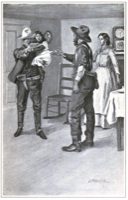
“Hands up,” the deputy growled, “and give me that gun butt fore-most – keep yer fingers outside the guard! Ye played me purty smooth, but it’s –” His eyes fell upon the extended weapon, carved and gold-mounted, and he started back.
“You’re the man I gave my other gun to!” he cried.
The tall man nodded. The woman held out her hands appealingly. The child threw her arms around the Stranger’s neck.
“Please don’t hurt my papa!” she sobbed.
The threatening weapon trembled, drooped, and dropped into its holster. The man from Montana held out his hand.
“The gal wins,” he said huskily; “the gal and the gun. But it’s lucky for you that I follered the call of the quail.”
"Writers live twice." —Natalie Goldberg
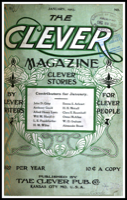
Casey, the itinerant, had been on the payroll of The Hillville Press six months, and was growing restless. He knew that he was violating his established rule and custom, and that he should have moved on long before.
Peculiar circumstances were making Casey’s sojourn in Hillville unusually pleasant. The county was in the throes of a close and bitter political contest over the election of a representative to the state legislature. There were other officers to elect, but the real fight was over the representative.
The incoming legislature would elect a United States Senator. The situation, state and national, was such that one vote in the legislative assembly might decide the political brand of the new Senator, whose vote in the United States Senate might determine the course of government.
The political telescopes, anxiously sweeping the field from Maine to California, lingered upon Hillville. Hillville seemed to be the pivotal point of the vast battle. At no other place was the sentiment so fluctuating and the result so uncertain. Speakers and specie were hurried to Hillville; it was the specie that made Casey’s sojourn pleasant and prolonged.
With the opposing parties a vote was a vote, and to Casey, the wanderer, a dollar was a dollar and a drink was a drink. One day, the blandishments of the Wilsonites appealed to him irresistibly, the next day the Hortonites claimed him as their own. On the Democratic poll-book of his precinct the upright mark opposite the name of Coriolanus Casey appeared in the column marked “D”; in the Republican poll-book a corpulent “R” headed the column in which the mark designated Casey's faith. Meanwhile, through all the orating and parading and horn-tooting, Casey flirted with Fate and waxed fat and wanted not. Through the night he set up dry political articles in the back room of the Press building; during the day, in other back rooms, he participated receptively in the setting up of other articles, political, but not dry.
The Hillville Press was the county organ of the party, and its columns blazed with denunciations of Wilson and bloomed with laudations of Horton. Its editor, a grim and uncompromising veteran of a hundred political fights, had satisfactorily sounded Casey, and when he discovered, upon the evening preceding the election, that Casey, for reasons sufficient unto himself, had positively promised to cast his sovereign vote for Wilson, a miniature cyclone swept the office of the Press.
That evening, when Casey reported for duty, he was informed, in a forcible and unmistakable manner, that the name of Coriolanus Casey no longer disgraced the payroll of The Hillville Press.
Casey accepted discharge and wages as a matter-of-course, dropped the latter into a pocket where it found congenial company from a different source, and departed silently to the convivial surroundings he wonted of. In the wee sma’ hours, through force of habit, perhaps, he wandered back to the press-room. The antiquated press, in the charge of a press-man and a cub, had just begun its nightly toil. The editor had inspected the first impressions and retired to well earned slumber.
Casey picked up a damp sheet and ran his eye down the leading article on the first page. Then he whistled — that long drawn out, expressive sort of a whistle that denotes extreme surprise.
“Good-bye, Wilson,” he muttered gloomily.
He folded the sheet, put it into his pocket, and sat down. For a long time he watched the slowly moving press, and pondered moodily. Suddenly his small red eyes twinkled and flashed. He drew the paper from his pocket and closely scrutinized the offending lead. With ink-stained finger he pointed off the number of letters in the respective names of the rival candidates. Then he approached the press-man and shouted above the din of clanking machinery: “It’s tired-out ye look, Jerry. A sandwich and a cup of hot coffee’ll do ye no harm nor th’ cub, naither. Take this, and run along both of yez. It’s on th’ committee. I’ll run th’ macheen till ye come back."
As the door closed behind the weary press-man and the cub the old press stopped. With deft and nimble fingers, Casey unlocked a form, exchanged the names of the two candidates, replaced the form, and threw the little pile of printed sheets into the fire. When Jerry and the cub returned the groaning machine was throwing off copies of the Hillville Press containing the following:
TREACHERY!
DAMNABLE DUPLICITY!!
JESSE K. HORTON BETRAYS HIS PARTY!!!
Last week, while in our Capital City, a rumor reached our ears concerning a man who is asking of the voters of Walpole County the high privilege of representing them in the legislature of this state.
We considered it our duty to the community, to our party, and to ourselves, to investigate this rumor. We have done so with startling results.
The last mail this evening placed in our hands incontestable proof that the said candidate is a party to an agreement, made with leaders of the opposing forces, for a consideration not yet ascertained, by the terms of which, in the event of his election, he is bound to betray his party, to deliver it into the hands of the enemy.
To put it plainly, that candidate stands pledged to cast his vote for any man whom the opposite party may name as its candidate for United States Senator.
Fellow citizens, the name of this scoundrel, this double-dyed traitor, is JESSE K. HORTON.
If you doubt this almost incredible statement, come to the office of The Press and behold the proof.
Voters of Walpole County, your course is clear. Let it be proclaimed to the world today that your verdict at the polls is for honesty and against corruption; that no party ties can dull your sense of justice; that you have cast aside all partisanship and have named as your representative in this hour of need, JAMES R. WILSON, a man against whose character, despite the croakings of political columnists, no word of reproach has ever been truthfully uttered. Relegate to the depths of infamy from which he sprang this arch traitor, this political Judas, Jesse K. Horton.
Men of Hillville and of Walpole County, we have done our duty, painful as it has been. See that you do yours as well.
Before the rising sun had kissed the bleak November hills the nimble newsboys had distributed the bomb-shells, and all sorts of things were happening in Hillville.
An astounded editor was vainly trying to explain to a howling mob headed by the frantic Horton; votes for Wilson were pouring into the polls; and the staunch members of the editor’s own party were openly accusing that martyr of selling out.
Meanwhile, Casey, with light heart and heavy pockets, was reclining in a chair-coach of the morning express, speeding toward the free and unfettered West.
Thus did Casey, Casey the itinerant; little, red-headed, insignificant Coriolanus Casey, elect Wilson by a scant majority, determine the political complexion of a United States Senate, and mould the policy of the government upon national issues pregnant with disastrous possibilities.
Alone he did it — this modern Coriolanus.
"There is no greater power than the power of a story, and no greater responsibility than to tell one well." —Paul Wilson
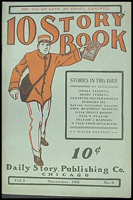
The queen, gazing from an open window of the palace, looked not upon the myriads of gorgeous flowers in the royal gardens beneath, heard not the warblings of bright-plumaged birds, the tinkling lullabies of flowing fountains — she saw only her subjects gathering sullenly in the silent streets — she heard only the rattle of the distant drums, the rumble of hurrying artillery, the ominous tread of marching men. Anxiously, she turned to meet the patriarchal man whose faltering steps had scarce announced his entrance.
“Your excellency,” she exclaimed “I have sent for you that you may explain why the preparations for the marriage are discontinued, why our troops are assembling, why the people have ceased to shout: Live Prince Ludovic, but scowl and mutter as they pass this way.”
The gray-haired minister bowed low. “Is it possible, your majesty, that the princess has not informed you”
“The princess has informed me of nothing,” interrupted the queen, “It seems that the queen, must beg for information possessed by her meanest subject.”
“Learn, then, your majesty,” said, the old minister, “that a crisis is upon us. Late last night your daughter dismissed Prince Ludovic and renounced the intended marriage. At two o’clock this morning the prince, raging and furious, departed for his father’s kingdom, taking his entire suite.”
The queen sunk upon a couch.
“Her reasons?” she gasped. “The princess’ reasons?”
“None know, your majesty. I suspect — strongly suspect — but am not sure.”
“Your majesty has yet to learn the worst,” continued the minister. “At eight o’clock this morning I received an ultimatum from the king of Montegramo. Unless within 24 hours the prince is recalled, an apology tendered and the marriage consummated, the king will declare war and begin hostilities.”
“War?” cried the terrified queen. “War with Montegramo? Impossible! Our troops need arms, our treasury is exhausted, our people taxed to the verge of revolution. The princess will retract — she will apologize — the marriage will be consummated. You will so inform the king immediately.”
“One moment, your majesty. If I obey and you, after hearing the princess’ explanation, should determine to sustain her and defy the king, his majesty’s wrath would be intensified”
“Have no fear, my lord. There can be no reasons sufficient to justify this outrageous conduct. I will hear my daughter's explanation, but her foolish fancies will not plunge us into a war that must result in the loss of our kingdom and the subjugation of our people.”
“Then your majesty must not listen to the princess”
The queen arose. “My lord, it appears to me that you are dictating to your sovereign. Am I not the queen? Do you doubt my sincerity, my sanity?”
With trembling fingers the venerable minister unclasped the fastenings of his robe of state and allowed it to fall to the floor. He lifted the jeweled collar from his bent shoulder and cast it aside. “See, your majesty," he said, his voice shaking with emotion, “it is not now the minister who speaks to his queen — it is the old servant who rejoiced at your birth, who held you in his arms at the christening, who has faithfully and loyally guided you through many perils of the throne. "My queen, for many years you and your royal spouse of loving-memory cherished the hope of uniting this kingdom with that of Montegramo, that you might found an empire and rear an impassable barrier against the encroachments of your mutual foes. The king of Montegramo wisely agreed, and the concurrent births of Ludovic and Alicia marked the approval of Providence. In all things fate favored your design, and the time has now arrived when your ambition may be reached and the prosperity of both nations be assured.”
“My sovereign, I doubt not your sincerity, but I have grown old and gray in plot and intrigue, in the study of men and of women. Do not, I entreat you, listen to the princess. You are the queen, but you are a woman, and, your majesty there are some things a woman never forgives.”
The silken curtains of an archway stirred, parted, and enframed the princess. The queen turned and regarded her sternly.
'‘Princess Alicia, without cause you have endangered my greatest ambition; you have invited a ruinous and suicidal war; you have invoked calamity and disaster upon the nation and our throne. I had intended to demand of you an explanation of your conduct. I have changed my mind. Your reasons are not material. Prince Ludovic will return this day, and you will immediately prepare for the marriage.”
Over the wan face of the princess crept an expression of inflexible determination. Tears sprang to her dark eyes — tears of indignation rather than of grief.
“Listen, your majesty, but for one moment. Last night —”
The queen made a gesture of impatience. ‘‘Explanations and entreaties are useless. Only prompt and implicit obedience can atone for your conduct.”
The princess turned to depart, hesitated, and turned back.
“Your majesty,” she said, softly, “I obey. But before I go I ask one favor, not of the queen, but of the mother.”
The queen smiled an assent.
“Recall, then, my mother, my situation when you departed from the Countess of Cannento’s party last night.”
The old minister cast a glance of warning and alarm toward the queen, but she, pondering curiously saw it not.
“I recall,” she mused, “that the last games were being played — that you and Prince Ludovic were partners, opposing the Duke and Duchess of Formonia — that you and the duchess were tied for the prize — and that you and the prince held winning hands. By the way, my child, I congratulate you. It is the first prize you have won this season.”
“But — we lost!” wailed the princess, extending her beautiful arms toward her mother.
“Lost!” cried the queen, incredulously, starting forward. “Again? And you have tried so hard!”
“Lost!” reiterated the princess, casting herself into her mother’s encircling arms and sobbing piteously. “The prince — trum.. — trumped — my ace!”
“All is lost!” exclaimed the old minister, turning away despairingly.
From over her daughter’s quivering shoulder the queen flashed her indignant and tearful eyes upon the dejected old man.
“My lord,” she ejaculated, hoarsely, “you were right — there are some things a woman never forgives! You understand! Go!”
In a few moments the two women, sobbing in each other’s arms, heard through the open window the tramp of armed squadrons rushing to defend the frontier.
"The most important thing for a writer is to find the right subject." —Willa Cather
“Is Mr. Irick in?” The red-shirted clerk in the Lucky Fall mine’s local office raised his eyes from a column of figures and stared at the interrogator, who had slipped noiselessly through the open door with the stealth of a shadow.
He saw a short, florid person with suspiciously black side-whiskers, small red eyes that peered, half-closed, through steel-rimmed glasses. A corpulent figure, tightly encased in a suit of reverberating checks, pedestaled by enormous patent-leather shoes and domed by a tall, glossy silk hat.
With a contemptuous grunt, the clerk pointed to a tall, lank man reclining in the shadow of an immense boulder and snarled, “That’s him.” The little red eyes blinked dubiously at the prone and unkempt figure, then glared indignantly at the scornful clerk
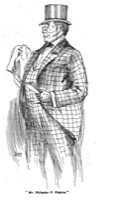
“I am inquiring, my young sir, for Mr. Ike Irick, manager of this mine.”
“That’s him,” the clerk repeated. “He’s It.”
“But it appears that he is slumbering,” said the flamboyant gentleman.
“Wake him up,” suggested the clerk, with an anticipatory smile. “He don’t mind. He likes it.”
In the ears of Idaho Ike, the monotonous murmurs of whirring wheels, the regular rhythmic crash of crushing stamps, had formed a melodic symphony that had lured and lulled him into Dreamland, wherein he once more wandered, foot-sore, hungry, discouraged and disowned, prospecting for the golden root of all evil.
Once more, he was taking that fortunate tumble down the slope that resulted in the discovery of the Lucky Fall mine when he was rudely awakened from the dream of bliss by the insistent visitor.
Slowly and drowsily, he drew himself to a sitting posture and wrathfully regarded the disturber of his repose.
“Well,” he growled, “what do you want? What’s th’ graft this time?’ Nuther orphun’ ‘sylum? Libury? Home for Chinee widders? Say yer piece. Don’t stand thar a-blinkin’ like I wuz th’ sun. Who air ye, anyhow?”
The corpulent gentleman seated himself ponderously upon a cool and convenient boulder, pushed back the glossy silk hat, wiped the perspiration from his bald and knobby brow, and carefully flicked the dust from the patent-leather shoes.
“Mr. Irick, I have not come here to be insulted, and I will not tolerate disrespectful language, sir. Let us understand that at the beginning.” — “My name is Philander P. Pipkins. I have called, sir, to present to you a matter involving the welfare of the struggling masses, the uplifting of oppressed humanity, the —”
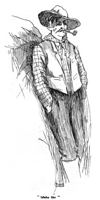
“Ye’re off th’ trail,” interrupted Idaho Ike. “Ye’re prospectin’ in th’ wrong gulch. They hain’t no strugglin’ masses nor’ pressed humanity about this plant.”
“You err, sir, you err — like all employers of labor, you are blinded by prejudice and greed. Here, in this mine, down in the bowels of this very mountain, human slaves, molded in the image of our common Creator, sir, are toiling hopelessly for a mere pittance that this company may declare dividends and revel in luxuries.”
“Th’ only revelin’ we’ve had ’round here,” remarked Ike, “was last Chewsday night, when Buster Williams an’ Pinto Phil wuz on a toot. Got buckeyed an’ shot up th’ town, an’ wound up by failin’ down th’ shaft, two hundred an’ eighty feet. They won’t do it no more.”
“This is no laughing matter, sir,” snapped Mr. Pipkins, shaking a pudgy first in the air. “Let me warn you that present conditions cannot, will not, continue. The giant will rise in his wrath, will shatter his fetters, will hurl the oppressor from his throne, and clad in the glittering panoply of justice, will himself be anointed and crowned monarch of all he surveys.”
“When he duz,” observed Ike, “you let me know. I want to’ tend th’ corynashun cerymonies. You kin put me down now fer six tickets.”
The little red eyes glared fiercely; the bulging brow contracted into what was intended to be an intimidating scowl. “Persist in your levity if you will, sir. I have warned you. Do not forget that when Chaos follows in my path”
“I hope he’ll ketch up with ye purty soon, an’ take ye back. He’d orter lose his job fer ever lettin’ ye escape,” said Ike seriously.
Mr. Pipkins recoiled, horrified. “Is it possible, sir,” he gasped, “that you imagine me insane? Why, sir, I am the traveling representative of The Compulsory Confederation, the grandest organization on earth, an organization, sir, founded by true philanthropists, a confederation whose mission is to gather within its protecting fold all who toil for others, and to compel all employers to make a fair and equitable division of profits, the only viable solution, sir, of the labor problem.”
“How about losses?” inquired Ike.
“Losses, sir, are always occasioned by bad judgment or poor management on the part of the employer. We cannot be responsible for the employer’s incapability.”
“Where d’ye git the grease to oil th’ macheen?”
“Our expenses, sir,” answered Mr. Pipkins, “including officers’ salaries, are provided for by an entrance fee and monthly assessment of each member.”
“It’s a good thing,” said Ike, “I reckon I’ll jine ef they’s a vacant office.”
“Employers are ineligible, sir. Only wage-earners are accepted, honest horny-handed sons of toil”
“Like yerself,” Ike suggested.
“I am a charter member, sir,” retorted the corpulent gentleman, “and I have ever been, will ever be, a friend to labor”
“Ez long ez th’ suckers keeps sendin’ in them monthly contrybushuns,” Ike interjected.
“Mr. Irick,” exclaimed the corpulent gentleman, rising to his feet, “I will no longer listen to your insulting comments. I now depart. You will be allowed to accede to our demands. If you refuse, your men”
Here Mr. Pipkins paused, folded his arms, and glowered majestically upon his recumbent auditor.
“Well,” demanded Ike, “what’ll th’ boys do?”
“Strike!” thundered Mr. Pipkins.
“Strike?” repeated Mr. Irick.
“Strike!” reiterated Mr. Pipkins, less confidently, the little red eyes noting Idaho Ike’s rising color. “Now, don’t be hasty, Mr. Irick. Don’t be rash. Take time. Think it over. We’ll be reasonable.”
“Enny uv our boys j’ined yer outfit?” queried Ike anxiously.
“If they haven’t they will, when I present my unanswerable arguments. Consider, Mr. Irick, what a loss to your company would be entailed by the closing of the mine, even for one month. Remember, too, what excesses are committed. Property is destroyed, mine flooded, perhaps bloodshed.”
Idaho Ike slowly stroked his mustache and meditated. At the same time, Mr. Pipkins, pretending to be absorbed in contemplating the glory of the setting sun, watched him furtively from the corners of the little red eyes. One might have thought that Mr. Pipkins was waiting for something; Ike did. “Looky here,” he finally drawled, “I don’t want no trubble — our boys gits union wages, an’ a leetle bonus besides. We don’t hire only good men, an’ ef they gits sick, er hurt, er killed in our sarvice, we help take keer uv their famblies. They like me, an’ I like them, an’ they hain’t never bin no kick. But ye kain’t tell what fool noshun sum uv ’em might take ef a smooth talker like yerself went a-nosin’ round amungst ’em. A mine’s mighty easy ruined.”
“Exactly, Mr. Irick! Exactly! You’ve hit the nail on the head.”
Ike looked up at the corpulent gentleman and winked significantly. “Couldn’t this thing be fixed sum-how, on th’ q. t., confidenshul-like?”
Mr. Pipkins assured himself that no one was near. Then he resumed his seat, leaned forward, and said, pleasantly: “I have authority, Mr. Irick, to arrange these matters in the manner you suggest if I deem it best for the interests of the Confederation.”
“Of course,” he added, sternly, “whatever I receive is placed, inviolate, in the treasury of the Confederation, for the benefit of labor.”
“That’s all right, Pip, ol’ boy,” said Ike, winking industriously. “I hain’t a-goin’ to send no tracer after th’ money. You jest slide out an’ let th’ boys alone. Thet’s all I want.”
“I can leave on the eleven-twenty, Mr. Irick if this matter can be adjusted in time.”
“It kin,” asserted Ike, confidently. “How much?”
“Well, five hundred wouldn’t be unreasonable, would it, Mr. Irick, considering”
“Be here at ten-fifty,” interrupted Ike.
“No check, Mr. Irick; cash, but in such form as I can easily carry.”
“I’ll fix it so’s ye kin carry it, easy,” said Ike. “You jest be here.”
“I will be here, promptly. Good-day, Mr. Irick. Complete secrecy, remember, and ten-fifty, sharp.”
Idaho Ike watched the waddling figure as it descended the slope and crossed the gulch into the little town.
“‘Hurl th” presser frum his throne, an’, clad in th’ glitterin’ panoply uv jestice, will hisself be’ nointed an’ crowned monark uv all he surveys,’” he quoted. “I remember when I wuz a kid, uv readin’ ’bout a feller named Warwick, what had a barrel uv fun a-makin’ kings, an’ I guess I’ll jest organize a Monark Mannerfackshurin’ Kumpanay, fer a short time only.”
At ten-forty-five that night, Mr. Philander P. Pipkins halted, half-way up the slope, to recover his breath and to murmur something about soft mark and easy money, when a revolver-shot rang out, Mr. Pipkins’ silk hat flew from his head.
A sepulchral voice commanded, “Hands up,” a behest which Mr. Pipkins promptly and tremblingly obeyed.
Three masked men emerged from the shadows of the rocks into the moonlight. One of them carried a bucket containing a large brush and a mixture. To Mr. Pipkins’ quivering nostrils smelled very much like a combination of linseed oil and glue. Another poured from a sack a heap of tiny, glittering scales, which Mr. Pipkins’ observant eyes recognized as mica.
“Stranger,” said the sepulchral voice, “havin’ fractured th’ rules an’ regulashuns uv this here community by appearin’ in a plug hat, patent-leather shoes, an’ a b’iled shirt, ye air now about to suffer th’ penalty. Sum uv us is in favor uv droppin’ ye down th’ shaft.”
Mr. Pipkins fell on his knees.
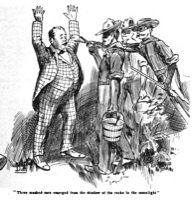
“Howsumever,” continued the voice, “this bein’ yer fust offense, an’ understandin’ that ye wuz here fur th’ purpose uv arrangin’ to be clad in th’ glitterin’ panoply uv jestice, an’ bein’ nointed an’ crowned monark uv all ye surveyed, we have concluded to accommodate ye, bein’ allers anxious to please. Th’ Lord Bishup will now apply th’ ointment. Shut yer mouth an’ eyes, tight.”
A few flourishes of the large brush deluged Mr. Pipkins from head to foot.
“Th’ Royul Guard will now apply th’ glitterin’ panoply,” commanded the voice.
Mr. Pipkins was vigorously rolled, dragged, and rubbed in the mica, and then stood on his feet, encased cap-a-pie in shining scales.
“Prepare th’ crown.” Mr. Pipkins’ silk hat was soused in the bucket, rolled in the mica, and poised over his glittering head.
“King Filander th’ Fust,” announced the sepulchral voice, “we air about to crown ye Monark uv all ye survey. Don’t be too long a-survey-in’ ‘kause we’re a-goin’ to fire a saloot uv five shots apiece, after which we’re all a-goin’ to take a few shots at that crown. That’s th' leven-twenty now, whistlin’ round th’ bend. You kin ketch her at the stashun ef ye fly fast enuff, an’ sumbody down in town don’t wake up an’ wing ye fer a strange bird. Apply th’ crown.”
Mr. Pipkins’ hat was jammed down over his head as far as the protruding ears would allow.
“Stand by to saloot. Saloot!”
As the revolvers roared, a streak of flashing scales shot down the moon-lit slope. Mr. Philander P. Pipkins had departed.
“Mister Irick,” said Dutchy, next morning, in a confidential tone, as he produced Ike’s favorite bottle from beneath the bar, “I vill sell mine saloon cheap fery cheap. I vas goin’ to leaf der town right away off already.”
“What’s th’ trubble, Dutchy?” asked Ike.
Dutchy leaned over the bar, guarded his mouth with both hands, and whispered, huskily:
“Say noding, Mister Irick, or I kannicht sell me oudt. A galamity iss to der town comin’ soon yah! Last night, vile I vas der’ leven-twenty train vatchin’ pull oudt, rushes down from der mountain ein horrible beast, like von pig golden dragon in der Pible, mit shiny scales all ofer, und ein head dot long, mit wavey yeller gills on der sides. It puffed der schmoke like ein locomotif, und beat der air mit its fore-legs, soyah! So fast it coom, it touch der ground maype drei times, und light on der hint blatform mit der train, und laid down und cough’d leetle fiery schpecks vile der train pull oudt.
“Ach! Laff avay, Mister Irick, but dot vas der solum truth. It vas a vaming, und I gets me oudt of der town shust so soon as I kan sell me oudt.”
“Dutchy,” drawled Ike, “I seen it, too. It wasn’t no dragon it was a onark.”
“A vat?”
“A Monark, Dutchy, a king. Pufectly harmless in this here country. Sumbody’s jest ben a goin’ into th’ king-makin’ bizness – fer a limited time only.”
"Every strike brings me closer to the next home run." —Babe Ruth
IDAHO IKE, aroused from sweet slumber, wearily drew on a few articles of clothing and stumbled sleepily after the straggling procession of citizens hurrying to the wreck.
“Seems like some folks is allers in a rush,” he yawned. “Reckon them cars’ll stay thar fer a while? What’s th’ use uv hurryin’.”
He seated himself comfortably upon a great gray boulder a short distance from the track, and calmly contemplated the confusion.
Dimmed and deadened by the pall-like mists of the morning, the flitting forms of rescued and rescuers, the roar of escaping steam, the crackling of lurid flames, and the lamentations of hysterical passengers formed a pandemonium suddenly projected into that land of mute mountains and calm canon, whose heights and recesses had hitherto echoed only the voices of adventurous gold-seekers, the cries of wild beasts, and the semi-daily whistle of a passing locomotive.
A man, lean and long-haired, another, short and rotund, and a woman leading a sobbing little golden-haired girl, issued from the envelope of mist and approached Idaho Ike’s perch.
“What’s th’ matter with th’ kid?” Ike called out.
“Frightened, sir, only frightened,” answered the lean man, glad, apparently, to have interest in even so unkempt a questioner. “Nobody hurt much. But baggage burnt. Our costumes, instruments and paraphernalia all destroyed. Irreparable loss, sir, irreparable.”
“Pairfumally — what’s them?”
“Properties, sir, stage properties. You behold, sir, the DeArcey Philharmonic Company, celebrated in the East, celebrated. Musical artists — and I do a neat turn in magic. My transformation scene”
“And th’ kid — what does she do?”
“Marguerite? The juvenile Patti, sir. Wonderful voice — for her age — only six. You should hear her in —”
“An’ ye need a grub-stake.”
“I beg pardon.”
“What fer?”
“Grub-stake? I don’t quite understand”
“Oh, I say yer up against it — busted — stranded.”
“Ah. Yes. True, sir. Quite true. Nothing left but our tickets. And booked for Yellow Rock tomorrow night.”
Idaho Ike slid down from his perch. “Foller me,” he commanded.
The DeArcey Philharmonic Company obeyed. In their distress they would have followed anybody.
Down the one street of the straggling town, to the foot of the rise across the gulch, marched the procession. Idaho Ike halted.
“Lemme carry th’ little gal,” he said, half imperiously, half entreatingly. “It’s a hard climb.”
The child nestled in the long, strong arms, her tired, golden head on the flannel-shirted shoulder. Straight up the slope they toiled, to the rude “hotel” hastily erected to accommodate the miners engaged in developing the Lucky Fall mine.
“Make yerselves to hum,” said Ike, regretfully surrendering his burden. “I’m boss here, an’ ye’ll git th’ best we got. Ye’re a-goin’ to do a show here tonight Ye’ve got a date with Mister Isaac Irick, manager. That’s me. I’m a-goin’ into —”
“But, my dear sir,” ejaculated the lean man, “impossible! No instruments — no opera house — no music — no properties”
“Dem th’ properties! What kind o’ instruments do ye need ?”
“Well, a piano, two violins, and —”
“Pianer! Why, pardner, they hain’t no pianer in a hundred mile o’ here — ner violins, neither.”
The long-haired man groaned, and wrung his bony hands.
“Ef ye could make out with a fiddle Sant Cox has got a fiddle — an’ Dutchy’s got a flute.”
“Excellent, my dear sir, splendid! Senor Arello can play the flute. We can manage without music. If the good people will come.”
“Come? You bet th’ good people’ll come — an’ th’ bad ones, too. You jest rest up, an' look after th’ little gal, while I see th’ boys. We’ll fix it.”
To the wondering miners, called from their task, Ike, mounted on a dump-car, made his first essay at oratory.
“Fellow-cityzens — boys — owin’ to th’ wreck this mornin’ we hev strangers within our gates, an’ one uv ’em is sure a angel. They’re stranded, an’ needin’ a helpin’ hand. By which I mean th’ Dorsey Phillips Harmoniky Kumpany, includin’ th’ kid.”
“They haint askin’ fer no hand-out. They’re goin’ to give value received — by which I mean they’re a-goin’ to give a show here to-night, an’ we want to turn out hansum.”
“We’re a-goin’ to knock off work on th’ mine this arternoon, and ye’ll all draw yer pay. Then I wants sum uv ye to hustle over to town, an’ up an’ down th’ gulch, an’ give th’ tip to th’ stragglers an’ prospectors. Th’ rest uv ye yank that loose lumber down into th’ gulch, where it widens out yander. We’re a-goin’ to build a opry house, an’ I’m a-goin’ into th’ show bizness — fer a limited time, only.”
At seven o’clock that evening numerous lanterns and innumerable stars illumined a roughly constructed stage and dressing-room, and a motley assemblage that filled and overflowed the four rows of plank benches.
“Why, it’s not enclosed!” exclaimed the astonished DeArcey. “And no box-office — no tickets — no —”
“Don’t need no tickets,” drawled Idaho Ike. “You make a bit an’ ye’ll git th’ stuff. Couldn’t keep ’em out with a forty-foot fence, nohow. Now, let ’er go.”
Mrs. DeArcey, greeted by vociferous cheers, stepped forth upon the creaking stage, glanced confidently down upon the area of unshorn faces, rolled her eyes tragically upward toward the starry heavens, and proceeded to let ’er go.
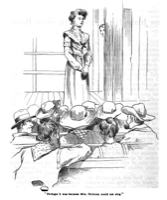
Her rendition of Der Erl Koenig, accompanied by the wailing fiddle and flute, failed to evoke enthusiasm. Perhaps it was because Mrs. DeArcey could not sing. Perhaps it was because she was even hoarser and flatter than usual. It might have been partly for the reason that a melancholy and amazed coyote, silhouetted, far up the mountain, against the sky, had generously added his howls to hers.
To the doubtful encore the lady responded with a perpetration of Una Voce Poco Fa, in which the coyote assisted with redoubled vigor.
There was an ominous murmur and shifting of the audience when the singer retired.
“Lookee here,” said Idaho Ike, impatiently, “th’ boys won’t stand fer no sich bizness. They wants music. Sumthin’ lively an’ devilish. Give ’em th’ fiddle an’ flute, once.”
Mr. DeArcey and Senor Arello glided smilingly out of the dressing-room and began to droll the overture to Poet and Peasant. The enraptured coyote threw his whole soul into his accompaniment, and was rewarded by a volley of revolver-shots from several of the suffering audience, a proceeding so startling to the two artists that they suddenly disappeared before the Peasant had had his innings.
Cries of “Fake, Bum, Shoot 'em up,” followed the exit.
“I tell ye they won’t stand fer this,” Ike expostulated. “They’ve be’n lickerin’ up, an’ ye must give ’em sum music.”
“Music! Music!” cried the trembling DeArcey. “My dear sir, we are offering them the choicest work of the best masters, the soul-symphonies of —”
“Cut out yer solesim funnys,” howled Ike. “Don’t ye know enny music Old Zip, er th’ Arkansaw Traveler, —”
“Sir,” cried the long-haired man, “you insult us. We are artists ”
A chorus of wild yells, punctured by revolver shots, interrupted his protest.
“There’s a-goin’ to be fragments uv artists scattered up an’ down th’ gulch in about two minnits ef ye don’t ante up,” observed Ike.
“If I only had my properties,” whimpered the quaking DeArcey, as a premonitory volley of stones rattled against the walls of the dressing- room, I would soothe them with a manifestation of magic”
“It’ll take some many festashuns uv magic to git ye out us this,” cried Ike, wrathfully. “What’d ye tell me ye could play fer? Ye’ve bunkoed th’ boys into turnin’ out to hear a lot uv”
The little girl ran to him, pulled him down, and whispered something in his ear, eyeing her parents guiltily.
“That's th' stuff,” cried Ike jubilantly. “Give 'em a song,” and he pushed her toward the stage.
DeArcey interposed.
“Never, sir, never, will my child —”
“Git out’n th’ way,” yelled Ike, pushing him back, “unless ye want to descend into that mob.”
The child sprang fearlessly forth, and at that moment the great, round moon crested the mountain and shone down, full and glorious, upon that little, golden-haired figure, dainty in pink and white, smiling and throwing kisses right and left in all the grace and innocence of childhood. At sight of that vision, a calm like that which stilled the Sea of Galilee settled upon the clamorous crowd.
Clear and sweet as a silver bell arose the childish voice.
“It ain’t no use to sing them songs to me; I love the tunes that have the melody, Like Swanee River, and Dixie Land.
Half way through the second verse fiddle and flute chimed softly in, and the audience swayed with the measure.
Roars of applause followed the little singer’s exit, roars that increased until she re-appeared, smiling, and singing as she came forward:“If you ain’t got no money, you needn’t come round ’’
Then the crowd, taking the hint, arose, laughing and cheering, and another fusillade, not of stones, but of coin, some of it wrapped in greenbacks, rattled upon the stage.
“Gather it up an’ foller me,” said Idaho Ike to the long-haired man, as he swung the exhausted child to his shoulder, leaped from the rear of the stage, and started up the slope toward the hotel.
“One more ?” he asked.
“I’ll try,” she panted.
“Make it Swanee River.
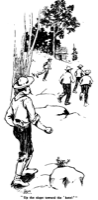
Three hundred loyal subjects followed the singer up the slope, and three hundred rough voices joined in the song with a vim that made the mountains ring.
At the door of the hotel Idaho Ike kissed the laughing child on both rosy cheeks, surrendered her to her mother, and pulled off his hat.
“It’s up to us, boys,” he said, as he deposited the first contribution. “Don’t crowd. Ye’ll all git a chance to chip in.”
When the morning train pulled out the little singer stood, with the happy Company, on the rear platform, tossing tiny kisses to the flannel-shirted throng that was sending up three cheers “fer th’ kid.”
“She is sure a peach,” muttered Idaho Ike, gazing wistfully after the disappearing train, “an’ I’m mighty proud about goin’ into th’ show bizness — fer a limited time, only.”
"The writer's job is to tell the truth." —Ernest Hemingway
Mr. Collins, of Collins & Hopkins, Real Estate & Loans, stroked his Burnsides. “Brace up, Hop,” he said. “I’m ashamed of you. Because a young lady declines to sell a half section of Missouri land is no reason you should tear your hair and smash the office furniture. For ten years we’ve been making profitable deals for other people. Now comes the opportunity to make our own fortunes, and if we can’t engineer this deal against a girl we’d better quit the business.”
“But what can we do? We’ve offered more than the market value of the land and she refused to sell: “…because pa and ma are buried on the old place.” They’ll probably stay there, won’t they? Don’t expect them to rise from the tomb and hustle themselves off the ancestral domain to accommodate us, do you? And we’re out five hundred hard dollars now for the tip. If his company discovers that Thompson has betrayed them, they’ll put the girl on before they’ll let us get the land. What do you propose to do? Forge a deed?”
“Don’t talk nonsense, Hop, and don’t talk so loud. The clerks will hear you. I’ve got an idea. Let’s analyze this case. A woman owning a half section of land is not allowed to remain long unmarried, especially in a rural community. Therefore this Miss Minerva Edgerton is young. Her letter indicates some education. Her reasons for not selling show that she is sentimental, therefore susceptible. Born and reared in that out-of-the-way corner she is ignorant of business methods and the ways of the wicked world. Young, ignorant, sentimental and susceptible why, Hop, it’s a cinch if we can find the right man one that we can trust absolutely.”
“She's beautiful and to be woo'd. She is a woman; to be won.”
The scowl on Hopkins’s face was gradually displaced by an expression of hopefulness.
“It might work, but where’s the man?
There was a long silence. Then Collins said decisively: “I’ve found the man.”
“Who?”
“Well, I call him Hop. His wife insists upon C. Connell Hopkins.”
“What? — Want me to commit bigamy or get a divorce from your own sister?”
“Hold on — did I say anything about divorce — or bigamy? You’ll not have to marry the girl. Capture her affections — set the day if necessary. She’ll sign the deed. Then you skip. We’ll cover your tracks. She’ll sniffle awhile, then marry some jay that wants her money. Nothing criminal. She gets her money — full market price for farm land. We discover the ore later. It’s the only safe way. We can’t trust anyone, and why should we divide the profits? It’s easy, and it means a fortune to both of us.”
“I guess, you’re right,” Hopkins said. “I don’t fancy the job, but I can do it. You arrange the details and I’ll take the next train.”
“All right, my boy. Notify me w’hen you’ve landed her and I’ll renew the offer. Send communications through Orton, of Springfield. And not a word of this to Laura. She might write or wire and excite suspicion. In a little town like that nothing can be kept secret. Tell her you’re called to South America — tell her anything except the truth. Good-bye, old boy, and don’t miss that train.”
Thirty days later, Collins ripped open an envelope bearing the Springfield. Missouri post-mark. It contained the first report of the absent adventurer:
“New Shanghai, Mo., July 10th, 1901.
Dear Coll: I’m it. She was offish, but I've got her going now, and any dance, picnic or spelling bee that we miss must be miles away and the roads muddy. Give me two weeks, then renew your bid. Send deed and draft at same time. That will let me off sooner.
Coll, as an analyzer you are a failure. Young; sentimental; susceptible. O, Lord! Minnie (to others she is “Nerve”), is as sentimental and susceptible as a wild buffalo. She is a bird of the Dodo variety. Tips the beam at 185; all bone and sinew. Hands like Swift's Premium. Red hair. Squints. Voice like a fog horn, and the disposition of a demon. Be cautious, Coll, for if this gentle gazelle ever gets into our game you'll need a new partner. I’m up against it, but we get that land. I’m going up to Springfield for a couple of days’ rest. My publishers are in Springfield, you know. I’m an author, down here getting material for a new book. My name is Charles H. Connell. Tell Laura to not worry, and you hustle that deed, etc., in two weeks from date.
Yours sufferingly,
Hop.
P. S.She didn’t write that letter. She got the Post-Master to write it. He was sparking her and I had to cut him out. She can’t write anything but her name, and she prints that. -H.”
Collins chuckled, leaned back in his easy chair, and clasped his hands over his rotund front. He saw castles spring from barren Missouri lands — castles of zinc with turrets of copper. Steam yachts, automobiles, racing stables and all the luxuries of the gilded gang passed in review before his ecstatic vision, transporting him to a delicious dream-land from which he was suddenly and cruelly recalled by the unannounced entrance of Mrs. Hopkins.
Now, if he had been prompt in concealing that letter, or if Mrs. Hopkins’s eyes had been less keen, the post office at New Shanghai might not have received a letter, directed to C. Connell Hopkins, bearing upon its upper left hand corner a request that it be returned, if not called for, to: Mrs. C. Connell Hopkins, 1313 Lakeview Ave., Chicago, Ill.
And if the postmaster had not been deposed in the affections of Miss Minerva Edgerton he might not have aroused the demon of jealousy in that lady’s bosom by communicating his suspicions.
Generations of adventurous ancestors of Miss Edgerton had opposed the meddlesome revenue officers of an inquisitive government. Suspicion, caution and prompt action were the natural heritages of the offspring. Minerva resolved to investigate.
The dashing Hopkins returned to be informed that his lady love had been called to the bedside of a distant relative. He also received from the scrutinizing postmaster two letters similarly addressed and displaying the Chicago postmark.
Following the most natural impulse, he accepted the letters. The next instant he realized his error, but it was too late to amend it, and the postmaster’s face was a revelation. Flurrying to his room he hastily opened the letter last mailed.
Hop: At last I’ve found a lovely girl, or rather she found me, for she came to the door looking for work. I don’t mean lovely to the eye, for she is a giantess, and she squints and has red hair; nor to the ear, for she has a horrid voice, but she’s such a cook, and so kind to the children. They tell her everything. She saw your picture on the wall and asked the children so many questions about you where you were — how long you had been gone — your occupation — that I was really provoked when Tommy told me.
One circumstance that I don’t like she gave her name as Mary Smith, but to-day I heard her muttering to herself, when she didn’t know I was about, and she said, ‘I’ll fix him before to-morrow night or my name ain’t Minerva Edgerton’
The shriek of an incoming train startled the stupefied Hopkins into immediate action. It occurred to him that a train that comes in almost invariably goes out, and he started toward the station with great earnestness. He carried with him an intuition amounting to a conviction that a cyclone was scheduled for that immediate vicinity and was due. The direction of the train was immaterial to him so that it went away from New Shanghai and went at once.
Half-way to the station he executed a lateral movement and cast his panting form behind the shelter of a friendly hedge. A tall, bony female had swung round the corner ahead of him. She was dusty and travel stained. A straw hat decorated with fluttering blue ribbons and a mass of faded artificial red roses was perched upon one side of the fiery head and pulled far down over the corrugated brow. The lower jaw protruded aggressively, and the voluminous mouth opened and closed regularly with suggestive gnashing of teeth. Her gaze was fixed with savage intensity upon the distant village, and her massive right hand, grasping a frayed carpet bag, rose and fell in agitated motion as though threatening an invisible foe.
The apparition had barely passed him when the locomotive signaled departure. Hopkins sneaked hurriedly along the hedge. A recumbent pig noisily voiced his protest at being roused from repose, betraying the fugitive. Glancing backward, Hopkins heard a howl of fury and saw a tall figure enveloped in clouds of dust sweeping down upon him. Then Hopkins threw his whole soul into his legs. Minerva ditto.
As they sprinted by the station, passengers, train-crew and loafing villagers shouted encouragement. “Hit it up, ’Nerv, you're a gainin’. We’re bettin’ on you.”
“More steam, old boy. She’ll git you in three more jumps.”
Lucky for Hopkins that he succeeded in grasping the rear platform as the train pulled out. Even then the wild gallop of the avenger might have carried her to victory had not the engineer been in haste to make up lost time. As the gap widened, a long right arm swung upward like the beam of a catapult and a carpetbag materially assisted the exhausted Hopkins in his efforts to open the coach door.
That night Collins awoke trembling from a hideous nightmare. He had been crushed to death by the crashing downfall of a mighty castle, a castle of zinc with turrets of copper.
"Writing is the only thing that, when I do it, I don't feel like I should be doing something else." —Gloria Steinem
Many remember the entrance into the musical circles of Spain some twenty years ago of Veraldi, the violinist. His marvelous mastery of the king of instruments, his preternatural power of improvisation, his magnetic presence, his abrupt advent, the mystery of his antecedents, all combined to compel his recognition as the peer of Paganini, and to render his success certain, his popularity permanent. The name of Antonio Veraldi was on every tongue. Men sought his society; fair women fell at his feet.
Suddenly, before his fame had fairly passed the Pyrenees, he disappeared. No one knew why — no one knew where. His genesis and his exodus were alike mysterious. Like a strange and shining star he had arisen from the realm of the unknown; like a flaming meteor he had vanished into the depths of the unknowable.
Little Leon was hungry, cold, and afraid. Hungry, because he had not eaten since morning; cold, because he was scantily clad against the winter wind; afraid, because his day’s receipts had been light and Miguel’s libations heavy. Reasons enough.
Slowly and sadly he climbed the desolate stairs and entered the dingy room that he and Miguel called home. Happily, Miguel, present in flesh, was absent in spirit — strolling with Bacchus in Elysian fields. Jetsam and flotsam of the morning meal, Leon could gather undisturbed. He laid down his violin, lighted the flickering lamp, drew the little table nearer the feeble fire, and, while he ate, he studied the sleeping man upon the shabby bed.
Miguel was a perennial puzzle, a profound problem, that Leon had often studied but had never solved. He could not remember a time when they had not been together, journeyed together, played together, he the violin, Miguel the great harp; and yet he did not know Miguel.
Two tastes they had in common, only two — the love of music and the love of books. Books were Leon’s only playthings; through them he roamed the world. Miguel had taught him. When Miguel rewarded, it was with a book; when he punished, it was by a beating. Leon never knew which to expect until Miguel promised. Miguel never broke a promise. Books and beatings were alike awarded without apparent cause. Once, after a book, Leon had asked why, and Miguel had answered, softly, “Because you resemble — her.” Once, after a beating, Leon had asked the reason, and Miguel had answered, savagely, “Because you resemble — him.” Leon could not understand.
Master of the violin, Miguel never played except to teach Leon. Handsome in person, courtly in speech and manner — when he chose — Miguel shunned mankind. Sober at all other seasons, Miguel was always drunk at this. The stages of his intoxication were always three. In the first he was cynically kind, in the second moodily morose, in the third somnolent. Recovering from the third he immediately re-entered the first, following the circle without intermission. From the morning of the twenty-fourth to the morning of the twenty-sixth day of each December he was continuously drunk. From the morning of the twenty-sixth to the morning of the twenty-fourth he was continuously sober. A strange creature, this Miguel.
Being now in the third stage, he would enter the first as soon as he awoke. The gin-bottle on the shelf was yet half-full. That meant several hours of the dreaded second stage before morning. Leon sighed, pillowed his head on his arms, and patiently awaited the awakening.
From the crowded streets arose the laughter of happy children, the chatter of gift-laden shoppers, the merry music of the jingling bells, and all the roar and bustle of the Christmas-tide. Flashed up from the depths of child-memory for one tremulous instant a fleeting vision of a happier time, a home, kind faces, treasures of toys, and then the vision vanished, leaving in its stead — Miguel and the garret. Often before had Leon dreamed such dreams. Sometimes there came a misty memory of a woman’s face, of fond encircling arms, a soft, sweet voice calling him, not Leon, but another name his ear strained eagerly to catch, his heart leaped lovingly to answer.
The Christmas chimes of distant churches lulled and soothed him to drowsiness. Gradually the faint, melodious medley of the bells melted into a symmetrical melody, a soothing symphony of surpassing sweetness, rousing again those misty memories of a perished past. Surely, somewhere, sometime, he had heard that melody — somewhere amid a concourse of people — sometime before there had been a Miguel in his life. Oh, could he but fix it in his mind, remember it, play it, perhaps some portion of the past would be revealed. Eagerly he grasped the violin. His skillful fingers searched among the strings and slowly seized the weird, unwilling notes. His bow, obedient to its master’s will, dragged from their hiding place responsive chords. Fragment by fragment, broken but distinct, the mystic music of his fancy flowed and waked the echoes of the lonely room. The sleeper stirred uneasily, and Leon paused.
"Were you playing, Leon?”
"Yes, Miguel.”
"What?”
"Nothing — a fancy — I do not know.”
Miguel arose. When he sat down the bottle on the shelf was empty. "Beggar’s champagne,” he cried, gayly, wiping his beard. Leon smiled, his was the first stage.
"I dreamed someone was playing playing — something none but I can play; something never played but once; something that will never be played again. What day is this, Leon?”
"This is Christmas Eve.”
Miguel started.
"True,” he murmured. "A time to be remembered. I had forgotten. When I am drunk I do not think. When I do not think I do not remember. Blessed be Bacchus!”
He staggered to the window and looked out. From a brilliantly lighted church in the distance came the swelling tones of a great organ. Miguel laughed derisively.
"‘On earth peace, good-will toward men. Beautiful words. Twelve years this night since I last heard them; one year before your birth; three years before you and I became companions. Truly, Leon, Christmas Eve is a time to be remembered by us — aye, and by others.”
Again he laughed bitterly, triumphantly. Leon listened eagerly; never before had Miguel spoken of the past. But Miguel only said: “Play for me, Leon, while I forget.”
With bow poised in air, the boy hesitated, glanced at his companion timidly, and then boldly struck the chords of the dim, dreamy melody caught from the Christmas chimes. With a cry of rage Miguel tore the violin from his hands and hurled him to the floor.
"Perdition!” he shrieked; "not that! What demon taught you that?” Leon, rising to his knees, cried out: "O, Miguel, tell me — tell me or kill me. I will not — cannot — live this miserable life.”
In the uplifted, pleading face, in the great tearful eyes, Miguel, looking down, saw that which caused him to stoop, to lift the child, to clasp him to his breast.
“For love of her whose face you bear this night,” he cried, “I, myself, dead for these many years, will tell you, will play for you, though you cannot understand. Listen, Leon. You are about to hear a tragedy. It began in Spain. It will end here.”
Then Miguel played, and lo, it was the music of the memories of Leon, such music as is heard but once in centuries, such music as enthralls the minds of men and wields them at its will. Slowly, softly, sweetly, at first, it rippled and glided and throbbed and trilled, telling of brooks and birds, of flowers and sunny climes, laughter and love, and hope and happiness. Suddenly it sank to troubled tones of darkness and despair, madness and misery and revengeful rage; changing again to run the gamut of all earthly grief with sobs and sighs, terror and tears, the wails of women and a mother’s moans.
Leon’s slight form was quivering, his eyes were closed, his breath fluttered between parted lips. Transported by the magical music, fascinated by the fiery orbs of the musician, for a time there was no Leon; he had become in mind a part of Miguel, their memories mingled, the stronger had absorbed the weaker will.
The last impassioned chord vibrated, diminished, sobbed, and died away. The player, exhausted, withdrew his magnetic gaze from the child’s face. With one long, quivering sigh, Leon opened his eyes; returned from ecstasy to earth.
“Again, Miguel, again. Let me see her again.”
“See — whom, Leon?”
“The lady of my dreams. She was with you, Miguel, with you, in a grove — and, again, in a great church — music — many people. She was at the altar — with a man, not you — you are outside — in the snow. Then an immense hall, bright uniforms, beautiful ladies — and you, Miguel, you are playing the same music. She leads me away — she is veiled — she weeps. O, Miguel, it is not a dream; It is real.”
“A miracle!” gasped Miguel. “Go on! My God! Go on!”
“A magnificent house fountains — statues. You are outside in the darkness — watching. A great, glittering Christmas tree — the beautiful lady again — she is playing with a little boy, with me, Miguel, with me! O, Miguel, she is my mother! I know it now! Where is she — tell me, Miguel, where is she?”
“Stop! stop!” moaned Miguel, white, trembling. “But — yes — it is a command from above. Go on! Go on!”
“A ship — waves all around us — I am crying. Now we are in a great city; it is snowing; you carry me along the streets; you take something from about my neck”
Miguel had fallen upon the bed, writhing, clutching at his side. Leon ran to him, but Miguel, with a mighty effort, sat up.
“It is nothing,” he said, after a moment, “nothing but — my heart. That was broken long ago. Leon, Leon, death has touched me with his finger, and tonight the good God has spoken to me through your lips — has commanded me to speak before it is too late. Sit here, by me, Leon — I must still call you Leon, for I cannot speak the name that was — his. He never saw you, Leon. I swore that he should never behold the child that would have been mine had he not foully slandered me. Because of his rank he refused to meet me; he laughed at the poor musician until I revealed to him what I had kept from the world, even from — her. Then, daring no longer to refuse, he faced me and found my hand as cunning with the sword as with the bow.”
“Now you will despise me, Leon; will leave me; will return to your own. But stay with me tonight, Leon, for I love you because of her — who broke her solemn promise. You will tell her that. Tomorrow I will give you rich gifts. See, Leon, I am a magician I, who have nothing, will give much — home, mother, fortune. Many times have your hands grasped these gifts and you knew it not.”
“Tomorrow we will sell the great harp and you will take the money and leave me. A joyous Christmas for you, Leon; a sad one for me. But God has ordered it so — and I will not stay long. Listen, Leon, to the chimes. They are calling to me — and I must go. Yes, this night, after so many years, I will ask pardon for the great sin I have committed — yea, I will even beg that she be forgiven the great wrong she wrought me. Once more, this night, I will bow before Him whose mission was mercy. Come, Leon.”
He led the bewildered child down the dark stairway and along the white streets to the distant church. Together they entered, and kneeling near the door, received the benediction. Then, as the grand organ filled the church with solemn music, Miguel, still on his knees with bowed head and clasped hands, sank slowly down, a gasping, quivering heap. With a cry of grief and terror, Leon bent over him to see him smile, a wan, pitiful smile; to hear him whisper, “Farewell, Leon — Francisco — the violin — the violin;” and then, with a long shudder, a convulsive clenching of the slender hands over the failing heart, Miguel’s dark, passionate eyes closed on this world forever.
Leon in the garret; Miguel in the morgue. Christmas night, the first night in many years that had not found them together.
Leon had sold the great harp that Miguel might not be buried as a pauper, that a little stone might mark the spot where he would lie nameless and unknown; a stone upon which the one word, Miguel, would tell all that Leon had ever learned. The child had refused the home offered him by sympathizing strangers, for somewhere in the great wide world a home and a mother awaited him. Miguel had said so, and Miguel, with all his faults, had never deceived. Earning his way with the old violin, he would wander from country to country, from city to city, until he should find the lady of his dream. A weary, weary quest for one who knew not even his own name.
Ah, if Miguel had only told; if Death had delayed but one more day. And yet — Miguel had promised that he should know today — and Miguel had never broken a promise. Perhaps — perhaps — could the dead return? The lonely child glanced fearfully about the dim garret and shuddered at the thought. If Miguel could he would — to keep his promise — that was certain.
A shape leaped up from a dark corner and moved toward him; something rattled over the bare floor. The child moaned in terror. Only a shadow cast through the little window by the street lamp swinging in the wind; only a gaunt gray rat searching for food. No, Miguel would not, could not come. He had spoken for the last time. But why had his last words been of the violin? Perhaps Leon sprang up and bore the battered instrument to the dim lamp, shook it, peered into it, sought some inscription, some word, that might lead to light, and found — nothing.
He laid the violin upon the table and cast himself upon the bed, crying, “No hope! No hope!” The wailing wind without echoed his words. The rattling window, the swinging, squeaking street-signs mocked him. The gaunt gray rat, emboldened by hunger, entered the faint circle of light cast by the flickering lamp and sniffed and grinned ominously.
A fierce blast of wind screamed up the narrow stairway, the flimsy door flew open, the rat squeaked and scampered away, the flame of the lamp leaped, quivered, and expired; the room grew suddenly icy cold. The child, rising to close the door, halted, terror-stricken, paralyzed by fear, for someone, something — he could not see — was playing upon the violin, softly, but surely, skillfully.
Stronger and louder swelled the notes, the marvelous music of Miguel, the chorus of the Christmas chimes, drowning the wailing of the wind, throbbing, pulsating, filling the wretched room with wondrous waves of heavenly harmony, and then — a snapping of strings, a splintering crash — silence and utter darkness.
Cowering in the corner, the child waited to hear the voice of the dead, to feel the touch of a ghostly hand, to see a shadowy shape bend over him; crouched there, fearing to move, hearing only the throbbing of his leaping heart, feeling only the piercing cold of the searching wind, seeing only the shadows of the night that finally fled before the blessed sunlight that stole slowly in, illumining the garret with the promise of a glorious day and revealing on the floor the shattered wreck of the old violin.
Emboldened by the light, the child arose upon his cold, cramped limbs, and turned to flee the fearful spot forever. At the door, glancing back nervously, he saw gleaming from beneath the splintered finger-board, in the cunningly hollowed neck, a locket of gold.
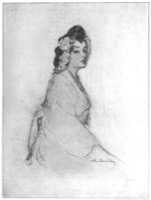
With a cry of joy he forced it open and beheld on one side a miniature of himself and the name “Francisco.” On the other, the lady of his dreams, a woman’s name and the name of a city across the sea. Miguel had kept his promise.
"There is no greater excitement in my life than writing something that I think is true." —John Hersey
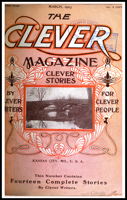
Old Stephen Lee entered the dingy office of Clinton East, and hurled this thunder-bolt at the young lawyer:
“Git your hat, young man, and come with me. Old Phillips had a tetch of paralysis last night. He’s wuss more skeered than hurt, but he’s got to ease up. He’ll have to have help in Fred’s case, and he wants you. Come on; he’s waitin’ fer us now.”
Mechanically, doubting his senses, East walked at Lee’s side along the streets of the country town. For two weary years he had starved and struggled here, had watched litigants pass his door to patronize old Phillips, until he saw no course to pursue but to return to his eastern home, where he could at least eke out a livelihood.
His one consolation for the wasted years was the thought that he had won the love of Ethel Lee, and that consolation was weakened by the fact that her father, the wealthiest farmer in the county, had refused his consent to a marriage. Even when the shock of Fred Lee’s arrest had come, old Stephen Lee, disregarding the entreaties of Ethel, had refused to allow East to assist in the defense, had turned his back upon him with the remark that: “…he did not keer to have Phillips hampered by a young sprig with nothin’ in the world but a sheep-skin.”
Little wonder that East was dumbfounded when this summons came, that he was asking himself as he strode along at Stephen Lee’s side if the tide had turned at last.
Phillips, in gown and slippers, seated in an easy chair near a window, silently motioned his callers to chairs. An anxious expression was on his wrinkled face as he slowly adjusted his glasses to his hooked nose and turned his shrewd gray eyes toward his young competitor.
“I presume,” he said in a low voice, “that Mr. Lee has informed you why I have sent for you. I have had a warning. The time has come to me, as it must come to all, when I must yield the right of way to younger and more vigorous rivals. I do not complain. I have fought a good fight and I have conquered. Those who have entered the race against me have fallen by the wayside. Now, at sixty-one, I am wealthy. I can afford to rest.”
“I have chosen you, because I know you have ability, courage and thoroughness. Don’t interrupt me. I am overtaxing my present strength, and must finish. I make you this proposition: Under my direction you will at once take charge of the Lee case and will perform all of the work of preparation that yet remains. I will be able, I think, to assist in the trial of the case — my last case. If you meet my expectations you will assume control of my business, subject to my advice and counsel. Your interest will be one-fourth of all old business, one-half of all new. As soon as you have all matters well in hand I will go abroad, for an indefinite time. Five years after my departure the business becomes entirely yours. Do you accept?”
“I certainly do, sir,” said East, "and I wish to —”
"Yes, yes, I understand. But your work will speak louder than your thanks. And now, good-morning, gentlemen. Return, both of you, in the morning. There are some points in young Lee’s case that I wish to discuss with both of you.”
At the gate, Lee faced East and said, "Well, I’m surprised, and I reckon you are. And I want to say to you that if you think I have ever disliked you, you are mistaken. But the man that gits my daughter must first show that he kin provide for her. You may have talent, but you can’t eat talent; you must know how to market it, to cash it in. Now, I don’t want no rush about this marriage, but I’ll say this much. If you git Fred clear, and if this here deal with Phillips pans out all right, you’ll not find me in the way.”
Left alone, Clinton wanted to throw his hat in the air and give one good, old-fashioned, hearty college yell. But he didn’t. He hurried to his office, hurled his hat into a corner, half spoke, half shouted, "At last,” and then sat down to think it all over. After which, of course, he went to tell Ethel.
It was the night before the trial of Fred Lee. Every necessary preparation for the defense had been made, and Clinton was enjoying that feeling of satisfaction that follows work well done. Now, before seeking sleep, he sat in his office building castles in Spain, basking in sweet anticipation. The click of a crutch upon the deserted street rudely recalled him to earth.
"That’s Joe,” exclaimed East. "What can he want here at this time of night?”
The crippled boy entered, hobbled to a seat, and sat there in silence, with bowed head.
"Well, Joe, what is it?” Clinton finally asked. More than once had he assisted the parentless lad, whose maimed body, quick intelligence and quiet manner appealed strongly to the young lawyer’s sympathy.
Without raising his head the boy answered, almost whispered, "Mr. East, you will hate me, but I can’t keep it any longer, I must — tell the prosecutor — that I saw it.”
"Saw what, Joe?” Clinton was wondering if the boy had gone daft.
Slowly the boy raised his face, turned his terrified eyes upon East, and answered, shuddering: "The murder! I saw Fred Lee kill Bill Thurber! I can’t keep the secret any longer. I am on my way to tell the prosecutor — but I wanted to tell you first.”
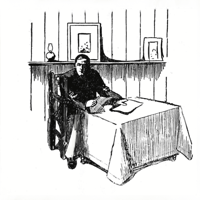
Into his chair East sank, stunned, helpless, limp. Strange buzzing sounds rang in his ears. The room seemed whirling ’round. In a moment he regained possession of his faculties. Then followed desperate thoughts. This boy, sole witness of the awful deed, was in his power, would listen to his counsel. Before morning he could be taken far away and Fred would be safe. He glanced about him to see that windows and doors were tightly closed. Then he leaned forward and said, "Go on, Joe. Tell me what you saw.”
Slowly, with faltering voice, the boy told his dreadful story; told how, while fishing in the river, he had heard angry voices, had seen Thurber and young Lee appear on the bluff that overhung the stream, had witnessed Lee strike down his fleeing victim with a weapon which, with the body of the murdered man, he cast into the river.
“I never meant to tell,” the boy cried, “You've been kind to me, and I knew 'twould break Miss Lee's heart. But last night for the third time I saw my mother in my dreams, and she said to me, “Joey, you must tell.” She leaned over me and kissed me like she used to do. All day she has seemed near me, pushing me on. 0h, Mr. East, tell me what to do — tell me what is right. It seems awful to let a murderer go just because you have been kind to me. But I will do what you say. I know you will not tell me wrong.”
Joe was on the floor now, sobbing, his head upon Clinton’s knees. East's face was pale as he stooped and gently lifted the boy into a chair. With bowed head, his hands opening and clinching convulsively, he paced up and down the little office. The boy huddled in the chair — watched him — silent.
To and fro East strode, many times seeing two visions; one of peace and love and happiness, a united family, fame and wealth, the realization of all his hopes and dreams; the other a vision of sorrow, unfathomable, unutterable, a murderer's gibbet, a family broken and eternally disgraced, failure, a miserable future, the loss of everything his heart held dear.
Through both pictures came glimpses of Ethel’s face, her dark eyes looking into his with abhorrence and reproach. But back of all he saw a bruised and swollen form, its sightless eyes turned toward the stars, lips gasping as the turbid waters hurried it onward, “Honor or Love? Which will it be? Choose quickly.”
Fiercely he turned upon the shrinking watcher and hissed, “Why did you come to me? What devil sent you here?” Then he opened the door and said, “Go!”
As the boy hobbled out into the darkness of the night he raised his white and tear-stained face toward his only friend. Clinton, looking into it that face, said, gently, “Forgive me. You are right. Tell all — and May God help us.”
Leaning on the old desk, he pillowed his head on his arms and listened to the sound of the crutch, each stroke a knell of hope, until he heard it no more. Morning had dawned when he arose, murmuring wearily, “I must tell Phillips.”
“Why, God bless me, sir, (which was not exactly the objurgation Phillips used) if I ever heard of such imbecility. Do you know, sir,” he roared, “are you capable of comprehending, what you have done?”
“I think I comprehend exactly what I have done; more thoroughly, perhaps, than anyone else concerned,” Clinton replied.
“You do, eh?” snarled the enraged old lawyer. “Allow me to venture the opinion that young Lee's comprehension of the result of your action will be much more thorough than yours when he feels the pressure of the knot under his ear. We would have cleared him; the evidence was circumstantial, and weak at that. The devil himself can't save him now.”
“Perhaps some less intimate acquaintance of yours can,” retorted East, losing his temper. “Doubtless my code of legal ethics differs from yours. I have not been in practice long enough to forget my oath. Generally, a lawyer's first duty is to his client, but under such circumstances as these that duty is due the State and the community. The true lawyer will further justice, not obstruct it. I would not search for evidence to use against a client, but, when the evidence presents itself, I will not be guilty of suppressing it. What talent I have is for sale; my integrity is not.”
“My scrupulous young friend,” said Phillips, cynically, “you have much to learn, so much that I will not undertake the task of instructing you. You will remember that the proposition I made you was conditional. You have broken the condition, and I now withdraw the proposition. But I trust that your wonderful sense of duty will bind you to remain in the case until the jury returns its verdict of murder in the first degree. Considering my condition, and your familiarity with the details of the case, you certainly owe that much to our client.”
“I will fight to the last,” Clinton answered. “As for the withdrawal of your offer, you have but anticipated my action. Nothing could induce me to remain here after this trial is over.”
“I would think not,” sneered Phillips. “You could not be expected to face either the father whose son you have betrayed or the sister whose brother you have murdered. You”
East, livid with rage, had clutched the old lawyer's throat.
“John Phillips,” he panted, “do you want me to choke the life from your miserable carcass? If you had one spark of honor in your despicable nature you would not add to my agony. I am losing more than life. Sit down there and listen to what I say.”
Released from that vigorous grasp, Phillips sank down in his chair, sputtering. East continued:
“You must go immediately and break this news to Ethel. Conceal nothing. I bear the blame. I will save Fred Lee, perhaps not from imprisonment, but from the gallows. With all your craft and experience you can’t do that. And then I will leave this place forever.”
Then he turned and left Phillips alone.
Despite the cold, raw weather and the steady down-pour of rain the court room was crowded with curious auditors; even halls and windows were filled by a gaping, eager mass of humanity.
When East entered the room the jury had been selected and sworn, and Phillips was listening intently to the prosecutor's statement of the case. At the old lawyer’s side sat Stephen Lee and the accused, and a slight, veiled figure that caused East's heart to leap. As he took his seat at the table he met the scowls of father and son, and the latter, leaning forward, muttered, “Clinton East, if I get out of this, I’ll get even with you.”
Taking no notice of the threat, Clinton turned his attention to the jury. The master hand of Phillips was seen there. All were comparatively young, and appeared sympathetic and impressionable, and East, well knowing wherein his sole hope lay, was encouraged. Once he offered a suggestion to Phillips and was promptly snubbed.
When the State's attorney had finished, Phillips, to East's surprise, at once made his statement to the jury. Though brief, it was strong as could have been expected under the circumstances, and at its close Clinton realized more than ever before how desperate were his client's chances.
The State, relying chiefly upon Joe’s testimony, offered but few witnesses, and they were subjected to a most searching cross-examination by Phillips. Joe was racked, threatened, bullied and denounced, until Clinton’s heart ached. But the boy could not be shaken nor confused, and when the State rested, its testimony, though small in volume, presented no weak points; it was conclusive and unimpeachable. All necessary and material facts stood out in bold relief to point the path to the gallows.
For the defense, young Lee himself was the chief and almost the only witness. It was apparent that Phillips had carefully coached him for the occasion. He firmly denied having been with Thurber on that fatal day, and he was cool and unshaken under the fire of a severe and skillful cross-examination. His story was a plausible one, and without Joe’s testimony was sufficient to raise a reasonable doubt and bring an acquittal.
The prosecuting attorney made a vigorous and able argument, and Phillips followed with an address that evoked East’s genuine admiration. It was a profound and valuable lesson to the young barrister to see and hear that old gladiator upon such an occasion. How clearly and forcibly he presented every favorable circumstance, however slight; how carefully and cunningly he avoided every dangerous point that could be safely omitted, and when avoidance was impolitic, how skillfully he handled, tossed and juggled the dangerous fact, how masterfully he twisted it to the prisoner’s advantage. How subtle his reasoning, how plausible his theories, how ingenious his explanations, how well-hidden his fallacies. His whole effort was directed toward the production in the mind of one or more of the jurors of a reasonable doubt, that salvation of many a guilty wretch, and when he at length resumed his seat, trembling and exhausted, it seemed to many that he must have succeeded.
But he himself was not deceived. He could read too well the living page before him. He knew that powerful as his speech had been, the boy, cowering in the corner, had made a stronger one; he knew and had recognized the unmistakable accents of truth, and he knew that the jury admired the lawyer but believed the boy.
“East,” he whispered, wiping his perspiring face, “I have failed. You must save this man. Get a life sentence and there may be a chance for a pardon some time. If you think you can’t do that we may as well let the State close.”
For one moment, as the young and untried barrister arose and advanced toward the jury, his courage faltered. His head swam, his knees trembled, and he saw as through a mist the half-sneering features of the prosecuting attorney, the scowling faces of the two Lees, the calm, impassive countenance of the judge, and the crowding mass of expectant auditors.
Then, by a mighty effort, he riveted his attention on the twelve men before him, those dread arbiters who held life and death in their keeping. Here was the mighty, mysterious instrument whose mystic chords he must sweep with deft and skillful hand, must attune to harmony that they might sound a strain in unison with the passion surging within his own bosom. It was the grandest, moat sublime, the most difficult of instruments that the young, untrained musician reached tremblingly forth to touch; it was the Creator’s own. Harmony meant happiness, and discord death.
In low and hesitating accents he began his task. Gradually his voice grew stronger, his thoughts came faster and more clearly, his words followed more easily and eloquently. His was a plea for mercy, simple, yet strong, passionate and pathetic. There was no attempt at labored argument, no display of learning, save that gleaned from Nature’s open book. He talked to the jurors, not over them, and they understood and followed him.
He appealed to them as fathers, brothers, sons, to their home life and home ties. Skillfully and touchingly he depicted the early life and environments of the accused, his rearing under the stern rule of an exacting father, deprived from infancy of a mother’s love and teaching. Fervently he pictured the interweaving of the lives of the brother and sister, their mutual affection, their dependence upon one another in all the trials of their motherless existence.
Vividly he portrayed the many noble traits and generous characteristics of the accused, his blameless life up to that time when, thrown unguarded and un-counseled among evil and vicious associates, he fell a victim to the demon of drink. He declared that the object of all penal laws was reformation, not vengeance.
He dwelt upon the punishment already inflicted by the ordeal, insisting that the object of the law had been accomplished, and that the fearful lesson had started the feet of the unfortunate prisoner upon the pathway of the right, never to leave it. With powerful effect he contrasted the desolation and grief with the joy and thanksgiving that would follow their verdict as it might be rendered.
He pleaded for the sake of that young girl whose faithful, sisterly love had clung so devotedly to its object for so many years, through so many trials; that sister who had labored so unceasingly to lift him, her only brother, from the depths into which evil and malicious hands had dragged him; that sister whose own life, perhaps, hung upon the verdict. He pleaded for that mercy that they themselves would ask for their loved ones; that forgiveness sanctioned and sanctified by Him whose mission was mercy.
When he had ended no sound broke the silence save the young sister’s stifled sobs and the wailing of the storm without. Judge and jury, audience and attorneys were silent and motionless, and tears other than those of weak woman’s were there.
Exhausted, and unwilling to witness Ethel’s grief, Clinton left the court room as the prosecutor arose to deliver his closing argument. As he passed out he overheard a threat made by one of young Lee’s associates. He turned back and beckoned Joe to follow him. “Come with me,” he said, “your life is in danger.”
Together they went to East’s little office, and from its window silently watched the lights that soon glimmered from the jury room through the fast gathering gloom of the night. Far into the night they waited, watching those ominous lights dancing and twinkling as though in mockery of their hopes. Through the darkness and the storm sounds of foot-steps came and went, and echoes of many voices arose and died away. Day dawned at last. The storm had passed, and still those fateful lights glared like the eyes of mocking demons.
Suddenly they vanished, and soon, from the court-house door, emerged a group of men, talking and gesticulating excitedly. Eagerly East went forth and questioned them.
Five years! It was a triumph — and his the victory! Would not they, would not she, relent? With returning hope Clinton re-entered the office, and for the first time noticed on his desk a tiny package, placed there, doubtless, during his presence at the trial. He tore it open, and a jeweled circlet of gold rolled forth. There was no other message. None other was needed.
With swelling heart, he turned to toss it into the fire. Then the old spirit of patience and determination returned. He would triumph again, as he had triumphed yesterday. He understood thoroughly the young girl’s nature, her sense of justice and her love of truth. He seized a pen and wrote:
“Ethel: I have done my duty. You, yourself, would not have me do otherwise. Some-day you will see this as I do. Knowing this, I cannot accept your message as final. When that day comes return the ring as I now return it, and I will understand. —CLINTON EAST.”
That day an east-bound train, with clanging bell and screaming whistle, sped toward the roar and bustle of a great city, carrying Clinton and Joe.
Clinton East, attorney and counsellor at law, is opening his morning mail. A few wrinkles and a sprinkling of gray hairs denote care and toil, rather than age. His fortunes have changed more than his appearance, if we may judge from the commodious offices and ample library, so different from the dingy den and few books of former years.
Joe, from his desk in the next room, watches his benefactor with anxious and affectionate eyes. He alone suspects, aye, knows what sorrow gnaws at his friend’s heart, knows that his cheerfulness and gaiety is assumed, knows that he must, in time, break down under the labor in which he seeks forgetfulness of vanished dreams.
As he watches, he sees Clinton open a small packet, sees him spring to his feet, pale and trembling, staring first at the letter in his hand, then at a gleaming circlet of gold that has rolled from the packet. Then he hears East’s voice ring out with the genuine, cheery ring of old days.
“Joe, I go west on the next train. Read this. I can trust you. Good-bye, my boy, and good luck until I return.”
Then he was gone, and this is what Joe read:
“Baltimore, Md. Mr. Clinton East:
“Dear SirI am going to get even with you, as I promised almost five years ago. I can say, as my father would say, were he alive, that you were right. Today I stand at my sister’s side, a man, cured of all old vices, ready to face the world anew. I hope to once more meet you here at the old home. As for Ethel, she sends what you will find inclosed.
“Your debtor —FRED LEE.”
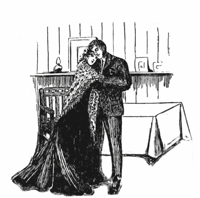
"The role of a writer is not to say what we can all say, but what we are unable to say." —Anais Nin
Flip th’ piller a leetle higher, Mirey," said the old man peevishly. Th’ cher hurts my backan’ th’ sun’s a shinin' right in my eyes.”
The girl adjusted the pillow and with masculine strength, lifted the crude chair with its paralyzed burden to a shadier spot under the apple tree.
“Ye ain’t a treatin’ Jake right, Mirey,” grumbled the old man. ‘‘He ain’t said nothin’, but I kin see it; an' you a goin’ to marry him this fall.”
“Mebbe I am — mebbe I ain’t.”
The old man looked up at her anxiously.
"I knowed it,” he exclaimed. “I’ve seed it a-comin’ ever sence that Evans, come a snoop-in’ ’round here, a pizenin’ yer mind with his stories ’bout fine houses, an’ great ladies, an’ dresses, an’ dimunds. What brought him ’way up here in this wild place? Who knows, what he is, ennyhow? Like as not he’s one of them revnoo spies.”
“Ye’ve got no call to slander him that a way, pap. Lots of them city folks spends their vacations in th’ mountains. An’ ennybody kin see he’s a gentleman. He ain’t no spy.”
These were hot words over the young city man, leaving the old man sullen and dissatisfied and the girl defiant.
As she turned to go he said: “Mirey, they’s sumthin’ I clean forgot to tell Jake when he come by, an’ I must see him. He ain’t more'n half way to th’ still, yit. Run, Mirey, ye must bring him back.”
The girl hurried obediently down the steep path and along the base of the mountain, smiling as she went, “I kin coax him into it after while, she murmured,“an’ then I kin be sumbody. Rob says I kin have ennything I”
A crash, a rattle of descending stones, a smothered ejaculation, and two struggling, interlocked men rolled down into the path below her. One of them, wrenching the revolver from the other’s hand, arose panting, tall and powerful. His opponent lay quite still, blood trickling from a wound on the curly, handsome head.
With a choking cry, Mirey sprang forward and raised the wounded head in her arms. “Ye’ve killed him,” she, moaned.
“He’s only stunned a leetle.”
“You lie, Jake! An’ this won’t do ye no good, neither.”
The tall man bent down and from the inner pocket of the stylish coat drew a long, official-looking envelope.“Look at that, Mirey,” he cried, with a note of triumph, “From th’, Internal Revnoo D’partment!”
“That ain't his name on it — It’s fer sumbody else. Let me read what's inside.’’
She reached up a trembling hand, took the opened sheet and her sun-browned face turned pale. The wounded head dropped from the encircling arms and she staggered to her feet, swaying, crushing the letter in her hands. The man at her feet stirred and sighed. The tall man knelt and with his handkerchief bound the unresisting hands cruelly tight.
“What ye goin’ to do with him, Jake?” asked the girl, almost inaudibly.
“Ye’ve heered rumors of what went with ’tother one,” the tall man muttered, with a significant glance. “But ‘tain’t fer me to say. Th’ boys'll decide that.”
The girl shuddered and turned away.
“You’ll have to go an’ tell th’ boys, Mirey. while I watch him. He musn’t git away.”
“I kain’t bring them, Jake. I’ll watch him. He’ll not git away,” savagely. “Give me th’ gun.”
Jake’s eyes looked searchingly into hers. She met the scrutiny unflinchingly.
“Kin I trust ye, Mirey?”
“Don’t I know what'll happen ef he gits away? D’ye think I’d send pap and you to prison? I’ll kill him first. Go — an’ hurry.”
She seated herself on a nearby boulder and with drawn face and cold, pitiless eyes regarded the unconscious captive. The bees, home-going, heavy-laden, droned musically among the blossoms, loath to leave.
From the distant river came the faint whistle of a passing boat. A great, black buzzard flapped heavily down upon the dead limb of a sycamore, wiped his hooked beak on his sable plumage and cocked his hey baleful eye inquisitively at the fallen man.
The captive heaved a long, quivering sigh, opened his eyes, struggled. and sat up, staring about him confusedly. “Mirey,” he said, faintly. “Is that you. Mirey?" He drew his feet under him to rise. “Mirey, have you turned against me?”
“Ye played th’ hypocrite long, enuff Joseph Armacost.” she sneered.
The breeze rustled the letter at her feet. He glanced at It and started. “I guess the play’s over,” he observed, wearily.
She made no reply. After awhile he looked up again and said softly: “Mirey. before they — before I go — will you forgive me?”
She turned away her head to hide the tears of wounded pride that would not be repressed.
“It was mean, cruel, despicable,” he continued, “but we have to do such things sometimes — they’re a part of our orders. I wish you could understand and forgive me. Mirey.”
“Fergive ye!” she burst out. “Fergive ye! You lied to me, made love to me, learned me to love — yes, to love — sich a snake as you. You’d have sent poor old pap to prison, an’ made me an outcast — a convict’s darter. Fergive ye? Never — you hound.”
“Mirey, it wasn’t all a lie. I did admire you — I do yet. And I intended to arrange that your father might escape if —”
“Then ye wouldn’t have done yer duty. You’d have played traitor to both sides. Don't talk to me. I don’t never want to hear yer voice.”
There was a long silence — then the man remarked: “I suppose Jake has gone after the gang.”
“Don’t mention Jake’s name. You ain’t fit to. He’s a man.”
“Look here, Mirey. Do you realize what you are doing? You are helping murder me, as surely as though you had shot me through the head with that revolver. Do you understand what that means — to take human life — in cold blood? Bad as I am I never did what you are doing now. You are helping murder me, Mirey.”
The girl shuddered again, then steeled herself.
“How do I know what they’ll do with ye? That’s their bizness — not mine. You an’ them fer that.”
“Mirey, you know as well as I that I’ll never see another sunrise if you keep me here thirty minutes longer. You loved me once, Mirey. An hour ago you would have gone with me to the ends' of the earth. Do you hate me so now that you will stain your soul with my blood?”
She gave a great sob.
“What kin I do? I dasen’t let ye go. Let me alone. Fer God’s sake don’t tempt me.”
He strained his strong wrists. The handkerchief fell over the supple, pliant hands, and he sprang to his feet, defying the deadly weapon upraised in the shaking hands.
“Stop! I’ll have to shoot! I promised Jake — ye're a spy.”
"Shoot, then. Mirey, I’d better die that way than by torture. Shoot — right here — between the eyes — be sure.”
The dark eyes looked Into his, filled with tears, and the grim muzzle dropped.
“0h, Rob, I kain’t — I’m a coward.”
He sprang forward, seized the weapon, and fired every chamber in the air.
"Now, you’ve done your duty,” he exclaimed, breathlessly. “You’ve fired every bullet at me and only wounded me as I ran. I’ve a boat concealed at the river. Goodby, Mirey.”
She grasped his arm and clung to him desperately.
“Not till I know ye won’t inform on pop and — Jake. I must know that, er I’ll hold ye till they come an’ they’ve heered th’ shots.”
“Could I betray you — after you’ve saved me? Mirey — girl — look in my eyes — they will never know.”
She looked, knew, and released him. He stooped to kiss her, but she thrust him back fiercely. He seized the brown right hand, pressed it to his lips, and bounded away. The girl fell on her knees.
“0, Lord, fergive me fer what I’ve done. Fergive me fer the lie I’m about to tell. An’, 0, God, help me to fergit him.”
Then she pressed her burning lips to the brown right hand, rubbed the spot madly with the crushed letter, and, with a little moan, cast the paper away, as she cast him from her heart, and rose to face the hurrying men.
Late that night when Jake returned, weary and desperate, from the fruitless search, Mirey, from the old man’s side, stepped forward in the moonlight to meet him. “Jake,” she said, softly, “don’t worry. He’ll never tell. I know.” Jake looked down, sternly, into the dark eyes.
“Mirey — you let him go.”
She laid both brown hands on his arm and looked up, pleadingly, into the grave, rugged face.
“Yes — it was better. I’ve been a fool, Jake. But it’s all past now. An’ Jake — ye needn’t wait till fall — ef ye’ll have me yit."
Jake stooped, kissed the quivering lips. put his strong arm about her and led her to the smiling old man.

"A story is a way to say something that can’t be said any other way." —Flannery O’Connor
In the ambitious fancies of the governor, gazing through the window near the rear of his desk, the shifting clouds that capped the distant peaks assumed prophetic shapes
Masses of wild, gesticulating men, assembled in convention, slowly changed into a proud procession with flaunting banners, bands and prancing steeds; then spread and curled and drifted into the semblance of a marble hall, wherein sat senators in solemn state: then massed, and rose, and took the shape, of a gigantic chair, in which a president might sit to guide a mighty nation.
A pleasing, flattering vision from which the dreamer turned unwillingly when the little, wan woman was ushered in.
“I am sorry, madam," said the governor, gruffly, when his insistent visitor had paused for breath, “but I have examined your petition and find no grounds to justify a pardon. Your son pleaded guilty — did not deny the charge. Malefactors must be punished, and it is my duty to enforce the law. That is all I have to say. I am busy and see no reason to prolong this discussion.”
He might have said that he had examined the signatures more carefully than the petition, and found no name of political weight, but the little, wan woman could not have understood. She wiped away a tear and arose with a weary sigh.
"It’s ‘bout as I expected — though I did think mebbe you'd see it different. Because he told th’ truth he has to suffer. I 'most wish now he’d a-run away, as sum of ’em wanted him to.”
"Very foolish, madam.” remarked the governor, turning to his desk. “He could not have escaped.”
"O, I dunno. Sumtimes they git away. There was th’ Widder Bennington’s boy, back in New Hampshire, run away with th’ bank’s money, an’ they never ketched him. But th’ widder give up everything to make it good. I hain’t got nothin’ to give. That makes a difference.”
A faint pallor crept over the governor’s bearded face; there was a tremor in his voice as he asked quietly: “You have lived in New Hampshire. Mrs. Appleby? Please be seated. Did you know Mrs. Bennington and her son?”
“I never seen th' boy. He run off before th’ widder moved to our town. I’ve heered a rumor that he changed his name an’ got to be sumbody out West here sumwhere. — a jedge or sumthin’. I reckon it wasn't true.”
“Did Mrs. Bennington grieve much because of her son’s misfortune?”
“Misfortune! I never heered enyone call it misfortune. He took th' money, same’s my boy did. He took dollars where Joey took cents, an’ he run — Joey didn’t — that’s th' difference.”
The governor nervously fingered the piles of papers on his littered desk.
“There may have been mitigating circumstances in young Bennington's case. Did you ever hear that he was led into speculation — that he was not naturally a criminal?”
"Neither was Joey,” said the little woman, bitterly. “Ain’t there mitigating circumstances in his case? He’d never done it if I hadn't been down sick so long an’ nobody to pervide for me but that poor boy. An’ he stood up like a man. He wouldn’t run an' he wouldn’t lie. He’d a-paid back every cent, too, after I got well, if they'd a-give him a chance — though they wasn’t payin’ him half decent wages.”
"Yes, yes — no doubt. They all intend to do that. But you haven’t answered my question about Mrs. Bennington.”
"Did I know th’ widder? Well, nobody could git much acquainted with her, but we could all see she was' a-grievin’ herself to death 'bout somethin’, though we didn't hear 'bout th’ boy till she’d been in our town quite a spell.”
"Lived all alone in a little three-room house, an’ didn’t mix with folks. Sum ‘lowed she was proud an’ stuck up, but she wasn’t. As sweet an' gentle a woman as you ever seen, she was. I know, because she lived right next door to me, an' sometimes she spoke to me across th' fence. Seemed like she was lonesome an' jest hungry to talk to sumhody, an’ was afeard to. But whenever I mentioned callin’ on her she'd kind o’ shy off, an’ I never was in her house till th’ night she died.”
“Why, she never even let ennybody know she was took down, not even a doctor. She’d a-died there all alone if I hadn't suspected sumthin’, not seein’ her around, an' jest went in an’ found he purty nigh gone. Then we had th’ doctor, but we couldn’t do nothin’, only make the poor soul more cumferble. She didn’t say much — she couldn’t — only once, when I axed her was there ennything she wanted, she kind o’ sobbed an’ whispered. ‘My boy — if only I could see him once more.”
“She went purty soon after that — easy an’ peaceful, like goin’ to sleep — jest as th’ robins begun to sing in th’ mornin’; I was boldin’ her hand when she went. Jest grieved herself to death ‘bout that boy.”
“We laid her away, nice an’ decent — we didn’t grudge no expense. Had th’ minister, n’ — was you tryin’ to say sumthin’ governor? If you’d jest turn your face this way — I’m a might deaf. Mebbe I’m worrying’ you with my talk. I reckon I’d better go eh?”
The governor did not answer. His back was turned to the woman in rusty black; his eyes again saw visions in the distant, drifting clouds. No halls of marble there — only a quaint old mansion, elm-embowered, ‘mid odorous orchards on New Hampshire hills; no proud procession now — but white sails swelling in the salt sea breeze; no senators in solemn state — only one face, patient and sweet, haloed silver hair, that smiled and called him by a long-forgotten name.
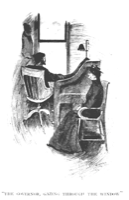
And then the west wind rose and whipped the drifting clouds into long shafts that lay along the peaks like bars of iron across a granite cell.
The governor seized a pen, and with haste filled the spaces in a printed form, affixed his signature and the seal of state, and held out the document to the woman. With a choking cry of joy, and broken words of thanks, she sprang at it and hugged it to her breast.
“Yes, yes — I understand,” the governor interrupted, hoarsely. “It is not much in comparison to what you did for Mrs. Bennington. Please go now Mrs. Appleby — I wish to be alone.”
"I write to reach the part of all of us that wants to feel not alone." —John Green
Come on, Jack, let the kid go.”
“No, indeed. The little fella came near winging me with that last poisoned arrow. And I want Kate to see a Igorot, fresh from his native jungle.
Come along, I’ll not hurt you.”
Far up on the mountain side, with wounded arm and broken bow, lay the little brown man. He heeded not the pain, felt not the awful heat of that mid-day sun; he only saw, with tiger eyes, his motherless boy, his little Juan, borne away by those two blue-shirted giants toward the troopers gathering in the valley. The heart of the father raged within him. But, what could one man, wounded, unarmed, do against so many? Had not he and his comrades just been scattered, chased up the valley, shot down by these terrible Americanos?
Ah, this was quite different sport from potting Spaniards, this ambuscading of Americano warriors.
And now little Juan was gone forever. But what a brave fight he had made, his little arrows all sped, before he turned to flee. No doubt he would be eaten to-night by these ferocious strangers. But there remained revenge. Another bow can be found, the trail is plain, and the Igorot swift. Never mind the wounded arm. Bind it with healing herbs. There is work to be done.
Will they never halt, those troopers, that they may be overtaken? Up mountain, walk; down mountain, trot; over plain, gallop; they are made of iron. The little captive, bound behind the big captain, notes with keen, quick eyes every landmark, rock and river, mountain and plain. Ah, my troopers, young though he be he is the finished product of generations of past masters in woodcraft, and though you carry him to the farthest confines of Luzon, let him once escape and he will regain home and kindred as surely and unerringly as the gigantic eagle of the Philippines that soars above you.
And far back on your trail comes the little brown man, never halting, never swerving, day after day, night after night, as vengeful, as unrelenting, as the Apache of your native land. Woe unto that good captain of yours, woe unto his waiting wife, if that little brown man with the long bow and deadly arrows ever comes within bow shot.
Hot now the trail enters a country new to the Igorot. Many villages and many people, rice fields and dykes, caribou drawing squeaking carts; now and then groups of blue shirted soldiers with those wonderful, murderous guns. Caution, little brown man. These people, too, are brown, but their tongues are strange and they joke and laugh with the Americanos. You must change your dress. That is easily done. Darkness, a crouch, a spring, a quick thrust; that is all, and the river is very swift and deep. The silver in the pockets will not come amiss in this strange land. Filipino gallants should not wander so far from the village alone after night and in time of war, even though it be to woo Filipino maidens. And you must cast away your weapons, all but the long, keen knife. You must learn a few words of this strange language, and you must avoid company and must speak but seldom.
The trail is lost now among so many, but it seems that all these white soldiers are sent from a village called Manila, and that a troop with a big, red-bearded captain and a Igorot boy have passed along on their way to that village. Onward, then, to Manila! Juan is yet alive. Perhaps they are saving him for a grand feast in Manila. Manila! — the word is difficult for your Igorot tongue, but by its use and inquiring gestures you may learn the direction from an occasional traveler.
Onward, onward, miles and miles.
And then, at last, in the early morning, as he leaves a rice swamp and cautiously ascends a small bank to look about, the little brown man starts with surprise.
Away yonder, water, all dancing water and blue sky. Over there, a village, a wonderful, mighty village, such as his mind could never conceive of. The sun shines brightly on many spires, the bugle calls come faintly to his ears, monstrous canoes glide grandly over white crested waves, some with great white wings, some belching fire and smoke. Manila — at last!
Americano captain, you of the red beard, strolling carelessly homeward, you hear the bands playing upon the Luneta, the laughter of merry promenaders, the babel of many tongues. You see the brilliant lights of street and shop flashing upon many faces, fair and swarthy, upon gay costumes of charming women mingled with the khaki and the blue of army and navy. But you cannot hear the cat-like footsteps of the little brown man, you do not see the glitter of his eyes as he follows you through the crowded streets, halting as you halt, moving as you move, even to the entrance of your dwelling.
There is safety in the peopled streets, my Captain, there is security within the barred doors of your home, but beware the evening stroll in the shadowy shrubbery of the garden, for a little brown figure crouches there, keen eyed as the eagle, crafty as the fox, agile as the tiger, and his knife bears the venom of the serpent.
Ah, well may you gasp in surprise, well may your father-heart leap for joy. There, only a few yards away, where the moonlight sifts through the tropical foliage, hand in hand with the red bearded one and his good wife, comes little Juan, alive, well, smiling, trying to repeat the words of the hated Americanos, who laugh merrily at the efforts of their pupil.
And you, little Juan, why do you break from them and bound forward, crouching, listening, panting? Again it comes, that low, weird cry, mingled with the strains of the distant music on the esplanade. To the ears of the Captain and his wife ’tis but the cry of some strange night-bird, but to you it is the wood-call of the Igorot hunter. Many times in far-away forests have you and your father traced each other by that tremulous signal. Warrior of the Igorots, your weary, faithful quest is ended, for it is truly your child who bounds toward you, calling, with extended arms. Leap from the shadows and clasp him to your breast, while the Americanos gaze in wonder.
A strange tale this, that Juan tells. They have treated him like a little prince. They have taken him into their home, have clothed, feasted, petted him. He goes with them everywhere, sees and hears everything, the wonderful houses, the mighty canoes, the marvelous weapons, the thousands of invincible warriors of these powerful people from over the great water.
He is pleased, delighted, charmed with this fairyland.
But his heart is with you and the forest home, little brown father, and he will return — yes — but not now. A little time yet in this enchanted realm filled with life and light and miracles and music — then he will come. Will you not stay here with him, with these good people whom it is folly to fight, who wish peace, who will be your friends?
You listen, you hesitate — but you are not a child. A warrior of the Igorots must breathe the air of his mountains, the odors of his forests, must hear the death wail of his enemy, the night cries of the prowling beasts. Yet, to please you, Juan, he will rest a little, will even accept a little food, will thank, gratefully, by signs and broken words, the Captain and his wife for their kindness to the little one.
And then, as a signal gun startles him with its mighty voice, he vanishes like a shadow in the night, calling back to Juan, in their native tongue, to come soon.
Two hundred picked fighting men, armed with deadly Mausers, lie concealed on either side of the mountainous ravine. Four hundred pairs of glittering eyes watch exultantly for the appearance of the little band of troopers led by the treacherous guide. How should they know, those gallant forayers, that the farther end of the winding pass is closed by an impassable barrier; that one detachment of the hidden foe will bar their retreat when they have passed, while the others pour down a murderous flanking fire from both sides? Do but ride well into that cunning trap, my blue shirted ones, and your eyes will never again behold Old Glory, your ears will forever be deaf to the call of the bugles.
The little brown man carefully shifts his position, that he may sooner scan the oncoming enemy. He cannot see them yet from where he lies, but he hears the clatter of hoofs, the jingle of accoutrements, the laughter of the troopers. Suddenly the little column swings into view around the base of the mountain. The little brown man starts to his feet. His gun clatters among the rocks. He does not hear the angry, low-toned caution of his officer. But he sees a great red-bearded Captain and a brown faced boy riding at the head of that column to certain death.
With a cry of warning he leaps forward and is half way down the side of the steep ravine before his comrades divine his intention. Then the Mausers ring out and the little brown man pitches forward and rolls to the very feet of the red-bearded Captain, who, with a soldier’s quick instinct, has already given the command to dismount and deploy.
Saved! — but the film of death is over the eyes of the Igorot. He has only time to place the little hand of Juan within the great palm of the Captain, to see their signs of understanding and assent. Then, with the sounds of battle in his ears, his shattered head on Juan’s breast, the little brown man closes his eyes forever.
"There are three rules for writing a novel. Unfortunately, nobody knows what they are." —W. Somerset Maugham
Alone, in my office, near midnight. I am reviewing my rough notes of the evidence given that day at the coroners inquest. They ran substantially, thus;
“EDWARD A. GRAY, Bachelor. 58 yrs old. Owner and manager Edgewood Hotel. At the desk on evening of Jul. 31st. About 6 p.m. deceased entered. Registered as W. D. Straughn. Aurora, N. Y. Shown to room 16. 6:30 relieved by clerk, Robert B. Hayes. Retired to rooms—20 and 21— about 10 p.m. About 11:30 awakened by someone moving about in room 20. Called out, no answer. Took revolver from under pillow, got out of bed and reached with left arm to turn on the light. Before I could do so man leaped and stabbed me in left forearm. Fired twice, he fell. Turned on the light and saw Straughn, dead. Recognized him by clothing, face was shot away. Several people rushed in; think Hayes came first. Think he picked up Straughn's knife. Know of no motive for Straughn's action, might be robbery.
ROBERT B. HAYES, unmarried. 28 yrs old. Born and reared in county. Clerk at Edgewood 3 yrs. On duty 6:30 that evening. Never saw Straughn alive. About 11:30 heard two shots in quick succession. Rushed up stairs. Hall light was burning dimly. Saw Mrs. Emmett entering the door of her room — 17, opposite a little south of room 20. Think she had on a white wrapper. The door of 20 was not quite closed. Pushed it open and entered. The light was on and Mr. Gray was standing with revolver in right hand. Left arm was bleeding. Straughn lay on the floor, face shot away, open pocket-knife near his right hand. Picked up the knife. Mr. Gray said the man had broken into his room and stabbed him. Door catch was broken.
MRS. FLORA EMMETT: Widow. 35 yrs old. (Beautiful) Wealthy. Husband, William D. Emmett, lost at sea 3 years ago. Came here from New York one month ago. Took rooms at the Edgewood, 16 and 17, intended to buy country residence. Never saw Gray before — speaking acquaintance only. Awakened by severe tooth-ache. Arose, slipped white wrapper on, stepped into the hall, intended to procure remedy of Mrs. Ralston in room 14. Heard scuffling, then two shots in room 20. Stood for a moment, shocked and terrified, then fled back to 17. Was confined to her rooms by neuralgia for three days afterward. Never saw Straughn alive.
This is all the evidence we could find. I could learn nothing of Straughn or his antecedents. He was unknown in Aurora, N. Y. Nothing among his few personal effects to furnish a clue to his identity. I had no choice but to accept the finding of the coroner’s jury — justifiable homicide.
With this conclusion, I sat back in my chair for a few moments rest, then straightened up with a jerk.
A man was in the chair opposite my flat-topped desk. He was leaning back, chin on his breast, staring at me. His eyes were dark and serious, his face pale, his head slightly bald. I judged him to be a professional man, about forty years old.
I was impressed by the sadness of his expression. While I was wondering how he had entered unnoticed, he spoke:
“You are Mr. Neilson, the prosecuting attorney of this circuit?”
“I am.”
“You have just decided not to prosecute Gray. Quite proper, with the evidence you have at hand. But, Gray is guilty of unprovoked and pre-meditated murder.”
“Now” with an impatient gesture, “don’t interrupt me. My time is limited. The murdered man’s name is not Straughn it is Emmett, William D. Emmett. Yes, he is or was Mrs. Emmett’s husband. They were married five years ago. One year afterward she deserted him. Emmett sailed for Europe on the Tuscola, searching for her. The ship foundered at sea, but Emmet escaped. The details of his adventures and final return to New York are not essential.”
“He had sought his wife. Foolish, I know, but there are men, who, loving always, love but once. He found that Mrs. Emmett, thinking him dead, had returned to New York, and, as his heir, secured his fortune. He also discovered that she had met Gray at a watering resort, and had followed him here at his request. They arranged, because of some complication of Gray’s, to meet here as strangers, and to be married later.”
"Impelled by his infatuation for the adventuress, Emmett came here to plead with her. He registered under the assumed name of Straughn, because, if his mission failed, he wished to leave her unsuspected, and free to follow her desire. He would not betray her.”
“That fatal evening he went to his wife’s apartments. She had really believed him dead. After the shock of recognition had passed, she threw herself into his arms, wept, and implored forgiveness, she lauded him in honeyed words for his constancy and charity. Then she begged him to leave her for a short time that she might compose herself. Ah, she was cunning — as merciless as cunning — as adorable as merciless.”
“She told him to return in two hours to room 20 — Gray’s room — she told him it was hers. On the morrow they would depart on their second honeymoon. He obeyed her, believed her, he was supremely happy. When he had gone. she sent for Gray, whom she loved. He was furious at the thought of losing her and her fortune. They arranged the plot.”
“Promptly, in two hours Emmett rapped at the door of room 20. His wife admitted him in the darkness, took his hand and led him to his death. Gray was nervous and fired too soon. In the darkness and excitement, the woman, fleeing to her own room, could not immediately find the door of exit, and she was seen by Hayes. Gray broke the catch of his door, cut himself, and placed the knife near the dying man’s hand. The face was intentionally blown away and burned by the second shot, to prevent recognition. Mrs. Emmett knew that her husband had no friends who were likely to trace him. It was a cunning plot, made safe and feasible by the victim himself, when he registered under an assumed name.”
“I am here to ask you in the name of Justice, the sake of that betrayed and murdered husband, to bring the guilty to trial. Will you do your duty?”.
“My dear sir,” I replied, cautiously, “this is a most serious charge against two apparently innocent persons, one of whom is a long-time and highly esteemed resident of this city. How can you prove this accusation?”
He looked, searchingly into my eyes, as though doubtful of the effect of his answer.
“I heard Gray and Mrs. Emmett discuss the affair last night — they meet again tomorrow night for the same purpose, and — I saw the murder committed!”
"Now, sir,” I exclaimed, reaching for pen and paper; "have the kindness to give me your name and address, and to state why you withheld this evidence when the officers were putting forth every effort to sift this matter.”
“My name — I will give you that later. My absence, believe me, was unavoidable.”
“This will not do, sir. I cannot assume the responsibility of having these people indicted until I am satisfied that your story can be proved beyond any reasonable doubt. If you are sincere you will answer my questions. Unless you do so, it becomes my duty to compel you to appear before the grand jury and at the trial.”
My visitor arose. "I had feared this,” he said, plaintively. “My attendance as an ordinary witness, under cross-examination is impossible. To give you my name would defeat my purpose. I can only urge you, implore you, to indict these murderers. I pledge you my honor that I will appear at the trial immediately after you have made such an opening statement to the jury as I have indicated. Look at me, sir; believe me, and rely on me. I swear I will not fail you.”
He held out his hands imploringly; his face glowed with seeming earnestness and sincerity.
I stepped quickly to the door, locked it, and put the key in my pocket. “Your request is preposterous,” I said. “You must either go with me quietly and give bond for you appearance, or I will telephone for an officer to take you into custody.”
“You doubt my sincerity,” he replied, sadly. “Since there is no other way, if you will meet me on the cliff, above the falls, at ten-thirty, tomorrow night, I will convince you, and will give you my name.”
I stepped to the telephone and called an officer. When I turned again to face my visitor, he had disappeared. I had heard no movement, but the open window — yes, the man had certainly dropped from that second-story window!
I rushed down into the deserted street, and saw no one but the officer answering my call. With all the available police force I searched the city without success. The fellow had out-witted us.
The next night, at 10:30, I stood above the falls. I had taken no one into my confidence, for I felt that my errand would be fruitless, perhaps ridiculous. I was strong, active and well armed, and was determined that should my mysterious visitor by any chance appear, he should not again escape me.
In front of me, and a hundred feet below, the lake stretched, broad and deep, illumined by the full moon until the smallest object was discernible upon its placid bosom. At my right, and within a stone’s throw, arose another cliff, the two forming a canon through whose narrow pass the waters swept with terrific rapidity, to plunge straight downward over the falls below in a wild leap of more than forty feet.
It was a secluded and a lonely spot. Save the roaring of the falls, the croaking of the frogs, and the occasional call of some distant night-bird, there was no sound to break the solitude. An uncanny feeling, an intuition of some impending horror, gradually crept over me, and I was about to resume my saddle and return to the city when I saw a boat emerge, noiseless as a shadow, from an arm of the lake a few rods above me, and slowly glide toward the opposite shore.
There were two forms in the boat; a man at the oars, and a woman facing him. They were talking earnestly, but in so low a tone, that I caught no word. Suddenly a third form appeared, that of a man, standing in the bow. I could not see whence it came, it may have arisen from the bottom of the boat; I only saw it appear as suddenly as the flash of the biograph, and then I heard a shriek, the most piercing, despairing shriek that ever burst from mortal woman’s throat, and the woman in the boat pitched forward on her face. I saw the man — it was Gray — turn his face so that the moon shone full upon it, saw him drop the oars and throw up his hands as though to shield himself, and then crouch, still looking upward into the face — it was my missing witness!
Slowly the boat drifted down toward me, its speed gradually increasing as it neared the deadly canon. Once in the grasp of that mighty current there could be no escape. Mortal thews and sinews could avail nothing against the immeasurable forces of those black, rushing waters.
“For God’s sake,” I yelled, “take up the oars and row! You are drifting into the falls!”
No one moved. Faster and faster came the frail boat, dancing, now, upon the troubled waters that heralded the impending peril. They were directly beneath me, and never will I forget the awful expression on Gray’s face, as they swept by, nor the sardonic smile and demoniacal eyes of the form that stood over him.
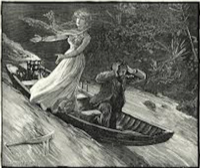
A threshing, foam-capped wave seized upon the boat, lifted it high, and hurled it whirling into the roaring canon, out of my sight. Horrified, I ran swiftly to a point directly over the falls, cast myself on the ground, and peered over just as the boat, with its three occupants, shot out from the brink, poised for a moment in mid-air, and then plunged downward and disappeared in the mad maelstrom below.
Hardly had I risen, tremblingly, to my feet, when I was confronted by the missing witness. He smiled pleasantly, and said: “I trust you are convinced. They deserved a more ignominious death, but — as you refused —”
“In the name of God,” I cried, rushing at him, “who or what are you?”
As I reached to grapple with him he vanished — to reappear, ten feet distant.
“My name? I have none now, not even in the memory of man. I was once William D. Emmett!”
"Every writer has the need to write. If you don't have to write, you're not a writer." —William Goldman

It might not have happened if Chelmsford hadn’t noticed her vainly trying to overcome the obstinacy of the car window. And it might not have happened then, had she not shot that appealing glance in Chelmsford's direction. To that glance from those eyes, Chelmsford — hitherto invincible, capitulated.
He dropped his grip and tackled the window. Under the spell of those eyes and that smile he was conscious of a Samson-like strength; if necessary he could have torn the window from its casing. After he had conquered the window there was nothing to do but resume the grip, acknowledge the thanks, and continue his search for a vacant seat. It was really too bad that the other half of her seat was occupied.
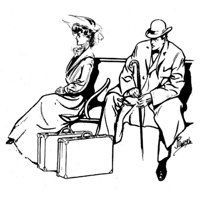
When he had at last settled down, he tried to turn his thoughts to the breeze-kissed lakes, denizened by voracious and inquisitive bass, which he had reluctantly left behind; to the city of turmoil and smoke to which he was reluctantly returning; but they determinedly refused to turn from those eyes.
At each stop of the crowded excursion train he watched to see if she left the coach. When she and her mother arose, as the train pulled into his own station, he hurried forward, elated, only to behold a handsome young fellow meet them and bear them triumphantly away, paying especial attention to her.
Thirty minutes later, Chelmsford slammed a grip upon his dressing-table, and scowled fiercely at his reflection in the mirror.
“Just my luck!” he growled. “Missed the one opportunity of my life.”
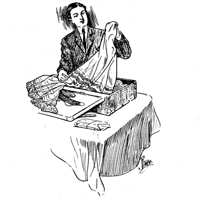
He slipped the catches of the grip and jerked it open savagely. Strange and surprising articles flew forth, articles quite foreign to the apartments of a bachelor. Marvelous and dainty garments, decorated with delicate lace and bows of ribbons, rose up from the yawning receptacle to confound him. A bunch of tiny hairpins tinkled on the table. A downy powder-puff rolled forth, its faint incense rising to astonished nostrils.
“Shade of Saint Anthony, protect me!” Chelmsford gasped. “It’s her grip!"
A little package of letters nestled at the bottom, the uppermost envelope bearing an Inscription:
"Miss Grace Olcott, 2714 North Walnut Street, City.”
Only five blocks away! One never knows how near he may be to Paradise.
Gingerly, reverently, he tucked the escaped articles into the grip, snapped it shut, and rushed out.
At a neat little cottage in a shady street, she, herself, answered his ring. She uttered a little cry of mingled joy and dismay, and held out her hands for the grip.
“Did you open it?” she stammered.
“Naturally; they are precisely alike and…”
“Horrible!” she interrupted, and fled with her grip.
Soon her mother appeared, handed Chelmsford his property, with a few cool words of thanks, and laid her hand on the knob of the door. Evidently, she considered the affair as a closed incident. So Chelmsford lifted his hat politely, and returned to his rooms humbly.
An oblong of pasteboard on the floor caught his eye. He snatched it up, turned it over, saw a face, and kissed it. Then, seeking solace, he searched his grip for something which should have been in it but which wasn’t. Meditating for a moment, he smiled hopefully.
Next day arrived a little missive:
“Pardon me if I say that a gentleman would not have kept my photograph. Kindly return it at once by mail.
(Miss) Grace Olcott.”
Promptly Chelmsford retaliated:
“Pardon me for wondering what use a lady can have for my pipe. I will call for it in person.
Respectfully,
John Chelmsford.”
As he approached the cottage next morning she emerged, hatted and gloved, bearing a stenographer’s note-book. She blazed at him for a moment with those eyes, then melted, and laughed merrily.
“What a muddle! That pipe must have fallen out when we opened your grip. We thought Brother Will had left it when he brought us from the station. I’ll run in and get It.”
The pipe restored, Chelmsford observed, brazenly:
"Come on. We'll miss our car. You’re going to town, aren’t you?”
She was, of course, and to Chelmsford, and yes, to her that car seemed to travel exasperatingly fast as they chatted together. As he handed her from the car she said, suddenly: “My photograph. You must return that you know.”
“Is It really necessary that I return It?”
“Why, certainly."
“By mail?” he asked, smiling.
She looked down, and shifted the notebook nervously.
“I think I will bring it this evening.”
She looked up at him quickly, then down again.
"Quick! The car’s going. May I?”
She glanced up archly, smiling bewitchedly: “If you think that safer than mail,” she called back as she turned away.
"The role of a writer is to say what everyone is thinking but is afraid to say." —Salman Rushdie
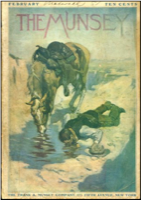
i.
From the East came Connors, burly, bellicose, and blunt; from the South, McKee, slender, sensitive, and silent. They met at Chilkoot's great gray wall; formed a friendship at Dawson City; staked out adjoining claims on Bonanza Creek, that marvelous treasure-field, concealed by capricious fortune from a dozen skilled prospectors to be revealed to a Chilkat whose native name is forgotten.
There, with thousands of others, Connors and McKee built fires upon the icy earth; shoveled and washed the few inches of thawed soil; kindled more fires in the slowly deepening excavations; shoveled and washed again, anxiously, fruitlessly, while their joint stock of costly provisions steadily decreased.
Then, on the same short arctic day, the precious metal glistened in each pan, and each tired toiler saw amid the golden grains the vision of a woman far away. To Connors came the memory of a mazy dance, music and moonlight, and low-whispered words. McKee was once more on a white-winged yacht, sighing sweet nothings into a not unwilling ear. Then both turned fiercely to the task at hand.
Henceforth there was little time for sleeping, less for eating, less still for cooking, and when, one morning, a starving, pain-racked wanderer appeared, offering to cook for his “grub,” the bargain was quickly closed. Neither Connors nor McKee asked the newcomer's name or history; time was too precious to waste in profitless inquiries. They dubbed him “Cook," and placed him in charge of the hoarded provisions, pleased that his help would enable them to return to Paradise a few days sooner. Neither confided to the other his hope and ambition — there are some thoughts too sweet, too sacred, too near the heart, to be laid bare.
Three days after Cook came, Connors cursed him vehemently, furiously. Cook only stared at him with sunken, tired, pathetic eyes. After dinner, in the pit, MeFee remonstrated with his partner.
“He warned us, you know, that he'd never cooked." he said mildly. “I shouldn’t be surprised if he'd leave."
“I wish he would leave, if he can't do better than that! We've got no food to burn. Grub's grub up here." Connors retorted, viciously jabbing his shovel into the earth.
Cook didn't leave, and one evening McKee, lingering at work after supper-call, heard an oath and a blow. Looking up, he saw Cook slowly rising from the hard earth, while Connors, still cursing, removed a smoking kettle from the fire. After the dismal supper, while Cook, with bruised and bleeding face, was busy with pots and pans, McKee called his partner aside.
“Now, look here Connors,” he said insistently, “this won’t do, you know. The man’s ill, and you're almost twice his size. I didn't think it of you Connors, and, if I must say it, it’s — it’s cowardly!"
Connors glared down at him pugnaciously.
“Cowardly, eh? Say, if you wasn't such a runt“
McKee put up a hand in protest.
“There, there; let's not quarrel, Connors. We’ve pulled together nicely so far. Just try to curb your temper, that’s all. Cursing him is bad enough, but please don’t strike him again. I can’t —“
“All right; I’ll not strike him again." Connors interrupted; and when McKee smiled gratefully, he continued: “I'll kick him next time; that’s what I'll do — just kick him off the diggings,” and he strode down to the pit, growling to himself.
MeFee returned to where Cook sat gazing thoughtfully into the fire, passing his left hand slowly up and down his right arm.
“I’m awfully sorry about this. Cook,” McFee said softly, “but I can't help it, really. Maybe you’d better leave. It’s likely to get worse, you know."
Cook looked up and grinned hideously. Not that he wasn’t a handsome fellow, normally, but his swollen and discolored face made his attempt to look pleasant, a ghastly failure.
“It’s all right,” he said slowly. “I'm taking on flesh and getting stronger fast. Maybe in another month I'll be ready to leave.”
That was all McFee could get out of him. Cook was a man of few words.
Four weeks passed without an outbreak. Perhaps the rapidly increasing richness of the claims kept Connors in comparatively good humor; perhaps it was because Cook was more careful. He had rounded out wonderfully, had a bright eye and a good color, and moved about alertly. Then, one day, just before noon, Connors suddenly straightened up, dropped his pan and scrambled out of the pit like a wild man, with McFee clinging' to him. The odor of scorching soup again permeated the frosty air.
‘‘He’s got a kicking coming this time,” Connors roared, trying to shake McFee off.
Now, wait a minute, Connors,” panted McFee. “Let me reason with him. Cook, I really think the soup is burning, you know, and —”
‘‘Does smell like it, doesn't it?” remarked the offender complacently, folding his arms and sniffing vigorously.
“Curse you, I believe you meant to do it!” howled Connors, breaking McFee's grip.
Cook gave a quick, sweeping glance at the ground behind him, and unfolded his arms.
“Well,” he said in a tone that made McFee gasp, “if anybody asks you — I did!”
Connors hurled himself forward — upon Cook’s fist. The big miner staggered and sank to one knee, while Cook waited, laughing. Connors arose unsteadily and advanced resolutely, but cautiously; his reputation was at stake, and men were running up from the surrounding claims.
Sparring and feinting clumsily, he saw what he thought was an opening. He rushed in, and swung his right with a mighty sweep. Cook's head ducked under the catapult at the same instant that his left hand shot out; then he stepped back while Connors again struggled to arise.
“Fair little game-cock, ain’t he?” remarked one of the grinning circle of miners to McFee. “Most fellers would be kickin’ Connors’ head off, ’stead of waitin’ fer him to git up.”
McFee nodded. Amazement had tied his tongue.
Connors regained his feet, swayed for a moment, and then, red with rage, his huge arms guarding his reeling head, crept step by step, half crouching, warily, watchfully, toward his antagonist. Let him but once get his foe within those ponderous arms, and all the fight, perhaps the life, would be out of him in a moment.
Cook, circling about, stepping nimbly in and out, stumbled, apparently, and in an instant his adversary was over him with eager, outstretched hand. No two agreed, afterward, just how Cook did it. Some of them contended that he was actually within the encircling arms when Connors went up in the air; but the opinion was unanimous that it was as neat an upper-cut as was ever landed 'on the point of a chin.
While some of the spectators labored with the unconscious man. Cook held out his hand to McFee.
“Good-by,” he said. “You know now why I stayed. After he cursed me that first time you couldn’t have driven me away.”
He walked jauntily through the crowd that parted respectfully before him, and disappeared in the direction of Dawson City.
Some months later, Connors and McFee, with the independent air of men who had conquered fortune, followed the same course. Turning from the receiving teller’s window in a Seattle bank, the big fellow took his companion's hand.
“Well, partner,” he said, “I guess it's good-by at last. I’m off for Los Angeles.”
“That’s odd,” said McFee joyously. “There’s where I'm going.”
“Good!” exclaimed Connors. “Acquainted there?”
“Only slightly. Passed my vacation there last summer. Good place to rest. And you?”
“Have an uncle there. Visited him last year. Thought I'd stop off again, and rest up.”
Stepping from the train at Los Angeles, McFee called out:
“Butler, Jack Butler! Don’t you know me? What’s the latest? How are“
Connors was shaking his shoulder and pointing to a scurrying automobile.
“Cook!” cried McFee.
“Cook?” said Butler. "I guess not. That’s Lamb, Sammy Lamb, the luckiest dog on the coast. First he wins the light-weight championship in the intercollegiate boxing contest — what are you laughing at, Mac?”
“Nothing!” roared McFee, beating Connors on the back. “Go on! What next?”
“Well, then he quarrels with his millionaire father over his allowance, disappears for almost a year, and when the old man is almost crazy, Sammy turns up, brown and hearty, from the Klondike. The pater promptly kills the fatted calf, or rather the golden calf, and hands it over to Sammy, who promptly marries the prettiest girl on the coast. You know her, MacRose Alton. Say, what is the matter with you fellows, anyhow?”
“I’m not quite well — change of climate, you know,” McFee stammered, staring hard at Connors. “See you later. Jack.”
He pulled Connors around the corner, stopped, and stared again into his ghastly face.
“You — you too?” he asked.
Connors nodded and pulled out his watch.
“In three minutes a train goes east," he murmured wearily. “ I think I’ll go with it. Good-by, McFee.”
"I am not at all in a humour for talking. Let me hear the merits of each party." —Jane Austen
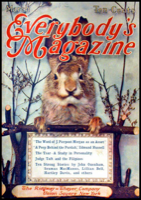
I kain’t understand it. I jest kain’t understand it,” wailed the old woman, rocking her bent body to and fro. “Fust they killed my old man, then they crippled Tommy fer life, an’ now they’re a-tryin’ to send Jimmy to prison."
“Why did they kill your husband?” the old lawyer asked.
“Why? Thet’s jest it, why?
Didn’t he hev ez much right to shoot ez they had? What call did they hev to come a-breakin’ up his bizness, an’ him a-tryin’ to make a livin’ fer his fambly ? Ef a man ’ud ruther make whiskey than meal outen his own corn what bizness wuz it uv theirn? That’s what I’d like to know.”
“And Tommy — what did Tommy do?”
“Do? What did Tommy do? Nothin’. Thet’s what. Nothin’. Th’ hoss wuz hisn. Traded fer it, fair an’ squar’. I heered Tommy say so. An’ jest bekase he’d fergot th’ man’s name, they wuz ackchuly agoin’ to take him to jail. What bizness wuz it uv theirn who he got th’ hoss uv? An’ they up an’ crippled him while he wuz agoin’ ’s way peaceable. Wouldn’t they ’a’ run too? Reckon they’d ’a’ hung him ef they’d ’a’ ben smart enuff to ketch him.”
“It is very unfortunate that your —”
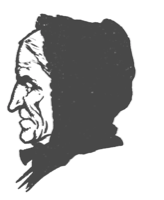
“Unfortunate. Thet’s what. They’ve jest ben a-pickin’ an’ a-naggin’ at me all my life. An’ now they’ve gone an’ ’rested Jimmy, th’ only one I’ve got left, jest bekase he made a mistake an’ got in th’ wrong house. They say he wuzn't drunk, but Jimmy sez he wuz. I’ll believe my boy ev’ry time. Yes siree, ev’ry time. D’ye s'pose ef he hadn’t ’a’ ben drunk he’d ’a’ got so turned ‘round ez to think thet big house wuz our little shanty? No, sir. Don’t tell me. They know a sight better, but they’ve jest got it in fer me an’ mine; want me to starve, ez I will ef they take Jimmy away.” “He hain’t guilty, an’ you kin save him you must save him. I hain’t got no money now, but I’ll work these old fingers to th’ bone ef you’ll only save my boy.”
“My good woman,” said the old lawyer, kindly, “I fear your boy’s case is hopeless, but I’ll try. Don’t worry about the money. I’ll do my best, not for Jimmy, for I suspect he’s not what he should be, but for his old mother. You see, I had a boy, once, long ago, and he — well, I know how you feel.”
The careworn face lighted up, the calloused fingers wiped away a tear.
“God bless you, sir, an’ may you never know sorrow. Ah, ef they wuz all like you there’d be some joy yit for an old woman who hafn’t got long to live.”
Jimmy, surly and defiant, was guilty. The lawyers knew it, the judge knew it, the jury knew it. None but the old mother entertained a doubt. She, knowing him innocent, sat at his side, caressed him, pleaded silently but even more effectively than the old lawyer who so eloquently begged mercy for her sake.
Late in the night the amazed bailiff saw an old woman crouching, listening, watching, at the door of the jury room,
“They’s only one agin Jimmy,” she whispered, as he hurriedly approached her. “They’s only one agin him now. . . an’ he’ll come over . . . he’s got to come over.”
“You can’t stay here, ma’am,” the bailiff said; “you must go home.”
“Not without Jimmy. I jest kain’t go home without Jimmy, It’s too dark, an’ lonesome, an’ far. Let me stay back yander in th’ dark corner. I’ll not move.”
Back yander in th’ dark corner of the court-room she kneeled, and prayed in whispers, listening between the prayers.
At intervals, through the open transom, the voices of the jurors came distinctly to her anxious ears. “It’s of no use to argue with me, gentlemen. The boy is guilty. That’s enough. We swore to bring in a verdict according to the law and the evidence, and I have some regard for my oath, if you haven’t.”
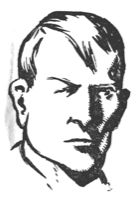
“That’s th’ little skinny feller,” muttered the old woman to herself. “O Lord, make him come over, please make him come over. You know Jimmy hain’t guilty.”
“We’re not sayin’ he’s not guilty,” came a deep, strong voice. “That’s not th’ point. Do you want to kill the old woman? That’s about what you’ll do if we disagree, and th’ boy goes back to jail for want of bond. Wouldn’t that be a heap worse than to let him go free? Who’ll suffer th’ most, him or his old mother? As for our oaths, the judge said we are th’ judges of th’ law and th’ evidence, and us eleven are makin’ some law to suit ourselves.”
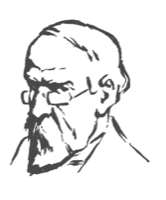
“Thet’s him thet’s th’ big man with th’ whiskers,” whispered Jimmy’s mother. “May th’ Lord reward him. He knows Jimmy hain’t guilty.”
The dreary hours dragged on, and still one man opposed eleven. Finally, the patient watcher heard the weary jurors stretch themselves upon their rude cots, abandoning the contest. She felt the oppressiveness of the ominous silence, she saw the lights go out, but she could not see the vision that came to th’ little, skinny man during his fitful sleep: a vision of a face of long ago, fresh and fair as it bent over a child’s little bed; then, tearful and more mature, bidding farewell to a youth in blue with musket and knapsack; then, wrinkled and seamed, with eyes forever closed.
She did not see the dreamer rise from his cot and pace the floor while his companions slept, asking himself, “What if it were she? What if it were she?”
When morning came, the old woman, weak from the night's vigil, tottered forward to greet Jimmy when he was brought in to learn his fate. When the clerk stood up to read the verdict, she too arose, trembling, her hand upon her boy’s shoulder, her dimmed eyes fixed upon that fateful slip of paper.
"Not guilty.”
The old woman sank into her chair, laughing softly, the pale lips murmuring indistinct thanks, a light marvelously like the glow of girlhood illumining the wrinkled face.
The lawyer, a suspicious moisture in his eyes, took the bony, calloused hand as reverently as any knight his ladylove’s, and said, huskily:
“That’s all. You may go — and take Jimmy.”
“I knowed you could save him,'” laughed the old woman. “I knowed ef enny man could save him you could.”
The old lawyer smiled.
“It wasn’t me,” he said. “It was his mother.”
"A writer who is ashamed of his trade should not be in it." —Ray Bradbury
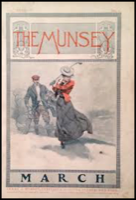
Reddy McGuire swung wearily from his saddle, leaned his gun against one of the cottonwood trees, hung a brace of plump birds across its muzzle, and stretched his lean, lank length in the thick grass at the river’s brink.
“They’ll be along in an hour,” he soliloquized, watching the gray mustang graze.
He rested his long chin in his tanned hands and beat a slow tattoo on the soft prairie soil with the toes of his cowhide boots as he meditated. The gleam in his gray eyes, the smile on his freckled face, indicated that Reddy was happy; the prolonged drooping of his eyelids, the steady gravitation of his red head toward the earth, indicated that he was also drowsy.
When the head finally rested on the folded arms, the two men who had been watching him from the cover of the thicket down the river rode swiftly forth, and Reddy, rudely awakened, struggled to his feet to tug impotently at the steel manacles on his wrists; to glare furiously into the smiling faces of his captors.
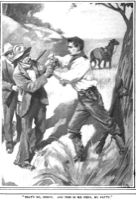
“Dan!” he cried. “Dan Rowe!”
“That’s me, Reddy,” responded the shorter man pleasantly. “And this is Ike Fenn, my dep’ty. Mebbe you remember Ike, too. Sorry to spile your nap, Reddy, but we’re in a desprit hurry to get away before your friends come up. They might put up a kick, and there's only two of us.”
Reddy's head had dropped on his breast; the freckled face had grown pale; the thin lips were tightly set. “I suppose it's for the — shooting,” he said, not looking up.
“Sure. Been follerin’ the wagons for a week waitin’ for you to straggle.’’
“But he pulled first,” the captive protested firmly. “Dan, I had to shoot!”
“How'll you prove it?” asked the sheriff. “I don't say that it wasn't a good riddance, but he was a big duck in the puddle, and besides —” The sheriff winked complacently at Ike, who grinned knowingly.
“There's the reward,” said Reddy cynically, finishing the sentence.
“That’s our business; eh, Ike? Ain't holdin’ down this office for our health, are we? If a man s'posed to be dead takes chances on comin’ through the State, and we, bein' out after smaller game, accident’ly catch a glimpse”
“Look here, Dan; you know mv record was good till this was forced on me. Why can't you”
“Come, Reddy; climb that mustang; there’s a long ride before us. If you're reasonable you can ride in the saddle like a man: if not, you’ll ride across it, like a log. Take your choice.”
With a look of despair on his face, the captive slowly clambered into his saddle. For one moment he gazed eastward, where a long train of white-topped wagons, dimly seen through the gathering twilight, writhed sinuously across the rolling plain like some gigantic serpent of the sea; then he struck the gray mustang with his heels and galloped madly down the river. Almost a mile the three rode silently, side by side, concealed within the fringe of trees.
At intervals came the faint squeaking of the distant train, the lugubrious howls of prowling coyotes, the melancholy hooting of owls. Suddenly the captive raised his head and moistened his dry lips with his tongue. “Dan.” he said sullenly. “I want to see your papers. How do I know this is regular?”
“Don't worry 'bout the papers, sonny,” the sheriff chuckled, tapping his breast pocket. “I've got 'em all right. Had ’em for three years. You'll see 'em — what's the matter, Ike?”
The deputy, with a sharp pull, had thrown his horse upon his haunches. With one long arm he was pointing to the hill far ahead that ran to the river's edge, intersecting the fringe of trees.
Upon the summit of the hill, in bold relief against the evening sky, a plumed, half-nude horseman rode in rapid circles, waving a fluttering blanket high above his head. The sheriff caught the bridle of Reddy’s mustang and wheeled toward the river at their right. Then he halted quickly, with an oath. From the crest of the bluff across the stream great rings and curling wreaths of drifting smoke, the wireless telegraphy of a savage foe, rose lazily in the still and sultry air.
“We're up against it, Ike,” the sheriff growled. “The Indians have seen that train — they'll be swarmin’ through these trees in five minutes!”
The deputy shifted his revolver further to the front and peered about him anxiously. “Dassen’t leave th’ trees: they’d spot us in the moonlight,” he muttered. “Jest one thing to do — sneak back to the train. Mebbe it's strong enuff to fight 'em off.”
“We'd lose Reddy,” the sheriff whispered. “His friends would never let as take him.”
“Mebbe we kin dodge past the wagons an’ git away on t'other”
The sheriff lifted his hand warningly. Up the river, from a point they had just passed, arose the sounds of splashing water, the snort of a pony, and low, guttural words of command. “They'll cut us off!” exclaimed the sheriff, whirling his horse up-stream. “Come, quick!”
Reddy, clutching his bridle-reins with manacled hands, held the mustang back. In the shadows his eyes blazed like those of a wounded grizzly. “To the wagons?” he hissed. “Never — with these things on my wrists. She don’t know; she mustn't know. It would kill her — now. Take these cursed things off first; before I'll go back this way, I'll give the alarm, and we'll all die right here!”
A gleam of cunning triumph shone in the sheriff's eyes. He leaned toward Reddy, unlocked the handcuffs and dropped them into his pocket. “Have to risk it, Ike,” he whispered, “but I reckon we hold trumps; there's a woman in the case."
Back up the river the three trotted stealthily, with every sense alert.
“Hope your friends has seen them signals, too, and rounded up the wagons,” the sheriff muttered to Reddy. “If they're caught hands-down, the jig’s up!”
Reddy did not reply. He was leaning over the mustang's neck, peering eagerly in the direction of the train.
A perilous quarter of a mile was safely passed.
“Looks like we’d slip through,” said the deputy.
As he spoke, from the river-bank at their left came a flutter of feathers, a rising cluster of painted faces, yells of wild surprise, and a mob crashed like a hurricane toward the three.
“Straight for the wagons!” the sheriff yelled. “The devil gets the hindmost now!”
Out from the trees, over the rolling prairie, burst the desperate chase. For a time the three raced neck and neck, then the gray mustang forged ahead. A scattering volley of shots rang out, and Reddy, glancing backward, saw the deputy, far in the rear, throw up his hands and fall from his saddle; saw the whole mob sweep over him, save two who leaped eagerly from their ponies to complete their work.
Shuddering, he galloped to the summit of the next swell and gave a low cry of joy. At the foot of the slope, far below him, their white tops gleaming in the moonlight, lay the wagons, drawn in one great, protecting circle, ready for the attack.
Half way down the slope another volley rattled in his ears, and he turned his head to see the sheriff about fifty yards back, pitch headlong, roll over, and lie still: to see the rider struggle to his feet, cast one glance toward the train, then grimly turn, his weapons in his hands, to die amid the foe.
Then did young Reddy McGuire, his wrists still smarting from the handcuffs, wheel the gray mustang right about and charge straight up the slope. High above the exultant yells his boyish voice rang clear and shrill: ‘‘Ready, Dan! I’m coming to pick you up!”
Quickly the sheriff turned and crouched to grasp the outstretched hand, to make the upward leap; then, with the double burden, the gallant mustang wheeled again and dashed panting down the slope, a scanty bowshot from the furious foe.
A desperate hundred yards they raced, and then the great white-backed tarantula down in the valley bristled with shining steel and stung with flashing. Before it, snorting ponies galloped riderless. The mob wavered, wheeled, and whirled away, beyond range of the avenging rifles, and hearty cheers went up as the gray mustang galloped safely home.
A tall, gaunt, hook-nosed man, with eyes like beads of burnished steel, grasped Reddy's hand.
“Mighty close call, stranger,” he said to the sheriff, scanning him searchingly as Reddy hurried to one of the wagons. The sheriff glanced, scowling, toward the spot where his deputy had gone down. “Lend me a rifle,” he growled savagely. ”I’ll get even before this light's over!”
The hook-nosed man grinned and waved his hand to the north. “Guess it's over now — for us,’’ he said.
Following the gesture with his eyes, the sheriff saw, far northward, a shimmering line of blue and brass moving rapidly toward the bluffs across the river, up whose sides scurried squads of retreating marauders.
“Cavalry,” observed the hook-nosed one. “Reckon they seen the signals, too.”
An hour later, when the camp-fires were blazing cheerily, Reddy, coming from his wagon, was confronted by the sheriff leading Ike’s horse.
“The coast's clear,” said the sheriff in a low tone, watching the young fellow furtively. “We'd better be goin'.”
“Goin'? I thought — maybe — you'd given that up.”
The sheriff shook his head. “You’ve got another think comin’, Reddy.”
Reddy’s face turned pallid; the cords of his neck swelled and writhed; he drew back, and his hand dropped to the revolver at his belt. The sheriff drew a paper from his pocket and took a step toward the wagon from which Reddy had just emerged. “Want to hear what this says? I'll read it — aloud.”
“Stop! ” cried Reddy, choking. “I’ll go. I'll take the chances of a trial. Give me a little time — to say good-by. Ten minutes is long enough to fix-up some kind of a story.”
“I’ll wait here,” replied the sheriff gruffly.
He watched his retreating victim curiously; then he walked stealthily around the outer side of the corral and peeped through the flaps of Reddy's wagon. At the further end, on a rude pallet, lay a young girl whose dark, disheveled hair spread like a cloud about her pale, wan face. One wasted arm was around Reddy’s neck, and the great, deep-sunken eyes stared questioningly up at him as he bent over her, whispering, clasping her hand.
Suddenly the coarse blanket that covered the girl was stirred and lifted at her side by something unseen. A muffled wail rose from beneath, and the girl, with a smile of pride and joy, turned feebly toward the sound.
The sheriff walked slowly away. “Well, I'll be cussed!” he growled. “A kid — a wife and a kid! And him always too bashful to look a gal in th’ face! What d'ye think of that?”
He halted at a deserted fire, drew a paper from his pocket, and gazed at it abstractedly. “A kid,” he repeated softly. “A blamed little red-faced, helpless kid with its mammy fightin’ death, and its daddy fightin’ this!”
He stirred the smoldering fire with his boot, dropped the paper on the coals, and watched it as it blazed and turned to a little heap of ashes that a puff of wind lifted and whirled away far over the prairie. Then he strode to his horse, swung into the saddle, and trotted up the slope. At its summit he turned and looked down into the camp. In the shadow of the wagons he saw the dim form of Reddy hastily saddling the gray mustang, and he laughed aloud.
“Sorry to disappoint you, sonny, but you're too slow — I can't wait.” he chuckled. “Good-by. Reddy, and good luck to you — and the kid — and the little woman!”
He leaned forward, struck his horse with the spurs, and galloped off.
"The first draft is just you telling yourself the story." —Terry Pratchett

The sheriff of Montebasco County pulled up his horse, leaned wearily upon the saddle-horn, and contemplated the lonely dugout, whose lowly, sod-thatched roof was scarcely distinguishable from its parent plain.
“Beats all,” he muttered, “that anybody’d live in such a lonesome, desolate —“
He stopped short as his restless eyes caught sight of the woman emerging from the bed of the sluggish stream below him. As he urged his horse toward her the woman dropped the bundle of drift-wood, folded her arms, and awaited his approach.
“So you’ve found us at last,” she said sullenly.
The sheriff repressed an exclamation of surprise.
“Guess I have,” he replied slowly. “Is Bob here?”
The lines in the woman’s pinched face grew tenser.
“Yes, he’s here — what’s left of him,” she answered.
“Wasn’t lookin’ for him; but I’ve just missed bigger game, an’ I might as well take something back home. Reckon he’ll come without the warrant. He’ll have to, or —”
“He’ll give you no trouble,” the woman interrupted. “He’s out there — under those rocks.”
She stretched a bony arm toward an oblong heap of stones half hidden by the drifted snow.
“There are wolves here, also,” she said grimly. “But those prey only on the dead.”
A quick pressure of the spur against the horse’s flank turned the sheriff’s back toward the bitter wind, his face from the bitter eyes. For just an instant he bared and bent his head, and the bitterness died out of the woman’s eyes. She glanced at the drooping horse.
“You’ve been long in the saddle, and must be chilled through,” she said quietly. “Come into the house.”
As she swung the bundle to her back the sheriff seized it, laid it across his saddle, and followed the woman silently. A little boy, thin-faced and hollow-eyed, ran timidly to his mother as she entered.
“Better put your horse in the shed,” the woman suggested, as she replenished the dying fire. “There’s a little prairie hay left, I think.”
The sheriff spent more time in intervals of profound meditation than in caring for the horse. When he reentered the solitary room, the woman and the child waited for him at a rough table.
“Corn bread, rye hominy, and water isn’t much to offer a guest,” the woman said, with a little, mirthless laugh; “though there’s plenty of the water.”
The sheriff ate silently and sparingly.
When the child, having eagerly devoured its portion, glanced appealingly mother-ward, the sheriff, ignoring the maternal frown, filled the empty plate from his own.
“Had a-plenty at Gulch Point,” he murmured apologetically, “an’ I like to see the youngster eat.”
The woman shot a quick glance at him, half grateful, half resentful.
“Gulch Point,” she repeated. “That’s a mighty tired horse to have come only from Gulch Point! ”
The sheriff grinned sheepishly, leaned back, and watched the voracious youngster.
“What ailed Bob?” he asked softly, after a while.
A little tremor came into the woman’s voice.
“I don't know. Fever, I guess — and worry.'
Didn't the doc know?
“We had no doctor. Doctors want money — and Robert thought he'd soon be well. Besides, we wanted no one to see us — you know why.”
“But you had help. — when —” The sheriff gave a quick gesture in the direction of the heap of stones.
The woman folded her hands in her lap and bowed her head. “Just me and little Robbie,” she said gently. “And — the Book.”
The sheriff coughed, fumbled at his belt, and turned toward the fire.
The child dropped his spoon into the empty plate, rested his head against the damp wall behind him, and heaved a little sigh of satisfaction.
“Thought you'd gone to Minnesoty, where Bob come from,” the sheriff observed. “How'd you come to stop at this God-fersaken place?”
“One of the horses died here, and we hadn’t money to buy another. We built the dugout and the shed, thinking we might push on, somehow, when spring came. After Robert went I had to sell the other horse and the wagon to get food.”
“What d’ye ’low to do now? Spring’s ’most here.”
“I don’t know. I might teach again — if there are any schools out here.”
“Looky here, Mrs. Cruthers, you’d better come back”
“And ask charity!” the woman exclaimed. “No! If we hadn’t lost the farm it would be different.”
“It would be different if Bob hadn’t tried to borrow money on the farm when it wasn’t his any longer.”
“He didn’t!” the woman cried fiercely.
“Oh, I reckon the grand jury knowed what they was doin’ when they fetched in that indictment.”
The woman gripped the edge of the table, and leaned toward her guest.
“What does that indictment say?” she asked breathlessly.
“It says a-plenty. Cuttin’ out the ‘thens’ and ‘theres’ an’ ‘aforesaids,’ it says that Bob tried to get money under false pretense. An’ Flint an’ Harmsley do tell a mighty ugly story. I didn’t think it of Bob. Knowed he was green an’ easy flustrated, but thought he was straight.”
The wan eyes of the woman gleamed and glittered in the dim room.
“Tell me what those men said,” she demanded hoarsely. “I never understood why we should run away, but Robert insisted, and never would tell me why.”
“Why, when Bob couldn’t renew the mortgage, an’ couldn’t borrow to pay it — the panic bein’ on, you know — Harmsley offered to loan him the money. But he wouldn’t accept an ordinary mortgage. So you an’ Bob made Harmsley an absolute deed; remember signin’ it, don’t you?”
“Yes; but I never knew why.”
“Well, then Bob an’ Harmsley signed an agreement.”
“In duplicate?”
“Don’t know'; ought to have been, if Bob had any sense. Agreement was that Harmsley would deed the farm back if Bob paid the thousand dollars, with twelve per cent, on or before last October”
“When?”
“First of last October — October 1, 1896. Record of Harmsley’s contract, in the recorder’s office, says so; read it myself. Well, Bob didn’t pay, an’ consequently the farm was Harmsley’s for good, ’cording to the contract. Then, about the middle of last October, Flint offered to loan the thousand at eight per cent, not knowin’ the situation, an’ Bob arranged to get the money on that farm that wasn’t his; did get Flint to advance him a little — to skip out with, I reckon, in case Flint caught on before he got it all, which Flint did. That’s all, 'an’ that’s enough — in this State.”
The woman had crossed the room, and was unlocking an old and battered trunk. She lifted out and carried to the table a huge and well-worn Bible, from among whose pages she drew a paper, frayed and stained.
“Tell me what this is,” she said, an exultant ring in her voice.
The sheriff stirred the embers of the fire to brighter light, stooped, and glanced hastily over the document.
“It’s a duplicate, sure enough. In Harmsley’s handwrite, an’ signed by him an’ Bob — just like the one Harmsley holds.”
“Is it ? Look again.”
Again the sheriff of Montebasco County stooped, then suddenly straightened up with a puzzled, suspicious look on his bronzed face.
“If Bob had this, why did he”
“He lost it. The next day after I signed that deed he told me he’d lost an important paper, and it must have been that. I found it — only last week inside the lining of his old coat.”
“Did Harmsley know it was lost?”
“Yes, I’m almost sure Robert told him. Harmsley was friendly toward Robert. He warned him, later, that Flint intended to prosecute — advised him to run.”
The sheriff of Montebasco County muttered an exclamation, dropped into his seat, and stared at the fire.
The little boy crept into his mother’s arms, and she swayed her body to and fro, crooning a lullaby, as she watched the sheriff curiously.
“Frien’ly toward Bob!” muttered the sheriff to himself. “Yes; oh, yes! That’s why he asked me to hold the warrant for a while — so’s Bob would have time to go, an’ stay gone. Of course he showed Bob his copy — Harmsley’s copy an’ the record!”
The woman ceased her lullaby, and interrupted the sheriff’s cogitation. “I’ve thought that if those figures are right, and Mr. Harmsley’s are wrong, maybe he’d give me a chance to get the farm back by next October, as it says. But if he wouldn’t — I couldn’t pay lawyers, and the thousand dollars and interest, as I’d have to, even if I should win.”
A sarcastic smile played over the bronzed face. “Oh, yes; Harmsley would do what was right or Harmsley — !” Then, as he looked up and saw the expression on the woman’s face, a soft light shone in the keen gray eyes. “You’ve studied an’ worried a good deal over this,” he observed reflectively.
The woman buried her face in the child’s curls. “Worried? Night and day — day and night! There’s a mistake somewhere. I can’t understand it. Do you?”
The two vertical furrows between the shaggy eyebrows of the sheriff of Montebasco County deepened and lengthened as he rose to his feet, slipped the paper into his inside pocket, and buttoned his coat. “I think I do,” he growled. “I ain’t, sure, but I reckon I do. I’m goin’ to. find out.”
The woman sprang up, distrust and alarm in the thin, gaunt face. “You can’t take that paper!” she cried. “It’s all I have to prove Robert’s innocence!”
The sheriff frowned. “Can’t you trust me?” he asked gruffly.
“Trust you — trust the man who dogged us to this place? I trust no one now. Give me that paper!”
She placed the drowsy child in the chair, and advanced upon the sheriff resolutely. He handed the paper to her, and she thrust it into the bosom of her threadbare dress. Then she followed after him to the door, and stood there, watching him with suspicious eyes, as he bridled and mounted the horse.
He rode up to her, and halted. “Go to Gulch Point every week,” he said, “and ask for mail. It’s a long tramp — nigh ten mile but you may get something that will clear him.” He pointed again to the mound of stones.
She looked up searchingly into his face. “I’ll go,” she said quietly.
“Then let me see the date in that document again. I may have to swear to it.”
The woman drew back, took the paper from her bosom, opened it, and held it up, out of the sheriff’s reach. Quick as a flash he bent from his saddle and snatched it from her hand.
She was still following him when he glanced back before galloping into the distant foot-hills.
When the sheriff of Montebasco County entered the office of Alexander A. Harmsley, dealer in real estate and shaver of notes and closed and locked the door behind him, Mr. Harmsley wheeled in his chair at the flat-topped desk and looked up inquiringly.
"A little private business, Aleck,” explained the sheriff, “U an’ I don’t want to he interrupted.”
"At your service, sheriff,” replied Mr. Harmsley briskly, “What can I do for you?”
The sheriff leaned hack in the chair at the opposite side of the desk and regarded Mr. Harmsley cordially. “My term’s ’most up, you know, Aleck, an’ I don’t care to run again. Concluded to settle down to farmin’. Been lookin’ around a little, an’ rather like that Cruthers place. What’s your figures?”
Mr. Harmsley summoned his most gracious smile, and caressed his respectable whiskers thoughtfully. “Fifty per acre four thousand dollars and dirt cheap at that.”
“Pretty high, Aleck. It don’t stand you in more’n a thousand or so, you know.”
Mr. Harmsley produced a cedar box on which was depicted an exceedingly burly gentleman engaged in the occupation of holding up the world. “Have a cigar, Tom. Don’t smoke, myself.”
“Too busy makin’ other people smoke, eh, Aleck?” the sheriff observed pleasantly, as he struck a match.
Mr. Harmsley chuckled. “If you don’t happen to have the ready cash, Tom, I can give you time on that.”
“Oh, I guess I won’t need much time in this deal.”
“Oughtn’t to, as long as you’ve been in office with the graft there is in it,” remarked Mr. Harmsley, winking significantly while the sheriff grinned.
“How’s th’ title?”
“To the Cruthers farm? Straight as a string. Gilt-edged.”
“Cruthers claimed, you know, that the time for redemption didn’t expire till next October. I ain’t buyin’ no lawsuits. if he should come back”
“Come back? With you holding that warrant? Not much. You don’t know Cruthers. And the statute of limitation don’t run while he’s concealed, you know.”
“That’s right. An’ I reckon your contract’s ironclad.”
“It’s recorded; read it.”
“Recorders have made mistakes. I want the place, but I’d have to see the original contract. Four thousand dollars is four thousand dollars, Aleck.”
Mr. Harmsley frowned, meditated, walked slowly to the great steel safe, unlocked a private drawer, drew forth a folded and labeled paper, and tossed it upon the desk.
The sheriff unfolded it leisurely. “Excuse me for bein’ so particular, Aleck, ‘specially with an old friend, but I’ve heard that Cruthers said”
“Damn what Cruthers said! He’s done.”
“Yes, I reckon he is,” remarked the sheriff, scanning the paper.“ Done to a golden brown!”
Mr. Harmsley darted a quick, suspicious glance across the desk, and laughed, faintly and unpleasantly. “You make devilish odd remarks sometimes, Tom; remarks that might cause talk if overheard.”
“That’s why I locked the door,” observed the sheriff dryly. He was holding the paper up, so that the light shone through it, and his weatherbeaten face was growing stern and rigid. Harmsley scowled, and reached an arm across the desk.
“You’re insulting, Hardwick — and too damned suspicious. Give me that paper. The place is not for sale. I’ve changed my mind.”
“As well as the figures, eh, Aleck?”
“What are you talking about?” roared Harmsley.
The sheriff had produced another paper, and was comparing the two through keen, half-closed eyes. “About forgery, Aleck,” he answered pleasantly. “That’s what a jury would call it. It’s really an artistic job, Aleck, but you scratched a little too deep on that seven; an’ when you filled in the six, the ink was blacker an’ thicker, an’ steady there! Drop that, quick!”
Harmsley’s hand came up from out of the drawer. He was looking down the barrel of the revolver of the Sheriff of Montebasco County.
“Now let me hear you push back that drawer shut with your knee, Aleck, with your knee! That’s all right. Now you may sign this, if you don’t mind. Just a matter of form, you know perfection’ the title of Mrs. Cruthers to her farm. Been’ the sheriff, I can acknowledge your signature.”
Harmsley’s fat face was livid with rage and terror as he stared at the deed that lay before him. “This is blackmail!” he protested. “Nothing less than blackmail!”
“Oh, no, Aleck. It’s justice something less than justice for I ought to give you up to the State’s attorney, along with these two papers, an’ the letter you foolishly wrote to your fellow conspirator, Flint, which I scared him into givin’ me an hour ago. Are you goin’ to sign, Aleck?”
Harmsley’s shaking hand reached for a pen. “You’re a devil,” he groaned. “If I sign, how do I know you’ll —”
“You’ve got the word of Tom Hardwick, sir. But don’t let anything I say influence your judgment, Aleck. If you’d rather take your chances what an easy writer you are, Aleck! So smooth an’ graceful. Thanks! Any time you want to make another little deal in dates like this one, Aleck, you can count me in — an’ don’t you forget it, either! So long, old boy. I’ve got to hustle to get this recorded an’ into the next mail north.”
"Writing is the creation of new realities." —Philip K. Dick
Dawson pushed his long fingers through his hair, laid the note on his book-littered table, and stepped back to regard it with incredulous eyes. Then he picked it up and reread it audibly, almost reverently:
Dan:
The B. & N. offers you the position which my elevation to the bench compels me to resign. If you accept come to my study at eight this evening. Altway.
"If I accept," Dawson chuckled. "That's good!"
The sound of the squeaking floor-board interrupted his soliloquy. He jerked the partition door partly open, thrust his tousled head into the front office, and grunted his surprise.
"Come back here," he commanded.
"Wasn't expectin' me, eh?" the short, stocky man asked, as he slid into a chair and set a bulky grip on the floor beside him.
"I wasn't," answered Dawson laconically, as he shut and bolted the door.
"I'm here, just th' same," observed the short man briskly, nibbling the tip of a fresh cigar. "No change in th' situation, is there, Mister Dawson?"
"Yes," replied Dawson gravely, "there is a change — a change of judge."
A keen, suspicious glance flashed from the short man's steel-gray eyes.
"How's that?" he demanded shortly.
"Judge Carey died Saturday — apoplexy — and Scott Altway was appointed in his place."
"Well?" the short man snarled, the curl of his shaven lip revealing the strong, white teeth.
"Well, as I told you, Judge Carey would have refused to admit Greene's testimony; Judge Altway will admit it."
The strong, white teeth met through the cigar tip with a snap; the muscles of the thick neck stiffened and swelled.
"Sure of that?"
Dawson nodded.
The short man chewed the cigar tip nervously.
"Change of venue," he suggested.
"Too late for that now."
"Continuance, then; somethin' might happen before next term."
"No possible grounds for a continuance, Martin."
The short man slowly lighted the cigar, and the steel-gray eyes glittered and gleamed behind the blazing match.
"Can't understand why that man Greene wants to perjure himself," he muttered.
Dawson smiled cynically across the table.
"Mr. Greene is one of our most reputable citizens," he said in a significant tone.
Mr. Martin removed the cigar from his lips and glared at his attorney.
"Look here, Dawson," he growled; "do you think I cracked that safe?"
Dawson thrust his hands into his pockets, stretched out his long legs, and contemplated the ceiling with twinkling eyes.
"I think it was last Saturday," he said reminiscently, "that I saw the carrier lay a postal on the desk of our Chief of Police — a postal from the Police Department of Denver, bearing a faithful portrait of a familiar face."
With an oath, the short man started up; Dawson, laughing reassuringly, waved him back.
"No cause for alarm, Mr.Martin. I appropriated the postal just before the chief came in."
Mr. Martin regarded his attorney with an expression of admiration mingled with distrust.
"Say, you're all right, pardner!" he exclaimed. "But hadn't you better give me that card? You might lose it."
"I think not," Dawson replied, dryly. "I think I'll keep it as a guarantee of good faith. You're to lay down another hundred, you know, if I happen to clear you."
"Pretty good likeness, eh, pardner?" Mr. Martin inquired, leaning forward in his chair.
"Excellent. And the description of Benjamin Burns, alias Matt Martin, professional safe-blower, is most minute, even to the scar that I see when you lean forward that way, Benjamin."
The short man straightened up, replaced the cigar, and puffed meditatively.
"There's one sure way out of this, you know, Benjamin," suggested Dawson, watching the other furtively.
Mr. Martin frowned and shook his bullet-like head.
"I'll stay an' risk the trial. An' there's always a chance for a get-away, even after conviction. If my pile was somewhere near as big as that bond, I'd skip, but I can't afford to let th' boys pay th' difference."
"Might need their assistance again?"
Mr. Martin grinned and nodded.
Dawson laughed, looked at his watch, and rose to his feet. "I've an appointment at eight," he said. "Come back in the morning, Martin, before court convenes."
The short man rose, flicked the ashes from his neat suit, and picked up the grip. "All right. I'm goin' to bed early an' get a good sleep at th' Linton."
At the outer door he halted and turned back. "You're sure that if Greene's evidence was cut out they couldn't convict me, eh?" he asked.
"Quite sure."
Mr. Martin cleared his throat and glanced wearily about the room. "Look here, pardner," he said in a low tone; "there's another way out of this. I want an acquittal, an' you want that extra hundred. You see that man Greene to-night, an' find out how much"
"Stop right there!" Dawson broke in. "I've taken your case and a fee, and I'll stay with you now to the finish, but no dirty business goes. I've gone the limit already in taking that card."
For a moment Mr. Martin stared steadily into the stern face. Then he shifted the grip to the other hand, opened the door, and scowled back over the broad shoulder. "Good-night, pardner," he growled.
"Good-night, Benjamin," Dawson responded.
"And farewell to Mr. Burns Martin and that extra hundred," he sighed, a moment later, as he donned his hat and locked the office-door.
In his private study, Judge Altway rose from the side of a portly, white-whiskered gentleman, and grasped Dawson's extended hand.
"I want you to meet Mr. Durwin, president of the B. & N.," he said genially. "Mr. Durwin, this is Mr. Dawson, the new counsel of the Belleville & Northern Traction Company — that is, if he wants the position."
"The judge knows there's no if in the case," Dawson laughed, as he took the soft, fat hand of the president.
"But there is an if, Mr. Dawson," said the president gravely. "In fact, our situation is serious."
"Desperate!" added Altway, compressing his thin lips. "No time to be lost. Draw your chair to this table, Dan, and I'll state our case.”
"On this map you see the B. & N. skirting the eastern bank of the river which forms the eastern boundary of Belleville. Here's where we had intended to bridge the stream, in order to enter the city, when the Belleville Street Railway secured that franchise, giving them the exclusive privilege of laying tracks on every street, apparently, over which we could enter."
"Yes," observed Dawson, "it's pretty generally understood, now, that the street railway, aided and abetted by the O. & E. the steam railway elected our mayor and common council for the very purpose of granting that franchise."
"But it isn't generally known," said the president, "that we must get into Belleville — must secure the Belleville traffic or let the bondholders take the road. And the greater part of my fortune, and of Judge Altway's, is tied up in this venture."
"You might connect by balloon," suggested Dawson dryly. "I must confess that I see no other way."
"But there is another way," said the judge. "While examining the records I discovered the existence of a short street, never made, never used, covered by rubbish and old shacks, but having an indisputable legal existence."
Dawson uttered an exclamation of incredulity.
"Yes," Altway continued; "the street is omitted from the later maps, which explains the failure of our opponents to include it in their franchise. Here it is, Dan, in the original plat."
Dawson's eyes eagerly followed the judge's bony finger as it started from the wavering lines indicating the river, moved slowly westward, and stopped well within the original plat of Belleville.
"Murden Street," he murmured, bending over the faded letters. Then he struck the table with his clenched hand.
"Checkmated again, Altway," he cried. "Melton & Co. got a franchise last night to track that same street; want to transport ice from the river to their ice-house."
The judge smiled mirthlessly.
"Yes; that's our franchise. Melton owns a block of our stock by proxy."
"Ah! Melton will transfer the franchise to the B. & N."
"Exactly," the judge assented, gazing abstractedly at the troubled visage of the president of the B. & N.
"I see nothing serious in the situation," said Dawson, looking from judge to president with a puzzled air. "Does Melton refuse to make the transfer?"
"No; Melton's all right."
"Mayor refuse to sign the franchise?"
"Signed it this evening, just before leaving for Canton — his wife's ill there, you know. His clerk has orders to deliver it to the city clerk, for record, to-morrow morning."
"Well, what's the trouble?" Dawson asked impatiently.
The judge slowly tipped the adjacent decanter, took a few sips of the port, set the glass down, and glanced again toward the president.
"The trouble, Daniel," he answered softly, "is that the genial Mr. Wykes, mayor of Belleville, and owner of O. & E. stock, has extracted page three of our franchise and has skillfully inserted a page more to his liking."
"The deuce he has!" Dawson gasped.
"Yes. There's a long list of minor privileges in the franchise, inserted for a blind, but page three contained the kernel of the nut — the innocent little clause about Murden Street. His Honor has carefully extracted the kernel, and has left us the empty shell."
"Altway, how do you know that?"
"I'm not at liberty to tell you. Rest assured that I know. That franchise, lying neatly signed in the safe of the acute Mr. Wykes, isn't worth a dollar and it would have been the salvation of the B. &. N."
"But can't we prove —?”
"Not without betraying a powerful friend. And, legally, it's Melton's affair, you know, not ours. It would ruin all our future chances if it were known that we were interested; especially as the council's against us. No, Dawson, the B. & N. is done up — unless you can devise a remedy."
"I don't understand why Wykes didn't simply veto the franchise."
"He couldn't have given reasons, and without reasons the council might have passed it over his veto. Melton has influence with some of them. Wykes wouldn't risk it. You will see a franchise, giving Murden Street to the street railway, presented next session."
"Wykes's clerk doesn't draw a princely salary," Dawson suggested, with a significant gesture. "If we could get possession of that document long enough to —“
"I had — ah — considered that, Mr. Dawson," interrupted the president of the B. & N., gently caressing the white whiskers. "The judge happens to have an exact duplicate of our missing page. But I have ascertained that the clerk is not open to, ah — persuasion."
Dawson threw himself back in his chair, closed his eyes, and shoved his hands viciously into the pockets of his sack coat. His long fingers closed mechanically upon an obstacle they encountered in the righthand pocket. He withdrew the hand, gazed absently at what it held, then hurriedly thrust it back and sprang to his feet.
"Give me that duplicate!" he cried.
"It's right under your hand," said the judge. "Hold on! Where are you going with it?"
Dawson turned in the doorway and shook the duplicate page above his head.
"The problem is solved!" he cried jubilantly.
The president of the B. & N. rose hastily from his easy chair.
"Don't be rash, young man!" he exclaimed nervously; "I'll assume no responsibility for any —
"No; it's too risky, Dan," the judge chimed in. "There's two doors, or a window, to say nothing of the safe"
Dawson laughed.
"Don't think I'd try that. I'm only going — well, to the Linton Hotel, then to my office. I'll be back in an hour. You wait."
When Dawson reappeared he wore a perplexed countenance and was accompanied by a short, stocky gentleman who bowed awkwardly, first to the president of the B. & N., and then to the gaping Altway.
"Why, bless my soul, Dawson!" gasped the judge, "this is the fellow that —“
"Yes, judge," Dawson interposed hastily, "this is the gentleman you try to-morrow. And here is Mr. Wykes's page three,”
“And our duplicate —.”
"Is in the franchise — neatly inserted by my own hands, judge."
"And the franchise, sir — where's our franchise?" nervously demanded the president of the B. & N.
Dawson's perplexed face turned crimson.
"To the best of my knowledge and belief, Mr. Durwin," he replied faintly, "it's in Mr. Martin's inside pocket."
Mr. Martin grinned cheerfully, ducked his bullet head courteously, and tapped his well-developed right breast.
"That's where she is, gents," he said, with an apologetic air; "safe an' sound. But you oughtn't to look at Mister Dawson that way — he couldn't help it. You see, gents, it's like this: "Havin' follered Mister Dawson when he first come here this evenin' — bein' a leetle suspicious regardin' some bizness of our own — I happened to git so close to that winder, there, that I couldn't help hearin' your very interestin' conversation."
A strangling sound issued from the white whiskers of the president of the B. & N. The judge snorted an exclamation that wouldn't have sounded well from the bench. Mr. Martin rubbed the point of his massive chin with the rim of his derby, and solemnly scrutinized the tasty decorations of the judge's private study.
"When Mister Dawson cut out fer th' Linton," continued Mr. Martin softly, "I hustled so's to meet him there. After I'd accommodated him by liftin' th' dockyment from th' dinky ol' safe — dead easy job, that was — an' had seen him, in his office, shift them sheets, thinks I there'll never be a better time fer askin' th' judge a leetle question that's been puzzlin' me considerable.
"So, when Mister Dawson gives me th' dockyment agin, to be put back in th' dinky safe, I stows it in this pocket an' delivers my ultymatum. Mister Dawson kindly hands over th' postal, seein' how sensitive I am 'bout strangers makin' so free with my photygrafFs, but he kicks on my comin' here. But here I am judge, wantin' to just ask you that one leetle question."
The judge wiped the perspiration from his bony forehead and moistened his dry lips with the wine.
"And what's your question, my man?" he asked.
Mr. Martin's shifty eyes rested admiringly upon the decanter.
"Mighty dry talkin', judge," he suggested, with a little cough.
After the second glass he smacked his lips approvingly and wiped them with the back of a hairy hand.
"It's like this, judge," he resumed, cocking the bullet head to one side, and laying a thick forefinger across a broad palm. "There's a certain feller named Greene that wants to offer some evidence to-morrow in a leetle case I'm interested in. Bein' at th' preliminary, you know what his evidence is. Mister Dawson tells me that 'cordin' to some of his law books that evidence is admissible, an' 'cordin' to some other books it ain't. Now, judge, I just wants your honest, unbiased opinion on that leetle question of evidence, that's all."
"Mr. Martin," said the judge, thoughtfully and judicially, his eyes riveted on the pallid features of the president of the B. & N., "after deep reflection and careful consideration I am of the opinion that, in this particular case, in this particular case — the proposed testimony is clearly inadmissible."
"It don't go; eh, judge?"
"Not for a minute, Mr. Martin."
"Well, then," said the grinning Mr. Martin, sidling toward the door, and tapping the bulging breast, "this does right back to th' dinky safe — an’ not a trace nor whisper of th' job. An' I goes, too — soon as that trial's over — forgettin' that interestin' conversation I hears at that winder. Was pretty certain you'd hold that way, after careful consideration as you said. Thanks, judge, fer your opinion. Just a leetle question of evidence — that was all. Good-night, gents, all."
"A writer is someone who has taught their mind to misbehave." —Oscar Wilde
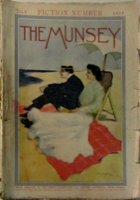
Robert Ashton looked up from his desk to the tall figure in blue and brass that had suddenly appeared in the doorway.
“Good evening, Mike. Now, don’t tell me you’ve got another one!”
“But Oi have, sor. Just put ’im in. An’ a tough nut he is fought loike a divil. He wants ye roight away, sor.”
Ashton groaned and laid down his pen.
“It’s a conspiracy, Mike. Ever since I was appointed county attorney, bound to defend pauper criminals gratuitously, you fellows have been perniciously active. This makes three this month. What's this one in for?”
Blue-and-brass expanded its chest.
“The Bigsby burglary, sor. Got ’im dead to rights. Old mon Bigsby oidentyfied ’im.”
“Good for you, Mike. Wants me right away, does he? Well, I guess if I don’t get to him for a few days he’ll keep all right in Jerry’s refrigerator.”
Blue-and-brass grinned copiously, nodded assuringly, and sauntered away with swinging club, while Ashton again plunged into the legal labyrinths of Dighton versus Purley. There was a fat fee in that case. The jail client could wait.
The clock in the court-house tower struck five with the vigor and promptness due from a public servant, and Ashton glanced out at it in surprise.
“Confound the luck! ” he growled. “I can’t catch that train now, and Purley is expecting me. I could go tonight, but I’ll wait, and run down in the morning.”
He pushed his chair back, put his feet on the desk, and lighted a cigar. A prolonged and insistent peal of the telephone, ending in two vicious snarls, interrupted his repose.
“Sounds as if it might be an urgent case,” he muttered hopefully as he seized the receiver. “Who? The jail? Oh, all right; what is it, Jerry? Yes, Mike told me. Well, you just inform the gentleman that he’ll wait until I get ready. What’s that? Oh, yes, I suppose I canto accommodate you. All right; I’ll drop in on my way home. And, say, Jerry, don’t give him too much of that rich food. You’ll astonish his stomach. Ha, ha! Good-by, Jerry!”
He hung the receiver up, resumed his recumbent posture, and finished the cigar. Then he leisurely put his hat on, locked the office door, and strolled down the street to the nearest newsstand. A tall, stern-faced man with long, stiff upper lip and sharp, cold, blue eyes, leading a bright-faced little girl, passed out as Ashton entered. The two men nodded as they passed, and Ashton caught a glimpse of the latest Puck in the tall man’s pocket.
“John Stone’s the last man on earth I should suspect of buying comic papers,” Ashton remarked as he picked up his favorite magazine. “If he has smiled once during the two years he’s been here, it’s not of record.”
“Buys ’em for his little girl,” the dealer explained. “Guess she’s the only thing on earth that can thaw him. Did you ever see such eyes? Like two sharp icicles blue with cold.”
“Good lawyer, though,” said Ashton, pocketing his change. “Plenty of money, and making more.”
The grim, gray jail, granite-walled and steel-barred, recalled to Ashton’s mind the existence of the Bigsby burglar. He ran up the stone steps, and pulled the door bell impatiently. The turnkey, stocky of form and fiery of head, admitted him.
“Glad you’ve come, Mr. Ashton. Your new client’s been goin’ on like a wild man, disturbin’ of everybody. Take a chair. I’ll have him here in a minute.”
From a hook on the wall he took a pair of handcuffs.
“Ain’t takin’ no chances with this laddy-buck,” he observed, in answer to Ashton’s questioning look. “He’s desperate. Took three of ’em to handle him till Mike reasoned with him with his club.”
“Old Bigsby says you've got the right man, does he, Jerry?”
“He does that! ’dentyfied him right here the minute he set eyes on him.”
“And what did the new boarder say?”
Jerry grinned sarcastically as he opened the great steel door.
“What’d he say? What do they all say? They’re all alike; ain't none of ’em guilty.”
The county attorney was absorbed in his magazine when the cautious Jerry reappeared with his handcuffed charge at his elbow. The prisoner dropped into a chair, and gazed straight into Ashton’s face with frank, unswerving eyes.
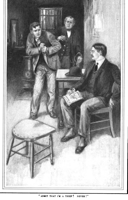
“So you’ve come at last!” he said sharply.
Ashton did not reply. He was surveying his client curiously. There was something familiar in the lad's manner, in the ring of his voice, in the clear-cut, intelligent face, with its aggressive chin and determined mouth.
“This is an outrage,” the prisoner continued hotly. “I haven't been near that man’s house!”
The county attorney smiled — a grim, incredulous smile.
“Can you prove that?” he asked.
“Prove it? I'm not required to prove it. The State must prove I'm the right man.”
“And Bigsby will swear you are.”
The prisoner’s brow knitted, and he moved uneasily.
“Why should he? What can he have against me? He’s mistaken or a malicious liar!”
“Let me have your side of the story,” Ashton suggested.
“There’s not much of it. I was sleeping in a freight-car when the officers found me. I fought; who wouldn’t? They dragged me here, and sent for the man you call Bigsby. He declared me to be the man he saw trying to break into his house last night. That’s all I know of the affair.”
“Beating your way in a freight-car, eh?” observed Ashton, turning the leaves of his magazine to the story he was particularly anxious to read.
“I was; yes, sir,” the prisoner answered frankly. “Slipped into the car at Greenville, forty miles up the road, and hadn’t been out of it. I was tired, and fell asleep.”
“Been up all night, eh?”
“I hadn’t. I’m telling you the truth,” the other answered sullenly.
“What’s your name and age?”
“ Wallace Johnstone. I’m almost twenty. And I’m a printer when I work.”
“And when you don’t work?”
“I loaf, and blow what I’ve saved. Oh, you needn’t look at me that way! I’m no saint, but I’m no thief. I’ve never harmed anyone but myself. Why should a fellow be steady, when no one on earth cares whether he lives or dies?”
“Haven't you a home and relatives who care?”
The prisoner’s face clouded. “That has nothing to do with this affair,” he said.
“It’s a bad case,” Ashton went on. “You’re found in a box-car, beating your way, like any common tramp. You're without money, though work is plentiful and wages good. You fight the officers, and you refuse to disclose your antecedents. A reputable citizen swears that he surprised you in the act of breaking into his house in the night-time. In defense, we have only your uncorroborated denial. I rather think you're in for it, my boy.”
“But you'll fight the case? That Bigsby.”
“And make matters worse? You’d better plead guilty. I’ll do all I can to secure a light sentence.”
The prisoner sprang to his feet with a hoarse cry.
“Admit that I’m a thief? Never! There'll be no record like that! I’ll fight and take what I get. And when I’ve served my time I’ll find the guilty man, if it takes all the rest of my life. I not a thief! My God!”
“Very well, sir. You wanted my advice”
“Confound your advice!”the prisoner was shaking his clenched and manacled hands over Jerry’s quickly interposed shoulder. “It’s money you want. If I had that you’d clear me; you’d prove Bigsby a liar; you’d scour the county for evidence. I'll not plead guilty. You’ll have to appear for me. And that's all I have to say to you, Mr. County Attorney, only confound you, and Bigsby, and your county with you!”
The turnkey bustled him away, livid with fury.
“Pleasant little cuss,” Jerry remarked when he returned, jingling the handcuffs, and shot the bolts of the steel door.
“Very amiable young gentleman,” Ashton assented. “Isn’t it sad, Jerry, to see so many innocent men sent up?”
The turnkey sighed sonorously and wagged the red head dolefully as he let the county attorney through the outer door.
“Sad? It's heart breakin’, Mr. Ashton. Sometimes I think I’ll throw up my job rather’n be a party to such scand’lous proceedings any longer. Seems like we never catch the guilty ones at all.”
Ashton laughed lightly as he ran down the stone steps and turned toward home, his precious magazine tucked safely under his arm.
When the case of the State versus Johnstone was called for trial, almost a month later, the county attorney, chatting in a corner of the court-room with the attorney for the State, had forgotten that he had a client of that name. Mildly indignant at being compelled to go through the form of a trial in so plain a case, the two attorneys took their seats. Ashton listened languidly as Bigsby related his oft-told tale to the listless and perspiring jury, and the venerable judge nodded drowsily during the perfunctory cross-examination of the prosecuting witness.
Ashton was about to dismiss the witness when he saw his client glance upward, start from his chair at the opposite side of the table with a look of amazement, then drop back and avert his face. At the same instant he felt a hand upon his shoulder, and, looking up, saw Stone bending over him, his stern face twitching convulsively.
“I beg your pardon, Ashton,” Stone whispered hurriedly, “but you must let me into this case. I must cross-examine this witness. That boy is no criminal — it’s not possible!”
Before the startled county attorney could reply, Stone was addressing the drowsy judge, who started up from his nap with an expression of profound interest.
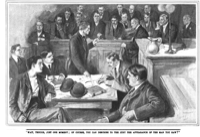
“Your honor, Mr. Ashton has kindly consented to accept my assistance in this case. With your honor's permission I will continue the cross-examination of this witness.”
The jury straightened up and leaned forward, mouths agape, while the judge adjusted his spectacles and stared curiously at Stone’s eager face.
“I will certainly object to such procedure,” the prosecuting attorney exclaimed, springing up. “Mr. Ashton, having begun this cross-examination, must finish”
“It is within the discretion of the court,” Stone broke in impatiently. “Your honor, this is the first favor I have ever asked of this court.”
“It’s rather irregular, as you are aware, Mr. Stone,” said the judge slowly, “but I think I will allow it in this ease; I don’t see that it will prejudice the case in any way. You may proceed, Mr. Stone.”
With a courteous inclination of his head toward the bench. Stone turned his keen, cold eyes upon Bigsby.
“Now, Mr. Bigsby,” he said softly, almost caressingly, “having just arrived. I did not hear your testimony in chief. Have the kindness to state what it was that first called your attention to the defendant.”
Mr. Bigsby, delighted to relate his story once more, assumed an expression befitting the center of attraction about which the case revolved.
“Well, as I said, he waked me up tryin’ to break in the winder. I jumped out of bed and run to t’other end of the house, where he was, an’ when I reached the winder I seen him jumpin’ over the hedge-fence.”
“And what is the distance from that window to that hedge?”
“Not further’n six rod. Just about six rod, I reckon.”
“Very well, Mr. Bigsby, we’ll say one hundred feet. And at what hour of the night was that?”
“Jest ten; I noticed the clock as I jumped out of bed.”
“Ten! Now, Mr. Bigsby, you certainly are mistaken about that.”
“No, sir; noticed it partic’lar.”
Stone seemed embarrassed, and Bigsby grinned confidently at the jury.
“Will you tell me what time it is now by that clock on the wall at your left?” Stone purred. “Not that I question your veracity, Mr. Bigsby, but I am sure you must have mistaken the time.”
The witness blinked for a moment at the clock, then drew a pair of spectacles from his pocket.
“Oh, never mind, if you can’t see the dial without glasses,” said Stone carelessly. “You don’t wear glasses in your sleep, do you, Mr. Bigsby?”
“Oh, I know you’re smart, but you can’t ketch me that way, Mr. Stone,” answered Bigsby, with a cunning glance at the attentive jury. “My clock set right by the bed, not ten feet from my nose, an’ the moon was jest comin’ up, an’ shone straight through the winder on to it.”
“Ah! That explains it. You were sleeping down-stairs?”
“I was.”
“Your house is a large one, I believe.”
“Purty good-sized. Two story; ten rooms.”
“And as you say, you ran the full length of the house — your bed was at that end of the house farthest from the hedge-fence?”
“That’s right.”
“If I remember your property correctly, Mr. Bigsby, and a very fine property it is, there are several trees in the front yard, between the house and the hedge.”
“Ain’t a finer grove of cedars in the State, I reckon,” responded the witness proudly.
Stone’s long, nervous fingers drummed softly on the table before him as he idly contemplated a fly buzzing desperately in the web that decorated a corner of the court-room. Mr. Bigsby, smiling complacently, awaited the next question. The prosecuting attorney was frowning, and aimlessly fingering the indictment.
“I think that’s all, Mr. Bigsby,” resumed Stone. “ Wait, though, just one moment; of course, you can describe to the jury the appearance of the man you saw?”
“You bet I can. Medium-sized young fellow, with brown, curly hair, blue eyes, smooth face, light clothes, straw hat, low-cut shoes. That’s the man, right there at the table!”
“Quite positive about that description, are you?”
“Sure. Didn’t I see him plain as I see you?”
“No doubt, Mr. Bigsby. But when you called on the officers you were unable to give them more than a very vague description of this burglar.”
Mr. Bigsby coughed slightly, hesitated, and caressed the abundant hirsute growth on his retreating chin.
“Well, you see — I was consid’able excited then. But soon as the officers fetched this feller in I knowed him; the sight of him sorter refreshed my mem’ry. Yes, that’s it — refreshed my mem’ry, as you lawyer fellers say. Ha! Ha! Guess I hit that time, Mr. Stone!”
“I see you will have your little joke, Mr. Bigsby. It’s strange that so shrewd a man as you didn’t search for tracks.”
“Didn’t I ? An’ found 'em, too!”
“Where?”
Mr. Bigsby stared at the prosecuting attorney with the dubious expression of one who realizes he may have told too much. Stone leaned toward him, the cold blue eyes scintillating fire.
“Did you hear my question, sir? I asked where you found those tracks.”
“At the little ditch between the hedge an’ the road.”
“You may describe them.”
“Don’t know as I can,” said Bigsby, shifting uneasily in his chair. “Only they wasn’t very big.”
“You measured them?”
“No, I didn’t.”
“You showed them to the officers?”
“Well, what if I did?”
“And you put your foot in one of —”
“How’d you know —”
“You’re not here to ask questions, sir. I know more than you think. The officers are subpoenaed, and you may as well tell the truth. State to this jury how that track compared, in size, with your foot.”
The witness gazed appealingly at the State’s attorney.
“Go on!” Stone snarled.
“Well, it was a leetle — jest a very leetle bigger’n my foot an’ I ain’t no big man, nohow.”
Stone leaned back and closed his eyes. Ashton heard the faint sigh of relief, saw the ghost of a smile that flittered athwart the stern face. Then the old gladiator opened his eyes and rose to his feet.
“Gentlemen of the jury,” he said quietly, “I ask you to note the comparative size of the shoes of these two men.”
“Couldn’t he have changed” Bigsby blustered.
Stone turned upon him fiercely, the lawyer’s hard face illumined by the fire of combat.
“Silence, you perjured scoundrel!” he roared. “And you, Mr. Prosecutor, keep your seat until this witness — who could not read the figures on that clock — explains how he was able to distinguish the size, height, shoes — aye, even the color of hair and eyes of a man of whom he had but a momentary glimpse at a distance of one hundred feet, and that in the night, when the faint light of the hardly risen moon was totally obscured by the house and a dense grove of cedars!”
The frightened witness attempted to flee from his chair, but the enraged lawyer pushed him back.
“Your honor,” said Stone, “I think you will agree with me that it needed not the evidence of the tracks to demonstrate that the State has committed a grievous error in this case; that it is this man Bigsby who should sit where this prisoner sits, on a charge of willful and malicious perjury!”
“I ain’t no perjurer,” Bigsby whimpered. “Can’t a feller be mistaken? Anybody’s liable to be mistaken an’ he’s nothin’ but a tramp, nohow an’ we’ve been robbed till it was time to do sumthin’.”
Stone turned away from him contemptuously.
“If the court please,” he said quietly, “I move the immediate discharge of this defendant.”
“Has the State any further evidence to submit?” asked the judge sternly.
“None, your honor,” answered the abashed prosecuting attorney. “The State will not oppose the motion. But I wish to say that had I suspected —”
“Never mind about that, sir,” the judge interrupted. “I want you to understand, you and Mr. Ashton, that henceforth this court will tolerate no such neglect of duty. Let this affair teach you that the mere arrest of a friendless stranger is not conclusive evidence of guilt. As for this witness, he will have my attention — my undivided attention — later. Gentlemen of the jury, the evidence in this case compels the court to take the case from you, and to discharge the defendant. Defendant discharged. Mr. Bailiff, adjourn court!”
The prisoner did not move. Stone beckoned Ashton aside and slipped a purse into his hand.
“For him,” he said in an undertone. “And if he — if you should want me, I will be in my office.”
When Ashton, thirty minutes later, tossed the purse upon Stone’s desk, the old lawyer scarcely looked up as he asked:
“Wouldn’t accept it, eh?”
“He guessed who sent it.”
“Very well,” Stone said calmly, and resumed his work.
“Look here, John Stone,” Ashton broke out impetuously, “it’s none of my business, perhaps, but I want to say to you that you’re a hard man, and that you’re making an awful mistake. With all his faults, that boy is one to be proud of, and if his story’s true — and I believe it is — you’re more to be blamed than he for his waywardness. While you may have meant it for his good, it was your sternness and tyrannical harshness that drove him away; and now, when a word from you would bring him back, you’re going to let him go to the dogs. I repeat it, John Stone, you’re a hard man and an unjust one!”
Stone arose slowly, and put his hands on the county attorney’s shoulders. There was a strange quaver in his voice when he spoke:
"I am. I know it. I realize it now. Ashton, you don’t know how the sight of him to-day, in that place, affected me. You’re not a father — you can’t understand how I love that boy!”
“Then come with me,” cried Ashton eagerly.“He can’t be gone far. We’ll overtake him and —”
Stone shook his head and resumed his seat.
“No,” he said decisively. “I was too harsh — I forgot that he was a Stone, to be persuaded but not coerced, but he must come to me; I will never go to him.”
“He will never do that,” the county attorney said.
“Then he may go his way. To-day I saved him, and our name — which, by good luck, he had the presence of mind to conceal from lasting disgrace, and he gave me not one look of gratitude or recognition. Until to-day, I had not seen him for five long years. Not in twenty times five years will I ask him to return!”
A patter of little feet sounded in the outer office. The door between the two rooms swung partly open, and the little, bright-faced girl danced in and climbed upon Stone’s knees.
“No more school ‘till fall, papa,” she cried merrily. “Now you and me will have such fun! You know what you promised me for vacation!”
The hard face softened, and buried itself in the golden curls.
“You will have the pony and cart this very evening, Bessie.”
“But that isn’t what I want, now and you promised me anything I wanted.”
“Don’t want the pretty pony and the cart?”
“Oh, there’s something I want a hundred times more! May I have it, papa?”
Two soft little hands were caressing the hard face; two bright blue eyes were beaming pleadingly. Stone smiled. Ashton looked twice before he could believe it, but he smiled — proudly, happily.
“May you have it, sweetheart? You may have anything you wish.”
The child led her father to the door, threw it wide open, and Stone stopped, transfixed, erect, motionless. There, in the doorway of the outer office, stood — Ashton’s late client.
The little girl ran to him. He lifted her in his arms, and met Stone’s gaze haughtily, unflinchingly. The child, tearful-eyed, stretched out her arms.
“I want him, papa. I want Wally — my brother! I found him and begged him to come. Please, papa!”
She whispered something in the boy’s ear, and he slowly held out one hand.
“For her sake and mother’s,” he said.
Then Ashton slipped away; for the arms of stern John Stone were about his children.
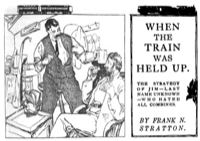
HARLAN, express messenger on No.6, snapped his watch shut, opened the door of his car with a jerk, and peered out into the night. He hoped to see a headlight approaching from the north; but there were only the lights of the long line of coaches behind him, waiting on the side-track for No. 7 to pass.
The icy wind dashed furiously against his face, and he was hastily closing the door when he heard sounds that moved him to glance again toward the coaches. Then he swore softly, and gritted his teeth. Harlan was tender-hearted and free-handed — foolishly so, his friends said — and the spectacle of the burly brakeman assaulting a small man of shreds and patches, with violence and lurid language, sent his indignation to a high notch. He watched the unfortunate arise painfully from the frozen ground, and mentally reviled the heartlessness that could deny, to even a tramp, the scant shelter of a coach platform on such a night.
"The poor devil will freeze before midnight,” Harlan muttered.
He sheltered his face from the wind, and calculated rapidly the chances of discovery should he indulge his impulse. The International Express Company was undoubtedly more interested in the safety of its freight, especially the fifty-thousand dollars in Harlan’s car, than in the comfort of tramps, and its rules relative to the admission of strangers to its cars were not open to more than one construction.
When he looked out again, the ejected was limping slowly along the main track, near the express car. Harlan hesitated for another moment, then called out, cautiously:
"Hey, there, Willie!”
The shabby one looked up quickly.
"Don’t stop; keep going,” Harlan said, “but sneak around to the other side of this car, Savvy?”
The shabby one nodded and limped away, sidling and stooping to the wind. Harlan shut and fastened the door, crossed the car, and listened. A whistle sounded far up the track.
"I wish he was here right now,” Harlan muttered. “They’ll all be watching No. 7 as she passes.”
A faint rapping sounded on the door. Harlan pulled it partly open and hauled the shabby one in just as No. 7 sped by with flash and roar, and No. 6, with shrieking whistle and much squeaking of flanges against frosty rails, resumed its journey northward. When the messenger turned from securing the door, the wanderer was stooping over the stove, almost embracing it.
"Bad weather for chilblains, Happy,” remarked Harlan facetiously.
The shabby one turned his head and grinned.
"I guess yes, pardner. But my name ain’t Happy, nor yet Willie, I ain’t no Hobo.”
“No? Perhaps you’re the general manager, on a tour of inspection. Your credentials didn’t seem to go with the brakeman back there! Have a chair, G.M.”
The shabby one dropped into the proffered chair, and paused in his task of pulling icicles from his ragged beard to stare curiously at Harlan as he replenished the fire.
"How’d you know my name was Jim?” he asked slowly.
"Jim? I didn’t call you — oh, I see. Jim, is it? And why are you bumming around on such a night as this?”
"Bummin’ it to Denver. I’m promised work there, an’ —”
Harlan looked up from filling his pipe, and laughed loudly.
“Work! You must be a brave man, Jimmy, to be traveling all alone in the direction of work. You might run right up against it. Something of a humorist, aren’t you, James?”
James was fumbling hurriedly in the pockets of his tattered coat, and did not reply to Harlan’s sally. He fished up an odorous cob pipe, seized Harlan’s tobacco-box, and helped himself to a generous portion of its contents.
“Gimme a light, pardner!” he growled.
"Well, you’re a cool number,” said Harlan, handing his guest a match.
"Oh, I’ll soon be a warm one,” the man rejoined, stretching out his hands to the roaring fire, and puffing audibly at the pipe.
Harlan noticed that the hands bore unmistakable marks of toil.
"What kind of work are you promised at Denver?” he asked the man, more seriously.
“Sheet iron plant. Good pay and steady job — if they don’t get on to who I am.”'
"On the black list, eh? Been on a strike?”
The man shook his head and pulled at his pipe in silence. Presently he planted his gaping shoes upon the upper edge of the stove, tilted back his chair, blew a cloud of smoke upward, and keenly scrutinized his surroundings. His gaze rested on the two heavy revolvers hanging in their holsters on the wall. "Ever have to use ’em ?” he inquired, indicating the weapons by a motion of the pipe.
"Not yet. They’re all ready for business, though, when the time comes,” Harlan added, with a furtive glance at his guest.
“No good against dynamite,” the man said decisively. "Used to know a young feller, good friend of mine, that run on the B. & O. He always had a brace of guns ready, an’ he had the nerve to use ’em, too. Never got a chance. They got him one night, ’bout such a night as this. Dynamite! Made a big touch, an’ got away. Jake wasn’t killed, but he’d better been. Knocked him loony. Ain’t never been right in his upper story since.”
"I guess Jake didn’t put up much of a fight,” said Harlan.
“That so?” the shabby one exclaimed, with an inflection that indicated profound faith in Jake’s bravery. He slowly removed the pipe from his mouth and the feet from the stove, leaned forward, and tapped Harlan’s knee impressively. “Just s’pose you had a big bunch of coin in here to-night as you may have, for all I know — an’ was held up on such a desolate, Godforsaken stretch of track as we’re runnin’ over right now, by a gang that was on to their job. Sonny, you’d last just ’bout as long — just ’bout as long — as them icicles that I pitched into that fire!”
"It’s getting uncomfortably warm in here,” observed Harlan.
He arose and carried his chair further from the stove — nearer the weapons on the wall. His guest straightened up and pushed back his seat.
"Why ain’t there two of you?” the stranger asked. "I’ve seen two in a car sometimes.”
"My helper failed to show up this evening — sick, probably — and I had to go on alone. I’ll take on another man at Denver.”
The shabby one crossed his legs, knocked the ashes from his pipe, and re-appropriated the tobacco-box.“It’s a big mistake,” he said reflectively,"this thing of puttin' only one man in a car. Two men could hold a car every time, if they understood how, an' had the nerve. How? S'pose you an' me was messengers. The gang flags the train, covers the engineer an’ fireman, cuts the engine an' express from the train, an’ runs down the track — as they 'most always does. You takes one of them guns, an' I the other. Just as the car stops, while the gang is still on the engine an’ tender, I jumps out of that door, an' you out of this. We takes cover in the rocks, in good shootin' distance of the car. Ain't we got the whole situation at the muzzles of our guns? — robbers, engine, express car, everything? The gang can’t get near the car, an' they can’t pull her away. We've got the whole outfit covered. See? Why couldn’t they attack us? They could — but they ain't never got no time to lose, an' there’s the train crew hurry in' up from the rear, an' trains runnin' both ways — an' with us layin' snug down among the rocks, I reckon we could stand 'em off for a while. Course the scheme has its drawbacks — there might be no good cover, or the night might be too dark — but it’s a blamed sight surer than stayin' in the car an' gettin’ blowed to kingdom come!”
Harlan shifted uneasily in his chair, and regarded his guest dubiously. "I guess there's no danger to-night,” he said, with a nervous little laugh. “Let's talk about something more pleasant. It's strange that you're out of work and on the bum when times are so prosperous and work so plenty.”
The shabby one uttered a strange sound, half laugh, half snarl. "Prosperous! That's just the trouble, pardner. It's got to be a holdup all down the line. Lookee here, pardner, mebbe you won't believe me, but it ain't been so very long since I had a nice business of my own. I'd worked up from the bottom, saved my money, got a good start, an' had a long list of names on my pay-roll. Things was comin' my way right along, when all of a sudden I found I couldn't land any more contracts. I knowed my bids was lower than some that got the business, an' I couldn't understand it. I investigated, an' found there was a ring — a combine that had a pull an' a system. Even the architects was in it, an' saw that outside bidders was thrown down. Whenever a job was on tap, the ring would meet an' fix the figgers for the lowest bid, with an awful margin of profit, an' would choose the firm, in rotation, to submit that bid. The others would all bid higher, an’ they’d divide the profits. All my competitors was in the combine, an' I had to get in or quit. I got in. After a while I discovered there was a ring in the ring that was gettin' the big end of the divvy. I kicked. They laughed.”
"One day I found the combine had submitted bids on a big job without callin' me in. Then I kicked clean over the traces. I went to the builder, give the whole scheme away, an' offered to take the job for fifteen thousand dollars — the ring's lowest bid was twenty-thousand. He took me up, approved my bond, an' I went back to my factory laughin' over the way I'd beat the ring, an' tickled to death over my big profit. Next morning a walkin' delegate showed up an' ordered my men out. I tried to argue with 'em, but out they went. I tried to get other men, but times was so prosperous they all had work, an' they belonged to the union, anyhow. I went to the builder an' explained — asked for more time. He said he was sorry, but if I couldn’t fill my contract he’d have to come to the ring's terms, an' hold me an' my bondsmen for the difference. That meant ruin. I throwed up my hands an' went to the ring. They finally agreed to take me back if I'd pay a heavy fine, turn over all my profit on the job, an' pay my men for lost time. I had to do it — that was the only way to save my business an' my bondsmen an' the ring promised to let me in on all future grafts. They didn't do it; they froze me out, an' I lost everything. Everything, pardner; my family's livin' now in two rented rooms, with just enough money to pay for food an' fuel till I can send 'em my first pay. And I'm on the combine’s black list, an' if the Denver firm knowed my real name they wouldn’t take me.”
"Why didn’t you lay the facts before the proper officials, and have the combine prosecuted?” asked Harlan indignantly."The law’s with you.”
The shabby one regarded his host with an amused expression on his thin face.
"Yes, sonny, the law’s with me, but the lawyers ain’t — I’m out of cash. Pardner, you may know all ’bout the express business, but you’re mighty green ’bout some things. Proper officials! What puts the proper officials into office, pardner? Votes! An’ what gets the votes? Money! An’ who puts up the money — the campaign funds an’ controls the nominations? The rings, pardner, the combines, that wants to be let alone, an’ is willin’ to pay for it. See? Prosecute! The indictment comes up, all right, for a blind, an’ then the real fine work begins an’ wins out. What’s the train slowin’ up for, pardner?”
Harlan looked at his watch with an air of surprise.
"Water-tank. Midnight already. You’re quite an entertaining conversationalist, Jimmy.”
He dragged a box to the stove, and lifted out a bulging basket neatly covered over by a snowy napkin.
“Lunch time, Jim. Pitch in!”
The shabby one precipitately discarded the pipe and pitched in. A little tear of joy started to Harlan’s eye when he discovered, in the depths of the basket, a diminutive pie, elaborately crimped and scalloped by a tiny thumb, and bearing the inscription,"P-A-P-A,” in sprawling characters on its flaky crust.
"Some of my baby’s work,” he explained proudly."She’s a regular little housewife already!”
Without pausing in his vigorous attack on a ham sandwich, Jim cocked his unshorn head knowingly, and then scrutinized the small pie with evident admiration.
“It’s all right, all right!” he mumbled thickly."Say, how old’s the kid, pardner?”
"Six next April.”
Jim poised the fragment of sandwich in front of his mouth, and beamed up at Harlan, who was placing a can of coffee on the stove.
"You don’t say! Just the age of my baby — an’ she’s a girl, too! How many you got, pardner?”
"Only two. Oldest’s a boy.”
"I’ve got three. What would' we do without ’em, pardner?”
Harlan shook his head, as if unwilling to consider so unpleasant and desolate a situation.
"Mine’s all girls,” Jim said, selecting another sandwich, and eying the can of coffee."My little boy died just after the combine did me up. We had to take a little ramshackly house, an’ he catched pneumony. Like to have killed my wife, that did. All our trouble seemed to come at once.”
The man’s eyes blazed, and his teeth went through the sandwich with a vicious snap. Then both men sprang to their feet. A shot had rung out — then another — and still another — and then a fusillade! The car, which had barely stopped, started with a jerk that almost threw both men from their feet, then plunged forward, rocking and swaying as its speed increased.
Harlan gave one great leap, seized both weapons from the wall, and leveled them at his guest. The shabby one threw up his hands with a deprecating gesture.
“Oh, no, pardner!” he cried."Don’t think that of me! Not guilty!”
"What business have you in here, any way?” Harlan exclaimed.
"What business ? Why, pardner, didn’t you invite me in when I was freezin’ to death, an’ warm me, an’ feed me, an’ treat me like I was human? Yes, you did! An’ now, by the Eternal, I’ll stay with you! Gimme one of them guns, pardner — there’s a combine of thieves out there that I can fight!”
Harlan’s flaming eyes were fixed on his guest as he spoke; as if convinced, he dropped the muzzles of the revolvers.
"I believe you mean it,” he said quietly,"but my job’s gone, whether we win or lose this fight. The company will know you were in here.”
“Cheer up, pardner; mebbe we can manage that. How much coin you carryin’?”
“Fifty thousand.”
Jim emitted a long whistle.
"They’ll fight hard for a pile like that. What time do you reckon we’re makin’ now?”
"Not less than forty an hour. We’re cut from the coachesI can tell by the swing.”
"They’ll stop purty soon. What’s your plan of battle, pardner? Goin’ to stay in here an’ git blowed to the beautiful stars?”
Harlan dropped his head and reflected rapidly. The speed of the car decreased; the trucks groaned noisily; the violent motion ceased. Harlan looked up and spoke decisively:
"We’ll try your plan. We’re among the rocks where there’s good cover, and the moon’s almost full. You don’t look like a fighter, but I’ll trust you.”
"Bully for you, pardner. I ain’t very big, that’s right — but you watch me grow! I was raised out West — fact is, I was dep’ty sheriff once, in Idahoan’ I reckon I know something ’bout a gun yet; enough to shoot some law into this combine. Gimme one of th’ barkers, pardner!”
"Here, take both. I’m no good with a pistol, but I’ve got a plaything here I can handle.”
Harlan reached behind a stack of boxes, and drew forth a short, heavy, double-barreled gun.
“Riot gun,” he remarked grimly, as he filled a pocket with murderous-looking cartridges."Made for mobs — at short range.”
Jim grinned approvingly.
"Beats all the statutes made an’ provided,” he observed.
There was an expression on his worn face that moved Harlan to thrust out his hand. Jim grasped it, and the eyes of the two men left nothing to be said. They took their stations near the doors, and waited silently. Harlan could hear the thumping of his heart as the car slid gently along the track with the gentle vibration that heralded its stoppage.
“Now!” he cried, and each threw open his door and leaped out.
The track lay half way up a steep hillside, and Harlan, leaping to the lower side, lost his footing, stumbled, and fell to his knees. From the direction of the locomotive came a loud command to halt, then several rapid shots. Harlan felt a sharp, stinging sensation in his left shoulder as he regained his feet and ran like a deer toward a mass of huge boulders, forty yards away, that glistened cold and gray in the moonlight.
Gaining their shelter, he kneeled behind the rocks and cautiously peeped out. But one robber was in sight; he stood on the cab step, his back toward Harlan, his revolver leveled at Robinson and Finney, the engineer and fireman, who sat facing the outlaw on the opposite side of the cab. Harlan raised his gun, then realized that the scattering buckshot would hit Robinson or Finney as well as the robber. He saw, too, that the fellow was protected by the loaded tender from a shot from Jim’s position.
With an exclamation, of disappointment he turned his head and looked up the hill beyond the car. Up there, in the shadows of the rocks, lay something that looked like the lifeless body of a man. A cold sweat started on Harlan’s face as he comprehended his situation. He understood, now. The robbers were attacking the car from its unprotected side; Jim was killed, or a traitor; and he, Harlan, had deserted his car would be branded as a coward. The company would never believe his story; it was too improbable, the circumstantial evidence against it too strong.
With a cry of despair Harlan sprang up and started toward the deserted car. He could at least die!
Two lines of light leaped from the shadows far up the hill; two quick, sharp shots rang and reverberated among the rocks; Jim’s voice — it came to Harlan like a reprieve from death sang out: “All down but four, pardner! It’s up to you. Keep ’em jumpin’!”
Then Harlan saw three forms duck hastily under the car and emerge on his side. As they rose to their feet he took quick aim and fired both barrels. One of the men staggered, then the three dropped to the earth and disappeared.
Again Jim’s voice came down the hill:
"Give it to ’em, sonny! There’s a panic struck one combine right now! This here’s the kind of prosecution that prosecutes!”
Harlan laughed as he sped back to his shelter. He shoved two fresh cartridges into the gun, and lay down to watch and wait. He saw the man on the cab step shift his position slightly, uneasily; saw Finney’s stocky body lean forward, ready to spring. Oh, if only Finney could.
A dark figure rose from the rocks at Harlan’s left and hurled a dim object toward him! The earth heaved skyward with a deafening roar; a black, blurring cloud whirled before his eyes, through which gleamed a flash of fire from the further side of the cab as the man on the step threw up his arms and fell backward; and then a great cloud encircled Harlan and blotted out the world.
When the world came back to Harlan he was lying on a cot, in his own car. His left shoulder throbbed and smarted. He raised his right hand painfully to his roaring, buzzing head and touched a bandage. He struggled to sit up, and Striker, the brakeman, loomed up and gently pushed him back.
"Lay still, old boy. Doc says so. You was hit on the head with a rock, but you’re all right — only a humped head and a scratched shoulder — but you’ve got to be good for a week or two.”
Harlan’s eyes wandered to the undamaged safe, and Striker smiled and nodded.
"Everything 0. K., Billy. You won out — got a majority of the delegates — two of ’em’s beautiful corpses, and another one’s coughin’ buckshot. T’other two was huntin’ for solitude when Robinson backed down to the coaches. You’re sure a game one, Harlan, to jump out and fight the gang face to face like that!”
"Where’s Jim?” asked Harlan feebly and unguardedly.
"Jim ? Jim who?”
"The — the tramp you kicked”
"Oh, Smith? Tom Smith, his name is, he says. Say, don’t call him a tramp — he’s a trump. He can have anything the company’s got, I reckon. Know what he did? Climbed on the bumper of your car after I’d fired him, and when you jumped out he crawled in, got your guns, sneaked down behind Robinson and Finney, and drilled a hole clean through the old thug that had ’em covered!”
"Well, where is he now?”
"Where is he? He’s in the smokin’ compartment, with his feet on the cushions, burnin’ ten-centers and cussin’ all combines. That’s where he is.”
From behind the newspaper clutched in Mr. Rohrer's fat hands issued a sonorous grunt, followed a few sound waves later by a growling voice:
“Country Club opens its new golf ground on the 20th, and my sticks haven't arrived yet. I'll blow Manson up as I go to the office in the morning; he's had my order two weeks."
“The 20th," repeated little Mrs. Rohrer timidly, as she poured the tea. “That's the date I've decided on for my my reception."
A grunt of double strength hailed this announcement. The long silence that followed was broken only at intervals by the rustling of the newspaper and the nervous clinking of Mrs. Rohrer's spoon.
Finally, a florid and whisker-fringed countenance rose from behind its screen and assaulted the evening meal with almost ferocious energy.
“I suppose that means that you want a check," it grumbled between mouthfuls. “What's this blow-out of yours going to cost?"
“I think I can make forty dollars do. I've figured everything down as low as —“
“You don't mean to tell me it'll cost forty dollars to shake hands with a few dozen women," Mr. Rohrer interrupted, poising a loaded fork half-way to his frowning and interrogative face.
“Why, Felix, that's very reasonable, I'm sure. Mrs. Austen's reception cost more than a hundred, and we owe it to —“
“We don't owe anything to anybody," growled the master of the house. “And no merchant in this town dares to leave anything in this house without the cash. You'll remember that, Jane."
“I was only trying to say, Felix," continued Mrs. Rohrer nervously, “that because of your late business success and our present social position we owe it to ourselves to make this reception an event that will cause favorable comment. Really, it can't be done with forty dollars, but if you think —“
“I think it's a piece of tomfoolery. You stand grinning at a line of smirking women on dress parade who pump your arm almost off, criticize everything in the house, gorge themselves on free lunch, and depart, vowing they've had ‘a perfectly lovely time,' to pick the whole affair to pieces. It's an absurdity — a grotesque absurdity."
“But it's the custom, Felix; and it's expected of us. People have been very kind to us since we came here, you know."
“It's not us, Jane; it's my money. They know I'm the wealthiest man in their little old burg — unless it's Miller. By the way, I took the wire edge off Miller to the tune of two thousand dollars in a little deal last week."
“Indeed?" observed Mrs. Rohrer absently. “I've heard he's a very shrewd trader."
“Yes; but when he went after yours truly he found he was up against the real article. I tell you, Jane, the manor woman, either — who can fool Felix Rohrer is welcome to all he gets."
“But my reception, Felix," Mrs. Rohrer urged. “The cards of invitation should be printed at once, and —“
“Invitations? Cards? 'Phone 'em. 'Phone em, Jane."
“Felix, you know that wouldn’t —“
“Write 'em out, then. Save the printer's bill."
“How, my dear?”
“You’ll write ‘em, Jane — or no check. We can’t sling money right and left. You must economize.”
Mrs. Rohrer hid her face behind the tea-pot and made a quick, furtive dab at each eye with her handkerchief.
“Very well, Felix,” she murmured.
“Let me see your estimate of expenditures, my dear,” the master of the house demanded when he had finished eating. “A penny saved is a penny earned, you know, and we’ve saved the printer’s bill already. I’ve no doubt I can cut your estimate down to thirty dollars.”
He did; he cut it down to twenty-five dollars. Mr. Rohrer was an excellent man of business.
“Now bring on your stationery, my dear,” he said, pulling a large, dark Havana from his vest pocket.
Mrs. Rohrer’s tearful eyes opened wide.
“The stationery, Felix?”
“Sure! You write out those invitations, and I’ll sign ’em now — along with you.”
“You’ll sign them!” Mrs. Rohrer’s weak voice rose to almost a shriek.
“Certainly. Both, sign ’em. Why not?”
“Felix!” Mrs. Rohrer expostulated desperately. “Such a thing was never heard of!”
“Well, it’s going to be. We’ll set a new fashion. Aren’t we both in this? Who’s putting up the cash, eh? Bring on that stationery, Jane.”
His eyes followed the departing form of his spouse with grim satisfaction.
“I believe she meant to have ’em printed in spite of me,” he muttered, shaking the ashes from his cigar. “I’ll spoil that. Guess she’ll not want to give another reception very soon.”
As Mrs. Rohrer returned with the box of cheap stationery, she suddenly halted as if struck with an idea. A hopeful light flashed in her blue eyes, and her tightly closed lips parted in a quick smile.
“I’ll do it!” she soliloquized spiritedly, and the lips closed again with a little pucker.
“How many, Jane?” asked Mr. Rohrer, adjusting his fountain pen.
“I’ve forty-two on my list now,” Mrs. Rohrer answered demurely, “and I think I’ll have as many more. I’m not quite sure. Let me see; there’s Mrs. Evans, I think I should ask her; and the Misses Burson; and Miss Stalker –– no, I don’t think I’ll have her either, I”
“Great Scott, do you expect me to sit here all night while you think out forty more and write eighty invitations? I’ve a most important business engagement at seven.”
A merry twinkle mounted to Mrs. Rohrer’s eyes.
“You might merely sign the sheets, then,” she suggested, “and I’ll fill them out and sign them afterwards.”
Mr. Rohrer nodded, and set hurriedly to work with the fountain pen.
“You’ll send them all off to-morrow, eh, Jane?” he asked as he finished the last signature with a flourish and reached for his hat.
“As many as I need, Felix,” replied Mrs. Rohrer reassuringly, as her lord departed to fill the important business engagement — the opening game of the amateur billiard contest at the club. He had a hundred dollars up on Wilkins.
Mrs. Rohrer’s reception was a success. In fact, so the newspapers declared, the affair marked an epoch in the social annals of the city and the society columns dilated upon the magnificent display of rare hot-house plants, the profusion of delicious viands, the band of professional musicians, and the elaborate and expensive gown of the charming hostess.
Mr. Rohrer had departed the day before the event on a business matter of importance, a three-day trip on a steam yacht for which he was negotiating. Returning, he stopped at the office on his way home, and smiled complacently as he glanced rapidly over the morning papers.
“Those reporters,” he commented as he opened his accumulation of mail, “surely have nerve. I asked them to give the affair a good send-off, and they certainly have spread it on thick. Wonder what the public would think if it knew the whole business only cost me twenty-five. Elaborate and expensive gown, ’eh? Well, hardly! Magnificent display of hot — what’s this? G-r-e-a-t Scott!”
Mr. Rohrer sprang from his chair, dropped limply back again, and stared in a dazed way at the two slips he had just drawn from an envelope.
One of them was a bill from Stone & Jenkins, florists, for one hundred and fifty dollars. The other, a small sheet of cheap stationery, bore a chirography that Mr. Rohrer hadn’t seen often since the days of his courtship:
“Messrs. Stone & Jenkins:
You will please honor any order Mrs. Rohrer may place with you, and present your bill promptly at my office, accompanied by this sheet.
Respectfully, Felix Rohrer.”
A light broke upon Mr. Rohrer’s bewildered brain as he closely scrutinized the signature. “Those invitation blanks!” he gasped:
Savagely he sorted out the suspicious looking envelopes, ripped them open, and stacked them in a little heap — florists, grocer, musician, caterer, confectioner, and all the others — an appalling array. The very last one —the dressmaker’s — was the cruelest.
“And I’ve got to pay ’em all to save my credit,” he almost bellowed. “Oh, Jane, Jane, how dare you?”
He grabbed the pile of bills in one pudgy hand and rushed home breathless. Mrs. Rohrer gazed up at him calmly as he stood shaking the documents in mid-air, too greatly overcome to speak.
“Yes, Felix,” she said pleasantly; “the man or woman who can fool Felix Rohrer is welcome to all he gets, you’ll please remember.”
Mr. Rohrer glared down at her blankly, stammered, and grinned foolishly. Mrs. Rohrer smiled up at him sweetly.
Then the master of the house did something that he hadn’t done for years; he stooped ponderously and kissed his wife. And when Mrs. Rohrer laid her head on the great shoulder, the master of the house imagined that she was crying for joy.
She wasn’t; she was shaking with laughter.

i.
As the clock in the tower of the Almeca court-house struck eight, the blinds on the doors of the Almeca Bank rolled upward, the bolts snapped backward, and the dark, wiry man who had been impatiently waiting outside stalked in and confronted the cashier.
“What d’ye mean by sendin’ me that notice, Wilson?” he demanded. “I hain’t signed a note in ten year. What kind of a game you runnin’ here, anyhow?”
The cashier gracefully dipped his long fingers into a file of papers.
“ Probably you’ve forgotten about signing this, Mr. Randall,” he answered quietly.“ Look at it; you’re surety for John R. Wilmer, you see.”
“Surety! Not me! It’s a forgery.”
The dark, wiry man bit the last word short, dropped the note to the counter, and stared at it with angry, glittering eyes. “Wilmer!” he ejaculated. “Why, that’s Jack Wilmer — the young fellow that bagged them Jackson City bank-robbers four year ago!”
The cashier nodded.
“Same man, Mr. Sheriff,” he observed. “Bagged the game and the reward while you were floundering about at the other end of the county!”
The sheriff's eyes snapped.
“What’d you take the paper for?” he snarled. “You know I don’t borrow nor indorse. Why didn’t you ask me?”
“Wilmer’s reputation has always been good; he told a straight story, and you were out of town. The signature appeared genuine.”
“Notified him?”
“Twice. He doesn’t respond. He's running a little general store among the miners down at Nugget Bend.”
The sheriff plucked thoughtfully at his short, grizzly beard.
“Twenty mile down the river.” he murmured. “Guess I'll lope down there now. Don’t need a warrant in this kind of a case. You can swear one out this evenin’ after I fetch him. The game won’t get away from me this time!”
“All right, Randall. Sorry for Wilmer, but we can’t countenance anything of this kind. We’ll hear from you this evening without fail?”
“You'll hear from me this evenin’ without fail,” the sheriff responded grimly. “Don’t you worry about that, Wilson!”
He strode to the street, sprang lightly to the back of his waiting horse, and cantered swiftly southward.
“Signin’ my name to notes, eh, after buttin’ in an’ beatin’ me out of that reward!” he growled. “Well, I reckon he’ll go out of business now — sudden an’ permanent!”
As the sheriff of Almeca County approached the only store of Nugget Bend, he heard a man’s voice, half growl, half bellow, raised within:
“What ye goin’ to do ’bout it, my lady? I’ve got the bacon. You’ll take two dollars er nuthin’!”
“Really, Mr. Doty,” protested a woman’s youthful voice,“bacon has advanced. That piece you have is worth three dollars, and ––”
“You're wrong, ma’am,” interrupted the harsh voice of the sheriff. “It’s worth six dollars an’ risin’ every minute!” The burly miner with the bull-like voice whirled toward the doorway with an oath. The sheriff’s right hand caressed a revolver-butt.
“Six is what I said, Tom Doty — it'll he seven next jump. Ah; that’s right. Now git, an’ don't never dispute with a woman, Thomas, about the price of grub. They know!”
He lifted his sombrero to the sweet-faced little woman behind the counter.
“Doty an’ me has met before, an’ he’s been willin’ to oblige me ever since,” he explained with a chuckle.
“Thank you.” said the little woman shyly. “That, brute isn’t the only one I’ve had trouble with since Jack left.”
“Jack’s gone, eh?” asked the sheriff sharply. “How long?”
The little woman pushed back a rebellious lock of glossy brown hair with a white, thin hand, and sighed wearily. “Four months yesterday.”
“You’re his sister, I reckon,ma’am?”
“His wife,” laughed the little woman, blushing faintly.
“Yes? Hadn’t heerd of it. Quite lately, wasn’t it, ma’am?”
“Almost a year now,” the little woman answered proudly.
“Good for Jack! You ain’t used to these parts an’ this business, I take it?” ventured the sheriff, glancing at the delicate hands.
“No; it’s all new and strange. I knew nothing of such people nor of work before Jack brought me here.”
“An’ where’d you say he’d gone, ma’am?” purred the sheriff.
The little woman looked up sharply. “I didn’t say. He went away on important business. II don’t think he’ll return soon.”
“Now that’s bad for me, ma’am. I might lose some money because he forgot to finish up a little transaction we was mutually interested in.”
“Oh, I’m sure Jack wouldn’t want that to happen,” cried the little woman anxiously. “Can’t it be prevented?”
“Why, yes; it can if I can see him for jest a minute. We’re old friends, ma’am. Hain’t you heard from him since he left?”
“I’ve had one letter,” answered the little woman hesitatingly, “but it was mailed, Jack said, by a friend a hundred miles from where Jack was. Maybe he'll send for me before long; and if you care to tell me” She paused as a customer appeared at the door. “If you'd step back into our living-rooms,” she suggested timidly, “I could talk with you soon — without listeners.”
The sheriff nodded, passed through the door at the rear of the store, closed it behind him, and surveyed the little room curiously.
“Not a blamed cheer to set in without spoilin’ a shiny cushion or a bunch of ribbon!” he growled. “Wimmin is th’ blamedest critters — specially young-uns. Mebbe there's a comfort'ble cheer in the next room.”
He tiptoed gingerly over the bright rag carpet, and thrust his head into a tiny bed-room. his inquisitive eyes roamed rapidly over the cheap pine bureau with its diminutive mirror, the neat bed with its varicolored log-cabin quilt, and rested on the contents of the sewing-basket at the side of the cane-seated rocking-chair.
“Gosh!” he muttered. “An’ her havin’ to scrap with that scum out there in that store! That’s one more mark again you. Jack Wilmer!”
He was reverently withdrawing his head when he saw an envelope through the meshes of the basket. He glided forward, lifted the letter from its hiding-place, and thrust it into his pocket. Then he hastily retraced his steps, and perched precariously on the edge of a beribboned chair when the little woman entered and faced him with flashing eyes.
“Why didn’t you tell me, like a man. that you’re the sheriff?” she demanded. “Because I was grateful, and thought you were a friend of Jack’s, I was tempted to help you. You know the bank can't make you pay that note!”
“So you know what I want with Jack, eh?”
She interlocked her slender fingers and gave a quick sob.
“He told me the night he left,” she said brokenly. “It’s the only wrong thing he ever did. He was half crazed when he did it. We should have lost everything, and he wanted money to go where he thought he could make enough to pay up the note before it came due. And now — of course he daren’t come back again!”
“Reckon you want to see your husband, as well as me an’ the bank,” the sheriff remarked.
“Want to see Jack?” her eyes shone like stars. “Oh, if you only knew! And I believe I can pay that note within a month. Since the rich strike here last week the people are flocking in, and the store’s making money. If I could pay, you’d let Jack come home, wouldn’t you?”
The sheriff turned his hard, bronzed face from appealing eyes.
“An’ if you did pay,” he asked,“ how’d you get word to him?”
“I don’t know,” she answered helplessly. “I’ve never known just where he was. And he dare not write again, he said. I’ll have to wait until he sends for me — how long? Oh, how long?”
The sheriff lifted his sombrero from the floor and rose to his feet.
“I don’t think the bank would take your money,” he said sternly. “They want the man.”
“Then he can’t come back?” she faltered.
The sheriff frowned and turned to the door.
“Oh, I rather guess he’ll come back.” he answered, with an inflection whose significance made the little woman gasp.
In the deepest, east-ward-pointing shadows of the pines that clothed the rocky slope, the sheriff of Almeca County slipped from his saddle, loosened the revolver at his side, and peered downward toward the fire that twinkled at the foot of the ravine.
“If that's him he'll ’most sure put up a fight before I can“
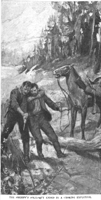
The sheriff’s soliloquy ended in a choking expletive as he crashed, sprawling, among the pine-cones that littered the slope.
He writhed vainly against the crushing weight that pinned him down, against the powerful hand that wrenched his weapon from his grasp: then the weight was lifted, and the sheriff sprang to his feet and faced the dim form that towered over him.
“Hunting Jack Wilmer. aren’t you” asked a deep bass voice.
“I was; guess I’ve found him!”
The voice laughed softly and melodiously.
“Guess you have Josh! Now, just step down to my fire below there, and we'll talk this matter over together. No, you go first, Joshua — I know your tricks!”
Sullenly the sheriff marched down the slope and seated himself near the fire. The young giant threw an armful of dead pine-branches upon the smoldering embers, and the flames crackled and leaped upward, casting dancing shadows along the steep defile. Then he leaned against a huge boulder and fished a pipe from his pocket.
“Awfully glad you came. Josh,” he said, blowing through the stem and tapping the bowl upon the rock. “Haven’t smelt the divine weed for two months.”
The sheriff grunted and tossed a grimy pouch into the outstretched hand.
“What put you wise, Jack?” he growled.
The giant tossed the pouch to its owner and stooped to pluck a blazing twig from the fire.
“Been expecting a visit ever since the note came due. You've had it in for me ever since I beat you to those bank-robbers. And Josh –– “ he grinned genially as he applied the twig, “when you mounted the rise up there on that horse you loomed up like the Bartholdi statue!'’
“Thought you was ten mile farther down,” explained the sheriff sheepishly.
“I was, yesterday. Moved up here this morning. Signs looked better.”
“Prospectin’?”
Wilmer nodded.
“Any luck?”
“None worth mentioning,” the giant answered moodily.
The sheriff slowly filled a pipe, then glanced furtively above the little blaze that he held to the bowl.
“They’ve struck it rich at Nugget Bend,’’ he observed carelessly. “Folks is pourin’ into camp, an’ the store’s coinin’ money.”
Wilmer took the pipe from his lips, leaned slightly forward, and peered down into the sheriff's impassive face.
“Been there lately, Randall?” he asked eagerly.
“Sure. Lookin’ for you.”
“See her?”
The sheriff nodded.
“Didn’t let her know you had a warrant for me, did you?”
There was a menace in the deep bass voice. The sheriff looked up defiantly. “What if I did?” he challenged.
The giant’s right hand dropped to the weapon at his side.
“As if she hadn’t trouble enough without that!” he exclaimed savagely. “I think I'll end your career right now, Mr. Sheriff!”
The sheriff's hand stole from his pipe toward the handle of the bowie just within the collar of his flannel shirt; his eyes measured the distance to Wilmer’s broad breast.
“I think not. Jack,” he said coolly.
“You’re goin’ back with me, you know. I’ve got a warrant.”
A gleam of admiration shone in the giant’s handsome dark eyes.
“You’ve got the same old nerve with you,” he said. “Go back? Do you think I'd go back with that cursed note against me — and a devil like you for sheriff? There aren’t enough men in Almeca County to take me back alive!”
“Is that the only note you've forged, Wilmer?”
“The only one; and I’d give half my life if I hadn’t.”
“It won’t cost you that ranch, Jack. Here it is.”
The giant clutched at the oblong slip of paper that the sheriff was holding toward him.
“Why, it’s stamped ‘paid’!” he gasped.
The sheriff smiled and rose to his feet. “Sure. I paid it — after I'd seen the little woman. Remembered all about signin’ it, then. Ugly-lookin’ piece of paper, ain't it? Hadn’t you better light your pipe, Jack? It’s gone out.’’
Wilmer lighted the note at the fire and held it to the pipe. Its charred fragments fell from his fingers, as the smoke from the pipe wreathed lazily upward and floated away on the soft night-wind.
“Let it be the pipe of peace, Josh,” said the giant, a faint tremor in the deep voice.
“Not unless you obey my warrant,"answered the sheriff sternly.
“And have the bank prosecute me on oral evidence? Why did they swear out a warrant, when you”
“The bank didn’t swear out no warrant. A little woman drew this one up — a little woman that’s pinin’ her life out for an ornery pup that hadn’t grit enough to stay by her an’ fight poverty like a man, but sneaked off, nobody knowed where till I found him. Here’s the warrant; I stole it from the little woman’s basket. Read what it says. Jack Wilmer!”
He laid something across the young giant’s trembling palm — something fluffy and soft and white, with two tiny sleeves, and a little neck-band of cheap ribbon, yet unfinished, whose wavering stitches told of unskilful but patient and loving fingers.
Wilmer’s chin dropped upon his chest; his deep breathing sounded above the crackling of the fire.
“You said all the men in Almeca County couldn't take you back alive,” the sheriff went on. “Perhaps they couldn't. But in a Book I've read somewhere it says, ‘A little child will lead them.’ Is the warrant good. Jack Wilmer?”
The giant slowly raised his head; tears were in the handsome dark eyes.
“Get your horse,” he said gently. “Mine’s close by. The warrant’s good!’’
From the corners of her roguish black eyes, pretty Molly McCrea, busy among pans and crocks in the milk-house at the foot of the winding path, glanced at the eastward and then at the westward slope of the cabin-crowned hill.
Striding vigorously up the westward slope, a long and lanky man, his head surmounted by a derby hat one size too large, his neck gripped firmly by a lofty collar, swept belated bees from the honey-laden clover with his well-oiled cowhide boots.
“Josh Miller! Comin’ on a We’n’sday evenin’!” Molly McCrea exclaimed.
Toiling upward through the orchard on the eastern slope, a short and corpulent man, flaunting a long-tailed coat and gorgeous tie, ruthlessly crushed under massive feet the golden yellow apples in his path.
“And Jim Stiver,” murmured Molly. “’Tisn’t his evenin’ to call, neither. There’ll be fun when they meet!”
Swinging around the cabin toward its closed front door, Mr. Miller’s oleaginous boots came to a sudden standstill as their owner stared dumbly at the perspiring Mr. Stivers emerging from the shadows of the spreading lilac-bush.
“Little off in yer dates, ain’t ye, Josh?” Mr. Stivers growled, halting abruptly and nervously fingering the resplendent necktie.
“Been lookin’ at the calendar upside down yerself, strikes me,” rejoined Mr. Miller, tugging at the torturing collar.
Mr. Stivers advanced slowly from the shadows.
“Looky here, Josh,” he said amicably, “I’ve come on important business, and I won’t be long. You back out and pull in again in about thirty minutes.”
“If there’s any backin’ out you’ll do it,” Mr. Miller responded pugnaciously. “I didn’t rig up and tramp over here fer fun, neither!”
The significant accent called symptoms of alarm to the broad face of Mr. Stivers.
“Draw cuts who stays,” he suggested.
“Ye’ll draw nothin’,” answered the implacable Miller. “Ye couldn’t draw to a bobtail with that face of yourn.”
Mr. Stivers took one step forward.
“If I was afflicted with the hatchet-faced mug you carry, I’d take a course of treatment,” he asserted in a highly aggressive tone.
Mr. Miller took two steps forward and dexterously shed his coat.
‘‘Ye’re goin’ to take coarse treatment right now, Jim Stivers,” he muttered, with a furtive glance toward the closed door. “You've been try in’ to cut the grass from under my feet jest as long as ––”
His further discourse was precluded by the impetuous onrush of Mr. Stivers. Gripped in each other's embrace, the two crashed through the lilac-bush and waltzed over the bed of sweet peas. Then something caused a breakaway as sudden as the clinch. Mr. Stivers hurriedly recovered his hat, and Mr. Miller hastily slid into his coat as Molly McCrea came up the path.
“Evenin’. Molly,” Mr. Stivers panted sheepishly. “Fine evenin’, ain't it?”
“Me and Jim was jest a scufflin’ around a little to pass the time,” ventured Mr. Miller, with an abashed glance at Molly’s disdainful face.
“Oh, of course; you both tramped a mile to get to wrastle in this yard, and smash down mother’s sweet peas,” Molly remarked sarcastically. “You know what I told you both the other time you fought about me. Now, git!”
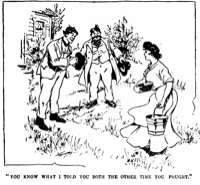
“I’m ready to ’pologize, Molly,” stammered Mr. Stivers. “Fact is. Josh threatened ––”
“I don’t want to hear a word from neither of you,” Molly interrupted, turning in the cabin door. “Not now.”
“Some other time, then, Molly,” suggested Mr. Miller hopefully.
“I’m makin’ no promises,” Molly snapped. “I’m waitin’ for you to git.”
Mr. Miller bestowed one more fierce scowl upon Mr. Stivers, and shambled away toward the setting sun. Mr. Stivers hesitated, coughed feebly, stole another look at Molly’s unrelenting face, and sneaked eastward. Half a mile he tramped, steadily and in silence. Then he dropped wearily upon a fallen beech at the roadside, removed his hat, mopped his brow, and meditated.
“By gosh, I’ll try it!” he finally ejaculated. “She wasn't half as mad as she looked, and I miss my guess if she don’t thaw out when I tell her about my hirin’ them eighty acres. Josh’ll be sneakin’ back about tomorry to tell her about his good luck with them mining sheers, and there’s no knowin’ what might happen. Girls is mighty funny critters. I’ll try it, by gosh!”
Hurriedly retracing his steps, Mr. Stivers once more toiled through the orchard and rounded the lilac-bush, to halt, dumfounded, at the sight of Mr. Miller bent almost double at the key-hole of the cabin door.
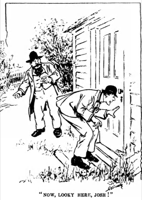
“Now, looky here, Josh!” he managed to begin, when Mr. Miller lifted a warning and beckoning arm.
“Sh-sh-sh! Don’t make no noise, Jim. Jest slide up here and take a' look.”
Mr. Stivers stole to the door, applied a curious eye and then an ear to the keyhole, stepped back, and stared up into Mr. Miller’s lugubrious countenance. The querulous tones of an old woman, followed by a deep, bass voice and the merry laughter of Molly McCrea, came through the door. Mr. Miller gulped at something in his lengthy throat.
“Jim,” he remarked hoarsely, “I’m dry!”
“Me, too,” murmured Mr. Stivers. “Thirsty as a tramp — and I hain’t carried a drop fer six months, ’count of Molly bein’ agin it!”
“That’s my fix. Let’s go to the milk-house, Jim. We’ll have to put up with spring water till we can git to the store.”
Arm in arm the two meandered down the path. Having partially assuaged their thirst, they found lowly seats upon upturned crocks, and gazed mournfully into each other’s faces.
“Did — did he have his arm around her yet when you looked, Jim?” inquired Mr. Miller pathetically.
Mr. Stivers nodded.
“And was a kissin’ her — right before the old woman,” he added.
“It’s all up with us, Jim,” said Mr. Miller decisively.
“He owns the biggest stock-ranch in ten counties. I’ve kind o’ suspicioned somethin’ ever sence he was here last Christmas. Must have got in on that last train.”
“S’pose we catch him, down in the woods, when he leaves, and lick him,” Mr. Stivers suggested.
“Not me! Them Texas fellers’ll shoot in a minute!”
“Ye orter have heard what she was sayin’ about you,” observed Mr. Stivers, after a long silence.
“Couldn’t have been no worse than. I heard her sayin’ ’bout you,” remarked Mr. Miller reminiscently.
“You can’t never bank on a woman, no-how,” said Mr. Stivers.
“Ain’t never goin’ to try again,” responded Mr. Miller. “ It’s a waste of time. I’m goin’ to ’tend to business.”
“That’s me!” exclaimed Mr. Stivers earnestly as he rose to his feet.
“Where ye goin’. Jim?”
“Down to the store. Darn water fer drinkin’ purposes, anyhow!”
“My sentiments, to a dot,” said Mr. Miller, hooking his arm within that of Mr. Stivers.
At the lower boundary of the orchard Mr. Miller halted.
“Jim,” he remarked thoughtfully, “strikes me the song that clown sung at the circus last week jest fits our' case. Can ye start it?”
“I can; but I disremember most of the words.”
“Let her go; I’ll jine in.”
A loud, rasping roar reverberated through the woods, evoking an alarmed response from a startled owl. A nasal, shrieking voice chimed in at the second word:
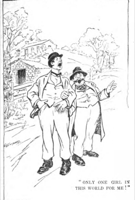
Only one girl in this world for me–e–e– Her face is on the dollar, and her name is Libertee–e–e!
Thomas Jefferson Baxter, standing with feet far apart, glared down at William Henry Bisbee; and William Henry Bisbee, seated on a boulder at the intersection of two gulches, scowled up at Thomas Jefferson Baxter. The gray mule flattened her flopping ears and threatened the black mule with two rows of jagged, yellow teeth. The black mule twitched her unshorn tail, and launched an ineffective kick at the gray with a vicious earnestness that rattled the pans, picks, and shovels cinched to her scrawny back. Unquestionably the spirit of strife hovered over the camp.
"You can’t bulldoze me for a cent’s worth, Bill Bisbee,” growled Thomas Jefferson. "I say we’re goin’ straight north — right up this gulch.”
"Don’t try your bluff on me, Jeff Baxter,” snarled William Henry. "I’ve stood all I can. Up this side-gulch we go due west.”
"Anybody that knew pay-ore from alkali dust wouldn’t squint twice up that gulch,” Mr. Baxter sneered.
"Nobody but a natural born idiot would keep on prospectin’ over ground like this,” rejoined the undaunted Bisbee.
Mr. Baxter bristled pugnaciously. "North we go — or bust the pardnership right here,” he proclaimed.
Mr. Bisbee rose to his feet. "The firm of Bisbee & Baxter is dissolved by mutual consent,” he announced. "Assets to be equally divided; the liabilities are big enough to take care of themselves.”
“Suits me!” declared Thomas Jefferson. "It won’t take long to divide the assets. I reckon I git the gray mule.”
"You reckon wrong,” snapped William Henry. "You can’t shove that black demon off onto me that way; we'll toss a dollar for the gray.”
"We'll find the dollar first,” observed Mr. Baxter sagely and gloomily. “If there’s a dollar in this outfit, you can take both mules.”
Mr. Bisbee drew from his hip pocket a section of plug tobacco. "Tag side is heads.” he announced laconically. "Say which.”
"Tails is mine,” said Mr. Baxter, and the plug spun upward, descended, and raised a tiny cloud of alkali dust as it smote the earth.
"Tails it is,” admitted Mr. Bisbee sullenly.
With silent celerity various articles were shifted from mule to mule, and Thomas Jefferson, preceded by the coveted gray, turned his bronzed face northward, while William Henry led the despised black into the lateral gulch and smote her with a ponderous foot.
“I never thought you’d treat me like this, Jeff Baxter,” he protested. "Guess you’ve forgot them fifty dollars I loaned you two years ago.”
Mr. Baxter, striding northward, turned to emit a hoarse cackle intended for a scornful laugh.
"I figger that I squared that by nursin’ you through that spell of smallpox when nobody else would come within a mile of you,” he shouted back.
The retort that quivered on Mr. Bisbee’s tongue was never spoken, for at that moment the black mule, carelessly permitted to wander beyond the reach of corporal reproof, seized the opportunity to add another jewel to her crown. With a joyous squeal and a flourish of spavined legs, she bounded high in air, and when she struck the earth she was galloping westward up the gulch with an energy that threatened demolition of Mr. Bisbee’s clattering chattels.
After her, lumbered the alarmed Bisbee, between whose apostrophic comments upon mules generally, and the black mule individually, were sandwiched emphatic observations about Mr. Baxter not conducive to the ultimate restoration of the entente cordiale.
Having merrily ambled a half mile up the gulch, the black mule whirled squarely to the right and charged straight up its steep and rugged side. A shower of stones and little lumps of soil rolled downward from beneath her clawing hoofs. When she finally gained the summit she halted, gazed down upon the perspiring Bisbee, and voiced her victory in a rasping, shrieking paean that elicited a sympathetic and congratulatory response from the distant gray. Then she whisked her unshorn tail contemptuously, and disappeared from her owner’s vision.
"I wouldn’t have thought she could do it,” panted the enraged William Henry, as he laboriously followed the fugitive’s trail up the steep incline. "I’ll bet she can climb a tree. Just wait till I catch ––”
He stopped short to stare with dilated eyes at a mass of crumbling rock shattered and denuded of its thin soil by the struggling hoofs of the black mule. With a gurgle of delight he fell upon the exposed ledge; tore at it with knife and finger-nails; dug and gouged for many minutes; and when at length he clambered to the summit his face was radiant.
"And I’d have walked right past it if it hadn’t been for that mule!” he soliloquized, as he cast himself upon the ground and laughed hysterically.
After a while he sat up, hugged his knees, and meditated.
"Wonder what Jeff ’ll say when he hears about it,” he muttered. "Guess he’ll wish he hadn’t been so brash. Pity he’s so bull-headed, for he did stick to me like a man when I was sick. But it's his own fault!”
Presently he drew a dog-eared book from his pocket, scribbled therein long and laboriously with the stub of a pencil, and rose slowly to his feet. Carefully and securely he impaled the page upon a splinter of a blasted pine, backed away to scrutinize the inscription, grinned broadly, and once more took up the trail of the fleeing mule.
Northeastward it led, straight to where Mr. Baxter, pausing occasionally to contemplate with grim pleasure a black mule and a gray grazing side by side, was encouraging a sputtering fire over which sizzled two meager slices of bacon.
"Lookin’ for somethin’?” inquired Mr. Baxter impassively as his former partner approached.
“Not now,” replied William Henry; "I’ve found it.”
Mr. Baxter grunted, and a silence broken only by the sputter of the fire and the sizzle of the bacon fell upon the assemblage.
“Jeff.” ventured Mr. Bisbee, “do you think that’s enough bacon for two?”
"I don’t,” answered Mr. Baxter, without looking up. "There’s more in your pack. You’re welcome to the fire — when I’m done with it.”
"Kind of crabbed with your old pardner ain’t you Jeff?”
Thomas Jefferson lifted his face to frown across the fire.
"Your blarney don’t go this time. Bill,” he growled. "I knowed you’d come sneakin’ back, but the pardnership’s busted — and it’s goin’ to stay busted.”
Something left Mr. Bisbee’s hand and caromed from Mr. Baxter’s boot. Mr. Baxter eyed the object suspiciously, pounced upon it voraciously, turned it over and about in his calloused hands, and stared at the smiling Bisbee.
"Bill,” he stammered, "where where’d you git it?”
"Picked it up off the ground. Did you think I’d shot it on the wing?”
"But where?” insisted Mr. Baxter excitedly.
"Would you like to see?”
"I would!” shouted Thomas Jefferson, abandoning the bacon to a fiery fate. "You can’t show me too quick!”
The expression of incredulity on his hard face fled like a flash when he had followed Mr. Bisbee up the gulch and had cast one searching glance upon the exposed ledge.
"Bill,” he ejaculated, "we’re millionaires this minute!”
“We?” snorted Mr. Bisbee. “Ain’t the pardnership busted — and goin’ to stay busted?”
"Billy,” pleaded Thomas Jefferson, "you surely wouldn’t go back on an old pardner! We’ve prospected together, and starved together, and fought together, and —”
“You ought to have remembered all that before you busted the pardnership,” Mr. Bisbee interrupted. “It’s too late now; I’ve made up my mind. And I’ve put it down in black and white. Come up and read it.”
They climbed to the summit, and Thomas Jefferson, turning his mournful gaze to the paper on the pine stump, threw his arms about the grinning William Henry and emitted a whoop that startled the distant mules; for he read:
"The Black Mewl Mine, Located by William Henry Bisbee and Tomas Jefferson Baxter, Pardners, Haf and Haf.”
Abimelech Crummitt, preacher of the word, pushed back his broad-brimmed hat and turned in his wagon-seat to peer curiously through his shaggy gray eyebrows after the two horsemen who had galloped by him toward the town of Colomo. Abimelech, who knew every citizen of Howell County, knew not these men, and the horses they rode — lithe, powerful, and slender of limb — were of a breed strange to that region.
“Beauties,” soliloquized Abimelech — not of the riders.
When the cavaliers had finally disappeared within the town, Abimelech clucked to his own round, sturdy steeds and jolted noisily on toward his little white farmhouse in the distance.
It was just as he reached the cross-roads that he heard the first shot; he had already halted, abruptly when the fusillade began; he was hurrying back toward Colomo when his alert ears caught the final report — the sharp, spiteful voice of the muzzle-loading, epoch-making rifle of the predatory pioneer, whose convincing eloquence had persuaded the reluctant aborigine to “move on.”
As he hastened toward the county-seat, Abimelech was sore troubled of spirit. Next to the fair fame of his meek, Quaker-garbed spouse, Martha, he cherished the fair fume of Colomo. Almost a half century before, he had helped at the “raising” of the first house in the town; he had loyally rejoiced when the straggling village had been chosen as the county seat, and he had been one of the foremost to contribute his quota of hewn logs for the court-house. For more than fourteen years — ever since the extirpation of the lawless Rolihan gang — Colomo had been a model of peace and quietude, a city of law and order and brotherly love — a condition largely due to the insistent influence of Abimelech and his sect. Wherefore was Abimelech perplexed and much mortified by those ominous sounds that presaged the return of crime and lawlessness to Colomo.
He tied his panting and indignant horses to the ancient hitching rack that disfigured the public square, and proceeded slowly toward the gaping crowd that surged about the entrance to Lumson’s livery stable. Halfway across the street he met the county clerk, a hard, strange look on his usually jolly face.
“What was the shooting about, friend Hiram?” asked Abimelech.
The county clerk slackened his rapid pace.
“Daddy Dow’s killed; shot down like a hog!”
Abimelech’s grave eyes grew wonder-wide.
“Killed! Israel Dow?”
“Yes; two hoss-thieves. We had notice they was headed this way, an’ we’d have got ’em, only Stone was too sudden — tried to arrest ’em before they was out of th’ saddles. They whirled an’ was off like two streaks, after firin’ th’ shot that killed poor ol’ Daddy an’ him dozin’ peaceful in his ol’ chair.”
“And they escaped, friend Hiram?”
The clerk’s eyes flashed vindictively as he hurried on. “We got one. Bill Seward dropped ’im on th’ jump, with his old rifle, shot through th’ hip. Stone hustled ’im down to jail — but he won’t be there long.”
Abimelech crossed the street and peered over the fast increasing assemblage of heads. An overturned chair and a little red pool marked the spot where old Israel Dow“Daddy Dow,” venerated pioneer and patriarch had met death.
When Abimelech had listened to the muttering of those about him, when he had seen man after man leave the crowd and hurry toward the court-house, his long, clean-shaven face grew severely serious. He clasped his calloused hands behind his broad back and walked thoughtfully along the main street to the rickety jail on the riverside, climbed the creaking steps, and rapped softly upon the door. It slowly swung open and the sheriff stood on the threshold, barring Abimelech’s entrance.
“What’s your business, Ab?” asked the officer, brusquely. “I’m busy.”
“I fear thee’ll be much busier very soon, friend Stone,” Abimelech observed. The sheriff eyed him sharply, and laughed faintly and uneasily.
“They’ll find us ready,” he answered. “I reckon me an’ my dep’ty knows our burners.”
“Thee and thy deputy! Friend Stone, thee’Il need twenty deputies!”
The sheriff frowned and his face flushed angrily; but there were many wearers of the broad brim in Howell County — a fact worthy of consideration by an officer asking a second term.
“Where’d I get ’em?” he growled. “I guess you ain’t on to public sentiment in this matter, Ab.”
Beyond the sheriff, astride a chair, his hat carelessly awry, the deputy removed the pipe from his lips and laughed sneeringly.
“Why don’t ye swear Ab in, Tom?” he suggested. “They may not be afeared of us, but they’d never tackle sich a terror as Ab.”
Well did Abimelech comprehend the irony of the suggestion. No man in Howell County was better fitted for personal combat than Abimelech. Standing flat-footed on his native soil, he could fold his massive arms on the top of a ten-rail fence. To vault lightly over the same fence, or with one blow to sink his axe to the helve in a standing poplar, were feats easy of accomplishment by Abimelech. But, true to the tenets of his sect, Abimelech, only begotten son of Elihu and Keturah, was a man of peace. He had seen his neighbors march, rifle on shoulder, to join Harrison at Tippecanoe; drafted during the dark days of the great rebellion, he had promptly furnished a substitute. With meekness and in silence he had many times heard his courage questioned — for he was a man of few words, save when the Spirit moved and the Friends’ Meetinghouse rang with Abimelech’s fervent prayers and quavering exhortations.
And so, when the grinning sheriff commanded him to hold up his right hand, Abimelech only gazed at him in reproving mildness and answered: “Thee knows I can’t fight, friend Stone.”
“You’re like th’ rest of ’em,” the sheriff declared, contemptuously; “only you can’t an’ they won’t.”
“Then, friend, I demand that thee immediately telegraph the Governor for the militia.”
“Th’ militia be damned, an’ you with it!” the sheriff snarled. “Howell County can manage its own affairs without shootin’ its citizens down to save th’ neck of a murderin’ hoss thief. An’ don’t you come nosin’ around, tryin’ to run my business, when ye’re too big a coward to practice what you preach.”
Abimelech calmly turned, passed down the steps and leaned against the dilapidated paling fence, his broad chin on his enormous chest. He was thinking of the Governor, whose half-section adjoined his own modest forty the Governor, shrewd observer and reader of men, who had once said, humorously: “If Quaker Ab were to state that two and two made six, I should feel it my duty to cause the arithmetics of our schools to be altered accordingly.”Whatever his personal courage, Abimelech’s stern probity and calm, conservative judgment remained unchallenged and unquestioned.
Ten minutes later Abimelech stood in the little office of Colomo’s solitary railroad, scribbling, erasing and re-writing, perplexedly — for the pen was a clumsy weapon in his untutored hand. At last he straightened up and regarded the agent dubiously.
“Friend,” he asked, “can thee get this through at once?”
The man scanned the message, and looked up at Abimelech’s grave, anxious face.
“This is th’ sheriff’s business; th’ Governor can’t —”
“Friend,” Abimelech interrupted,“ James Wilson is not the man to quibble in such a case. He was raised in Colomo, and he loves it. I have given thee the message; if thee shirks thy duty thee will have to answer to James Wilson.”
The agent seized the key of the instrument.
“I’ll try,” he said, guardedly. “If they haven’t cut th’ wire I can get it through quick.”
“I thank thee, friend,” said Abimelech, fervently. “I'll wait for an answer.”
Thirty long, anxious minutes ticked away. Then, with a sigh, Abimelech arose from his seat in the aim corner of the dingy room.
“I may as well go home,” he said, in answer to the agent’s questioning glance. “I’ve done all I can, and I don’t want to be here when —”
“Answer’s coming,” the agent broke in as the little instrument suddenly set up an insistent clatter.
A moment of hasty scribbling, and he laid before Abimelech the little yellow sheet, yet un-copied.
Metropolis, Ind., July 10 18y.
Abimelech Crummitt, Colomo, Ind.:
Militia there by ten, special train. There must be no lynching in Colomo. Hold the jail. I rely on you ––James Wilson.
Outside the office, the little slip of paper clutched in his hard hand, Abimelech, gazing helplessly down the street, saw that the stores were closed, the streets silent and deserted. Somewhere on that balmy summer evening the men of Colomo were gathering, organizing, planning deliberate murder, and Abimelech groaned as he thought of the Governor of a mighty State relying on one man to thwart that mob — and that man Abimelech Crummitt, preacher of the word, man of peace! If it were only either of those poor, misguided men of war, Captain Adonijah Crummitt who had stood with Stark at Bennington, or Seekpeace Crummitt who had charged with Cromwell at Naseby. Into Abimelech’s mind flashed a damning doubt, a sinful suspicion that, perhaps, after all, there might be times when the sword rather than the word was necessary for the accomplishment of the Lord’s work.
“Hold the jail. I rely on you!” Mechanically Abimelech muttered those words as he moved dejectedly in the direction of his waiting team. The old clock in the court-house tower struck nine, slowly and solemnly. The moon began to peep timidly above the dim horizon. Glancing up, Abimelech saw that the windows of the court-house were ablaze with light. As he passed slowly under the old oak in the court-house lawn, something dangling from its branches swayed in the rising breeze before his face. Impulsively he seized the portentous noosed thing, tore it down, and hurled it far away. The doors of the court-house squeaked on their rusty hinges, and a grim, double column of men marched forth, turned toward the jail, and halted while the leaders called out sharp, stern instructions. Shuddering, Abimelech made three plunging strides toward his team, then stood still, gripping the Governor’s message in his hands. "I rely on you!” The words burned in his brain. If he could gain a hearing from these men of Colomo before they began their murderous work, perhaps —.
“Is not my word like as fire? — and like a hammer that breaketh the rock in pieces?” A great voice seemed to cry out the question, and to make of it a command.
Down the dark side of the street Abimelech, half-crouching, sped to the jail, sprang up the steps, and beat upon the door.
“Git away from there,” the sheriff called. “Th’ shootin’ will begin in a minnit.”
“No!” cried Abimelech. “I can help thee. I’ll take the affirmation if necessary.”
“I’d let him in, Tom,” the rasping voice of the deputy penetrated through the thin door; “it’ll help us in case th’ Gov’ner gits inquisitive an’ he’ll git on to our game out there.”
The sheriff mumbled over the affirmation as he hastily re-bolted the door behind his recruit.
“There need be no bloodshed, friend Stone,” Abimelech exclaimed; “I’ll speak to those erring”
“Do yer talkin’ at the other door through yonder,” interjected the sheriff, thrusting a revolver into Abimelech’s hand. “Jap an’ me stays here.”
Mechanically grasping the unfamiliar weapon, Abimelech hurried through the inner door of the office and into the corridor that circled the cage of grated cells. A dozen jailbirds, grimy and unkempt, leered out at him between the iron bars. He slipped the solitary bolt of the pine door and peered out. The head of the grim column was filing through the gate of the dilapidated fence. Abimelech dropped the revolver into his pocket, removed his broad-brimmed hat, and stepped out into the moonlight. The white hair that the breeze tossed about his head was little whiter than his face. Abimelech lifted up his hands.
“Halt, friends!” he cried, in deep, sonorous tones.
The column halted, as if in surprise.
“It’s Quaker Ab,” a dozen voices uttered.
The leaders whispered together; then one called out: “Go home, Ab — get out of the way. We don’t want to hurt you.”
“It is thee, friends, who should go home,” returned Abimelech; “thee, who are about to commit murder, and bring disgrace upon our town of Colomo. Friends, listen to me”
“Forward!” growled a score of voices. “We didn’t come here for a sermon. Forward!”
The column pressed against its leaders, who held it back.
“Crummitt,” called one, “we don’t particular want this fellow if he’ll tell who his partner was, and where he’s headed for. ’Twas his partner that shot Daddy.”
Abimelech’s face shone. “Friends, I’ll ask him — if thee’ll promise me to make no attack before I report.”
“Sure! We’ll wait. Won’t we, boys?”
Subdued laughter ran down the column as a hundred voices gave assent. Honest Abimelech re-entered the jail and hastened around the corridor, peering into each cell.
From the floor of the furthest one a man with pallid, pain-distorted face looked up through half-closed eyes and spoke convulsively between clinched teeth: “It’s me you’re lookin’ for. An’ you can go back an’ tell that mob to go to”
Abimelech covered his ears to shut out that last word. “Friend,” he said, earnestly, “if thee refuses, only a miracle can save thee.”
The man on the floor held out a hand.
“Give me that gun in your pocket,” he gasped. “I'll have company on th’ way over.”
“Blank cartridges, friend — like the others,” answered Abimelech, with a significant gesture toward the sheriff’s office. “Thy only chance is to —”
A volley of shots from the office drowned his voice. A chorus of fierce cheers arose from the column he had just left, as it swept through the open door and into the jail.
Over the solemn face of Abimelech flashed a look of indignant amazement; his long, heavy jaw shut with a click. He seized the rusted bar that fastened the prisoner’s door, and in his immense hands it snapped like a pipe stem. He lifted the groaning prisoner in his arms and sped to the flimsy stairway that led to the upper story. As he sprang upon the lowest step an axe hurled from the oncoming mob glanced from his white head. Abimelech reeled, took one more upward, staggering step, shifted his burden to his left arm and faced the mob. Blood streamed over his face — not the blood of Abimelech, man of peace, expounder of the word; it was the blood of that Captain Adonijah who had stood with Stark at Bennington, of Seekpeace Crummitt who had charged with Cromwell at Naseby! From behind the shaggy eyebrows his eyes shot forth blue fire; his teeth gleamed, white and set, between the snarling lips. A ponderous arm swung in darting, catapultic circles against the foremost pursuers, hurling them back disabled. Then, with three springs, Abimelech reached the upper floor and laid his burden down. Stooping, he wrenched the flimsy stairway from its upper fastenings and it fell, crashing, with its load of panting, scrambling men.
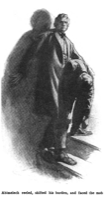
“By the gods, old boy, you’re a brick!” the wounded man moaned.
Two men in the cell at Abimelech’s back pressed their hard faces against the bars. “Let us out, Goliath,” said one. “We’ll help ye keep ’em down.”
“The law put thee in; the law must let thee out,” laconically said Abimelech.
From below arose curses and epithets uncomplimentary to Abimelech. The shooting ceased, and more men poured into the corridor from the sheriff’s office. The top of a ladder shot upward through the opening at Abimelech’s feet. The voice of the sheriff called from below:
“Abimelech Crummitt, as sheriff of Howell County I demand my prisoner that I may protect him.”
“Come up and get him,” growled Abimelech.
The officer’s head reared itself above the upper floor. A hairy hand twined like a rope of wire around the scrawny neck, shook the sheriff of Howell County rudely in mid-air, and dropped him to the floor below. Then Abimelech seized the ladder, drew it quickly upward, and waited.
Listening, hopefully, to catch the first sound of the special, he heard only the tramping of many feet, the confused babble of angry voices. Suddenly, with a rending crash, fragments of glass and sash sifted through the bars of the window at his right. He took the heavy revolver from his pocket and handed it to the man at his feet.
“Thee must try to guard this stairway,” he said. “Hit every head. I must go to the window.”
“They’ll shoot you,” the man warned.
Abimelech drew himself up proudly. “Shoot me? They daren’t!”
He drew an arm across his eyes to wipe away the blood, leaped toward the window, then halted, perplexed. In the moonlight he saw two ladders thronged with men. To attempt to overthrow them — to thrust his arms between the bars — meant certain maiming by those battering hammers. He glanced about, despairingly. His blazing eyes discovered a dim and narrow cul-de-sac, formed by the wall of the building and a row of cells. He raised the helpless prisoner, carried him to the further end of the blind passage, and tenderly laid him down. He heard the bars of the window fall, clattering under the hammers. He heard cheers, fierce cries, the rush of many feet. And he heard the roar and rattle of a train speeding into town!
“By the mighty sword of Gideon,” muttered Abimelech, “we’ll save Colomo yet!”
The opening of the passage filled with dark, hesitating, peering forms. Abimelech took two strides forward; the lust of battle swelled his heart.
“Cowards!” he challenged, “come on! I bear no arms save those the Lord gave me!”
Then, down the passage they swept — men of Colomo with angry faces and cruel eyes, and Abimelech struck — struck with bare hands as even he had never struck with axe and maul. Down went the foremost, man after man, but others pressed forward, climbed over prostrate forms, precipitated themselves upon the giant, forced him back inch by inch, while he fought as Adonijah and Seekpeace had never fought.
“Kill him! Kill the meddling Quaker!” they screamed, snarling like enraged beasts.
A demon leaped up within Abimelech’s breast ; the impulse to slay possessed his brain. His retreating foot struck the hammer-like weapon that had slipped from the nerveless hand of the fainting man upon the floor. He stooped, quickly, to seize it, his foes leaped upon him, and the struggling mass crashed to the floor. With a Titan’s strength Abimelech rose to his knees and swung the weapon above his head. Then, as a column of blue coats and leveled bayonets came charging down the passage, something hard struck Abimelech between his swimming eyes, and he pitched forward, a quivering mass of mighty bone and muscle, muttering in triumphant delirium between clinched teeth: “I rely on you!”
When Abimelech opened his eyes they wandered painfully about a familiar room through whose little eastern window the sun was shining brightly.
His buzzing ears caught the gruff tones of old Dr. Newland: “Just keep him quiet, Mrs. Crummitt. We’ll have him up in a day or two, and as good as new in a week. Good-day, ma’am.”
“Then it wasn’t a dream,” groaned Abimelech.
A Quaker-garbed, patient-faced little woman hurried to his side.
“Thee must not try to arise, Abimelech,” she said with low and gentle voice.
“Martha, did I — was any one killed?” he whispered, hoarsely.
“No, Abimelech; praise the Lord. But thee has sinned — grievously sinned.”
“And I deserve to be disciplined — severely and righteously disciplined, Martha.”
The little woman bowed her head. “Yes, Abimelech; already two of the brethren have called to express their opinion of thy amazing conduct.”
Abimelech closed his eyes wearily and his lips tightly. “Martha,” he said, after a while, “bring me the Book — and a pen.”
While the little woman held the ancient Bible before him he turned to the old family record, between the two Testaments, and drew two black, obliterating lines through the names of Captain Adonijah and Seekpeace Crummitt.
“Martha,” he said, plaintively, “it was in the blood.”
The little woman sighed. “Yes, Abimelech. But thee can live it down. I will help thee.”
Abimelech raised one ponderous arm, drew the little woman to him, and kissed her.
“I rely on you,” he whispered, an odd smile playing about his lips as he closed his aching eyes.
"Things are coming our way, Joyce," said the Honorable James Lane pleasantly, from the depths of an easy chair in his private office. "I saw Evans and Bell today. Two hundred each. That makes nineteen of the necessary twenty-one, and I'll land Dunham and old Dean tomorrow. The nomination's mine, and that means election in this circuit this year."
"How can you get Dean and Dunham?" Joyce asked. "They were elected delegates for Allen, and you can't buy them; they're not that kind; at least Dean isn't."
The Honorable James chuckled softly.
"Bob, I wish you wouldn't talk about 'buying.' It's a harsh word to one of my sensitive temperament. My little tributes of gratitude should not be considered as purchase money. If, because of certain favors done me in the convention, my gratitude should prompt me to present old Reuben Dean with the mortgage on his farm, and to assist Tom Dunham in his matrimonial inclinations, it would be rank injustice to insinuate that I had bought them, wouldn't it?"
Joyce removed his cigar from his lips and regarded the Honorable James keenly and curiously.
"I don't just catch your drift," he remarked.
The Honorable James clasped his red hands over his rotund front, lowered his massive chin until its folds overflowed his collar, and beamed placidly upon his lieutenant.
"Just a little stroke of diplomacy, Bob; that clinches the game. The mortgage on Dean's farm is past due and money's so tight now that he can't borrow. See the point, eh?"
"I see," replied Joyce, musingly. "But Joe Ayres will never—"
"Joe Ayres doesn't own the mortgage now."
"Who does?"
"Yours truly."
"The devil!"
"No, Bob; not the devil, but a man who intends to have what's coming to him," rejoined the Honorable James, with a complacent grin.
"And Dunham?"
"The girl, Joyce, the girl! Old Dean's daughter. Same one you were smitten with before you and old Dean quarreled. Pretty as a picture, she is. Tom Dunham's crazy for her, and, of course, to save the game she'll—"
Joyce's feet dropped from the window sill to the floor with a crash. His chair swung around until he faced the Honorable James squarely.
"Lane," he ejaculated tersely; "is it possible that to gratify your political ambition you would compel Bessie Dean to marry such a man as Tom Dunham?"
The Honorable James tilted his easy chair further back and lazily puffed clouds of fragrant smoke through the open window.
"I will do just that, Bob. It takes those two votes to land this nomination. Business is business, and politics is politics. I'd be a rank sucker to allow a girl's foolish notions to block my game."
"Look here, Jim," exclaimed Joyce, hotly; "you're trotting too fast a clip for me. I entered this fight to learn something of practical politics, and it's getting decidedly too practical for my tastes. I've seen men sent up for less deviltry than you're doing. You'll get the nomination and be elected judge, but what have I to gain in this—"
The Honorable James straightened up with a jerk and shook his fat fore-finger in his confidant's face. "Don't try that game on me, Joyce," he growled excitedly. "It won't work. I won't be held up, and I won't be bluffed. I need you and your vote in the convention, but if you're a quitter, quit now. Stay to the finish and you'll never regret it. But don't try to bleed me for money—I won't stand it. Don't you worry about my going to the pen. How would they get the evidence? I'd like to see the grand jury that would try that game on me in this county, anyway."
Joyce re-elevated his feet and puffed carelessly at his cigar, meditating between puffs.
"All right, Jim," he said, soothingly, after a moment's silence. "Don't get huffy. I'll stay to the finish now that I'm in, but it's the last game of the kind that I'll ever play. When will you see Dean and Dunham?"
"I've seen Dunham. He's all right if Dean will promise him the girl. Old Dean will squawk of course, but he'll have to take his medicine. I'll bring the suit for foreclosure, and that'll fetch him. I'm going to see him to-morrow morning."
"Well, good luck to you," said Joyce, rising. "I'm going now to get a little sleep. I'm almost worn out. See you to-morrow, Jim. Good night."
On the street he glanced up at the black clouds gathering ominously across the evening sky.
"A good night for bad deeds," he soliloquized, "and perhaps a bad night for good ones—I'll try it."
Next day, when Farmer Dean's dinner bell, rung by Bessie's plump hands, called him from the barn, he encountered the Honorable James Lane, animated and jovial, who consented to stay to dinner, and who enlivened the occasion with many pleasantries and several compliments upon Bessie's culinary skills. The after-dinner conversation between the men, held under the old pear tree in the backyard, was long and earnest, and when his guest finally departed, Farmer Dean seemed to be in exceedingly bad humor, although at intervals he tried the semblance of a tune, a proceeding unusual for grim Farmer Dean, and one which seemed to afford Bessie much quiet amusement.
The following day, when Farmer Dean encountered the Honorable James Lane in the latter's private offices, he was quite humble and downcast.
"I reckon I'll have to come to your side, Lane," he said dejectedly, "though it doesn't set very well. I wouldn't do it ef it wasn't fer Bessie. She's all alone sence her mother died. Mightynigh killed her to lose th' old house. About this Dunham—I don't like that part. I want to keep Bessie safe."
"Too high, Reuben; too high," said the Honorable James, gravely. "That mortgage comes to something over a thousand dollars and I'm giving you two votes for it. Bessie's worth it."
"Well, I reckon it's no use to argue. I tried all o' that yesterday. Dunham's old and ugly, but Bessie must have a home. I've heard, though, that Dunham never really got no divorce from his first wife in Minnesota. I don't want Bessie to get mixed up in a bigamy scrape. I'd rather—"
"All bosh, Reuben. Now, let us understand the deal. Mr. Joyce, who is one of my delegates, will stand near the ballot box. You and Dunham will vote with your ballots open, so that Joyce can see that you are both for me. Joyce will deliver to you your note, mortgage and release of that record. That's right, isn't it?"
"Yes. We can both trust Joyce, I reckon. You promise Dunham that if he votes for you, Bessie will marry him within thirty days after the convention—providing she don't break no law. I wouldn't get in no trouble like that fer ten farms."
"Not a chance of that, Reuben. I have a certified copy of Dunham's decree of divorce."
"I'll do what's right. But I allow you're certainly the meanest man on earth. If I didn't know that, I wouldn't give you back them papers after I knew you. I wouldn't trust you."
"Thank you, Reuben; thank you," said the Honorable James, amiably, as he bowed the old farmer out. "Good-bye, Reuben, and don't be late at the convention."
Dean was not late. He was one of the first to arrive when the convention assembled in the court-room, where the forty-one judicial delegates solemnly transacted preliminaries preparing for casting their votes in obedience to the sovereignty of the people. Allen, the opponent of the Honorable James, was nervous and plainly apprehensive. The Honorable James was smiling, confident from his seat near the bench which, in his eye, he already graced. He watched Dean and Dunham as they walked forward in their turn to cast their ballots. He smiled benignly upon Dean and Joyce as they passed him on their way out of the room. He wondered if the case of Ives vs. The R. & S. Railway would be continued when he should assume the ermine—there was "something" in that case. He heard the tallying of the ballots, and just as he had begun to rehearse his speech of acceptance, he heard them yell—yells that shook the old building—as they counted twenty-one ballots for Allen. While he was yet stunned and confused, the Chairman's voice rose above the tempest. "Mr. Allen, having received twenty-one of forty-one ballots, is declared duly and regularly nominated for Judge. Judge Allen!"
The Honorable James did not move to make the vote unanimous. Dumbfounded and furious, he left the room and rushed down the stairs, seeking Joyce. He encountered that young gentleman, laughing and talking with Farmer Dean, issuing from the recorder's office.
"What does this mean, Joyce?" he panted. "You—you must have thrown me—you and Dean!"
"Business is business, and politics is politics," chortled Joyce, sarcastically.
"You won't rob me this way," roared the Honorable James. "I'll sue to cancel that release and mortgage. I'll teach you a trick."
Joyce stepped forward and shook his finger under the nose of the Honorable James.
"I don't think you will, Jim," he said, meaningly, "but if you do you will also appear as defendant in several prosecutions for bribery."
The Honorable James looked into that determined face and wilted.
"But—the girl!" he protested feebly, keeping up a pretense of resistance. "Dunham kept his promise, and Dean promised him the girl."
"Providing she wouldn't break no law. Always providing she wouldn't break no law," said Farmer Dean, slowly and solemnly. "And Joyce and her was married the night before you et at my house!"
Then, grim old Farmer Dean stooped, placed his knotted hands on his knees, shook his grizzled head violently, and did something he hadn't done for many, many years—he laughed—laughed aloud, actually shook and roared with laughter—hurled forth a howling, shrieking, snorting cataclysm of mirth that rent the atmosphere into tattered fragments and curdled the blood of the Honorable James as he fled, overwhelmed, to his office.
It's all over, Mary," he said, as he met her at the gate, "and I'm a fool for asking him again."
"Does he really refuse, as rich as he is?"
"Yes, and even refuses to allow us to take any part of the crops. Says we knew when we planted them that the year of redemption expired to-day, and that we took the chance. Of course that's the law, but I did not think that he would take everything. We were boys together and have been neighbors ever since."
"I can't understand why he wants to prosecute us. I never could understand why he bought the mortgage."
"I can tell you, now. He told me plainly that he had waited thirty years to get even with you for choosing me instead of him. Said he would show you now that you made a mistake."
"Oh, Phillip."
"Yes, he was very complimentary. Said I did not know how to practice economy. And when I suggested that economy could not prevent sickness and death, he answered that he was not responsible for our afflictions, and that he would insist upon his rights: that he had made his money that way."
"Is it possible that William Otis is such a heartless brute? What can we do, Phillip?"
"Nothing. Absolutely nothing. If he would give me only one year more, as I told him, I could save the farm. This panic is almost over. But I have done all that can be done. We must leave here tomorrow. Come Mary, I want to walk over the dear old place for the last time."
Side by side they walked in the moonlight. The tall, odorous corn, softly stirred by the evening breeze, nodded and bowed, and whispered to them a pathetic farewell.
Across the distant meadow the dancing lights of the fire-flies flashed and faded like vanished hopes.
The little brook, made sacred years ago by the white feet of happy children, murmured and called to them to stay. The tree that child-hands had planted and cared for so proudly, showered its blossoms upon their gray heads, as though stirred by unseen hands.
They could almost hear the patter of little feet, the babble of baby voices, the cheery, childish laughter that had so lightened the burdens of the years gone by.
Here they had gone forth, hand in hand, with strength and vigor, and youth and hope, to hew a home from the wilderness. Every spot was hallowed by sweet memories, every foot of ground was sanctified by love-lightened toil.
And now all was lost; the labor, the sacrifices, the heartaches; all had been for naught, and they were adrift in the great world, old, childless and almost penniless.
"I guess he was right, Mary," said Haynes, bitterly. "You made a mistake. With him and his money you might have been always happy and comfortable."
She laid her gray head upon his toil-stooped shoulder, and her wrinkled hand stole as softly and tenderly into his as ever in days of old.
"I made no mistake Phillip. I chose the honest man, not the scoundrel. If it were all to do over I would make the same choice. It will be very hard, but we must try to endure it."
He stooped and kissed her tears away and then lifted her to his side upon the high bank that overlooked the farm and the river below.
"The old oak is down," he exclaimed. "I did not think the storm was so strong to-day. And the river is higher than for years."
"It is higher than I ever saw it," she said, wearily. "And what a peculiar shape it gives the tongue of land that the old oak stood on. Like an arrow with its barbed head."
"So it does. Odd, isn't it? Let us go down and see the old oak before the river washes it away. It was the children's favorite tree, and we ought to say good-by to it."
Half way along the narrow strip of land that projected into the river, Haynes stopped to view the rising waters, and his wife walked on slowly toward the point of the arrow head where the oak had stood. As the waters gradually rose the arrow-like shape of the little peninsula became more marked and apparent, and to Haynes' mind came memories of a tale of how, long years ago, two Indians had journeyed from the far west to dig upon that very farm for treasure that they failed to find. Before departing, disappointed, one of them had said that in their tribe was a story of some of the early French explorers who, hard pressed by savage foes, had buried somewhere along the river in that neighborhood, the treasure that they were carrying from Quebec to the settlements on the lower Mississippi. They never returned for it, but had said before they ran, that it was buried at the point of an arrow, within sight of the falls.
"If it were only true, and if this should be the arrow." Phillip smiled at the idea, and moved to join his wife when he heard her calling him. When he reached her she was deep in the hollow where the fallen tree had stood, and was waiting for him, smiling, with uplifted face.
"Look!" she cried.
And Phillip saw, back among the mighty tree's roots, a glittering heap, struck full by the harvest moonlight. It was gold; gold coins of old and odd design; some of them disfigured by the soil and damp of years, but still gold, as valuable now as when it was buried.
"At the arrow's point," cried Phillip, thrusting his hand into the heap, "but too late!" And he looked up at her and smiled sadly.
"Who knows?" she cried. "O, Phil, quick! If he hasn't made the deed to anyone else yet, we may save the farm. I wonder if there's enough."
Laughing and crying, she helped him load the treasure into her apron, and then they hurried to the stable. She tied the precious coins securely while he bridled and saddled bay Nell, and she leaned from the saddle that she might kiss him and wish him speed and good luck; her upturned face was youthful with the radiance of hope.
Sheriff East, working late at his desk, listened wonderingly to Haynes' hurried story and looked askance at the strange old disks of gold.
"Don't know about this, Phil. They're gold, I reckon, and old Bill Otis is mighty particular. If I take anything but legal tender he'll make trouble if he can. He called for the dispossession papers, but I was busy, and told him he'd have to wait till morning. He kicked. Said the time was up at six o'clock. But it ain't up till midnight, and you've got an hour and a half yet. If you had legal tender we could fix it. Of course the gold is worth something, but how much?"
"But, Tom, the banks are both closed. It's gold, good gold, and there's certainly enough. If you refuse it my farm is gone."
"Yes, I reckon it's gold. But what kind? I've got to go by weight, and I've got to protect both Otis and my bondsmen. Tell you what, Phil — Jim Stanley, cashier of the Citizen's Bank, he's up at the Elks' blow-out. If he'll weigh it and fix the value maybe we can fix it. He's got the scales at the bank."
He was back in half an hour, smiling broadly and holding out his hand.
"Shake," he said, "the farm's yours, Phil, and I'm as glad as you are."
Phil could only look his thanks, for he was thinking of the brave little woman waiting in the old home.
The sheriff footed up the amount of principal and interest, costs and attorney fees.
"Eight hundred and two dollars and fifty cents," he announced. "And Stanley give me credit for eight-ten even. Here's your receipt and the eight dollars and fifty cents change. It's a close call, Phil. It's striking eleven now."
Phil was thinking of his last conversation with Otis.
"Tom," he said thoughtfully, "what's the 'squire's usual figure for a plain, ordinary case of assault and battery?"
The sheriff looked up and grinned.
"Well, 'Squire Bradley's a friend of mine, and in a case such as this I should say not over eight dollars and fifty cents; just about that change you're holdin'."
"Such a coincidence might be considered a positive interference of Providence, mightn't it, Tom?"
"I'm sure. And I couldn't blame you."
Phil hesitated, and gave a sigh of self denial.
"We're both too old. And it would shock Mary. Good-night, Tom. If I can ever be of service to you —"
The door was thrown open and Otis rushed in.
"Sheriff East, somebody tells me that Haynes has redeemed that farm. Mr. East, I'll stand for no such scheme as this. The time of redemption expired at six today. I demand immediate dispossession. Refuse if you dare."
"You're mistaken, Mr. Otis," said Haynes, quietly, though his eyes were flashing. "There are twenty-four hours in each day, and this day has almost an hour to run. My farm is safe, and the sheriff will give you your money at the opening of business hours in the morning."
"It's a swindle," yelled Otis furiously, and his hand struck Haynes full in the face.
The sheriff was surprisingly slow in reaching the combatants.
"A case of self-defense," he said, as Otis arose groaning and limped out cursing and threatening. "But you can beat that in any court."
The little woman met Phil at the gate, and as he slipped from the saddle and took her in his arms she knew in some manner that all was well.
"Your face is bruised, Phil. How did you do that?"
"Practiced economy," he answered, grimly, "and saved eight hundred dollars and fifty cents. Otis didn't think I knew how."
The Popular Magazine, 1904.

“Speakin’ of strikes said the conductor, glancing out of the window,“ reminds me that right there, in that bend of the crick, a world’s record was made for breakin’ a strike. Ever tell you about it? It was when this branch of the line was bein’ built, say ten year ago. The boss contractor sent me word to turn over my gang to Murphy and come to headquarters.”
“Baker, says he, you can patter Italian pretty good, and I want you to take a couple of the men and a hand car and run down to the West end of the branch line. The workers down there has struck for higher wages. They’re fresh immigrants, just over, and that damned Bald Pete has wandered down there and riled ’em. We’re under bond to shove that branch through by the first of August, and something’s got to be done quick. The quickest way is to buy Bald Pete off. Here’s fifty dollars; run down and see what can be done. Report to-night.”
“You see, Bald Pete had been fired by the construction company, and had been makin’ it his business to get even. Ugly devil, Pete was—and his eyes—once I looked into the eyes of a live rattlesnake, not two feet away, and Pete’s eyes was just the same. Once, when he was cookin’ for a party up in the Black Hills, he’d had a lop-sided argument with a band of Sioux who lifted his scalp and left him for dead, and their bright smiles still lingered in his dreams. That’s why we called him Bald Pete, and that’s why he was prejudiced against Indians. Mighty proud of that head, though, Petey was; kept it tied up in a red bandanna, with the knot hangin’ down over one ear. Always braggin’ to the others ’bout bein’ a terrific Indian fighter, and provin’ it by that head.”
“Well, when I reached the camp first man I seen was Bald Pete sittin’ in front of the shack, smokin’ an old black pipe. He was polite as you please, grinnin’ and flashin’ his ragged, yellow teeth, but when I tried to talk business there wasn’t but one side to it, and that was Pete’s side. He was onto his game, all right—knowed that men was scarce and time precious—and the way the fakir orated ’bout the wrongs of his countrymen was disgustin’, while the rest of the gang crowded up, waggin’ their heads and flourishin’ their dirty paws and chippin’ in whenever Pete stopped to get his breath.”
“I seen I couldn’t do anything with ’em just then, so I left my two men with the hand car, and took my Winchester, intendin’ to hunt for a couple of hours while the workers cooled off. There was game in these parts then. I strolled to the top of the slope, and lookin’ across the river I seen an antelope standin’, head up, watchin’ a clump of trees on my side of the stream. It was a long shot, and when the Winchester cracked that antelope was gone quicker’n a boy after breakfast when the lawn needs mowin’. At the same time what should walk out of that clump of trees and stand starin’ up at me but an Indian. Couldn’t hardly believe my eyes for a minute; then I seen it was old Billy—Billy Pi, I called him. His name was too much for a white man’s tongue—and mighty proud Billy was of that name; said it meant ‘eagle that soars.’ I’d run across Billy and some of his relations two years before, when I was on a fishin’ trip a hundred miles up the river.”
“Well, sir, I don’t know how the scheme struck me so quick, but the minute I seen Billy Pi I knowed the strike was as good as broke. So I was mighty well pleased to see the old sinner, and he appeared tickled to see me. He come slouchin’ up the hill, carryin’ an old percussion smooth-bore that he shot pebbles out of when he could get powder. I met him halfway down the hill, for I didn’t want them workers to catch sight of him.
“Where’s your people, Billy?” I asks. “Without openin’ his eyes he points up the river and holds up one finger, meanin’ they was one mile upstream.”
“How many?” I asks.
“Much people,” he says, throwin’ out all his fingers three or four times. “Billy’s brother there, too. All poor, all hungry.”
“Hungry, eh!” I says. “You come with me.”
“I took him near the top of the hill, made him lay down and peep over, and his eyes stuck out like a snail’s horns when he seen them workers down there cookin’ supper. They had about week's provisions yet, that the company had furnished, besides some delicacies of their own importation, and when the smell of that garlic and macaroni and fried bacon floated up to his proboscis I thought the old thief would break something dancing.
“Friends of mine,” I says, pointing to the camp. Want to see Indian. I want to please friends. Billy come this evenin’ and bring all people. Plenty grub.”
“You ought to have seen how quickly Billy hooked onto that proposition.”
“All hide here,” I says, ‘till moon comes up. Want s’prise friends. Mustn’t come till I shoot. Then all come quick. Run, yell—shoot Billy’s gun—big s’prise friends—friends very glad.”
“Good!” he says, poundin’ his chest and swellin’ up. Billy un’stand. Billy great chief! Come like hell! He yell! Billy shoot gun! Big show, huh!”
“Then he trailed up the river faster than I ever seen him move. I knowed no one would get hurt even if the scheme fizzled, for there wasn’t a gun in the outfit, an if they should put up any kind of front, them Piutes would skeedaddle. So I hurried back to the camp, lookin’ very solemn.”
“‘What shoot at?’ asks Bald Pete, quite pleasant.
“Pete,” says I, loud, for some of the workers could understand a little English, “I shot at an Indian—and missed him.”
“He humped his shoulders, cocked them eyes at me, and grinned—thought I was lyin’ to scare him away.”
“The senor is mistaken,” he says, with a sneer. “Indians all gone many year.”
“Come with me and I’ll prove it,” says I. “I’ll show you the tracks.”
“When Petey’s eyes lit on them prints of Billy’s old moccasins he turned plumb green and jumped like he’d stepped on a tack.”
"Santa Maria,” he gasps, crossin’ hisself. “Indian sure!”
“They’ve broke away from the reservation again,” I says, doin’ my best look scared. “Five hundred mile ain’t nothin’ to them Sioux when they’re out for blood. We’d better get a move on.”
“Honest, I had to pity the cowboy. His eyes rolled as if they were closed, and his teeth chattered all the way back to the camp. I was afraid he’d give me a sneak if he wasn’t watched, so I told the gang myself what we’d seen. Half of ’em wanted to pull stakes right then, and some, with an eye for their job talked big about fightin’ it out under the brave and valiant Pietro’s commandership. I could see that the brave and valiant Pietro was prayin’ for a good excise to flit, so I kept him in the front, remindin’ everyone of his skill and experience, and arguin’ that mebbe there was only one Indian, after all. I wanted ’em to stay—wanted ‘em to see the fun. I kept the arguments goin’, so as to give Billy plenty of time, ‘till the moon was well up, and then, while they was chatterin’ like a flock of scared parrots, I made a dash for the hand car, where my men was, and turned, the Winchester loose.”
“In less than a second it seemed to me that every Piute that had ever lived was pourin’ over the top of that hill and town the slope for the camp. Mebbe I was a little excited, but Billy and his brother certainly were prolific and hadn’t left anyone behind.”
“They’re comin’,” I yelled, “and they was—comin’ like a comet fallin’ through space. Screechin’? A fleet of steam tugs wouldn’t have been in it. Billy and his brother led the procession, on the jump, and everyone of ’em was wavin’ some kind of a weapon, from Billy’s old smooth-bore to a rusty fish knife. Halfway down the slope Billy let off the old musket with a roar like a Fourth-of-July anvil—like to have knocked the old scoundrel over—and when them pebbles come wailin' through the air that strike was broke. By that time the workers had recovered their breath, which had left ’em when the irruption busted loose, and things begun to develop in that camp.”
“First move Bald Pete made was to try to jump over a row of barrels—hadn’t time to go ’round—and he didn’t jump high enough. Must have fell twenty feet, and he was runnin’ before he’d got up. It wasn’t a minute till the prairie was dotted with workers. Some of ’em headed for the hand car, and we shot her up the grade and round the bend, and waited till the racket died down; then we pumped back to the camp.”
“The noble red man had full and undisputed possession, and he wasn’t doin’ a thing to that grub—just pitchin’ it in, like that was the last half of the ninth, and the score tied. Billy’s brother was experimentin’ with a big, blue onion, one of the kind that will eat holes in anything but a dago, and his eyes was squirtin’ water like busted fire plugs. Billy had got busy with a mess of macaroni in one fist and a hunk of raw bacon in the other, and he was sure a sight, with the grease drippin’ from his mouth and runnin’ down his skinny paunch.”
“Whoopee—whoop!” he yells at me, thumpin’ his ribs with the bacon. “‘Skeezy-kee-mah-chuk’”—that’s as near as I can say his name—“great chief! Tell friend come back. Billy not hurt ’em. Billy good Indian.”
“But my friends never came back—no, sir! Not much! Next time I seen Bald Pete was about a year after, in New York—reckon he’d run all the way—and you couldn’t ’a’ got him West of the Hudson then without killin’ him first.”
“And that’s how Billy Pi broke the strike and made me solid with the boss—put me in the way to get this job. Here’s your station. See you on th’ down trip, I s’pose.”


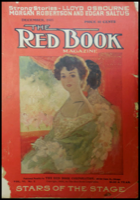




Over 50 years of research into the Stratton, Schneider, King, and allied families—from colonial Massachusetts to Indiana and beyond. Built by Bill & Karen Stratton.
If you are tracing a Stratton line, start here. Harriet Russell Stratton's two-volume Book of Strattons is the most comprehensive Stratton genealogy ever compiled—both volumes are free and fully searchable online.